


There’s a moment in the Fast Company piece I keep coming back to.
A mother uses AI to generate a bedtime story read aloud in her own voice, for her kid, while she’s away on a business trip.
The article frames it as a hack. A clever workaround. Evidence of senior-level women figuring it out.
I read it differently. I read it as a woman who has been asked to be in two places at once for so long that she’s now engineering a simulation of herself so nobody notices she’s gone.
That’s not resilience. That’s a system extracting everything it can from someone it was never designed to support, and calling her creative for surviving it.
Here’s what I’ve observed across fifteen years of watching leaders operate: most of the problems we call systemic are actually behavioral first.
Not policy failures, or pipeline failures. They are behavioral failures. Daily decisions made by leaders who say they value their people and then build cultures that make it impossible to actually be one.
Four behaviors show up most in that gap.
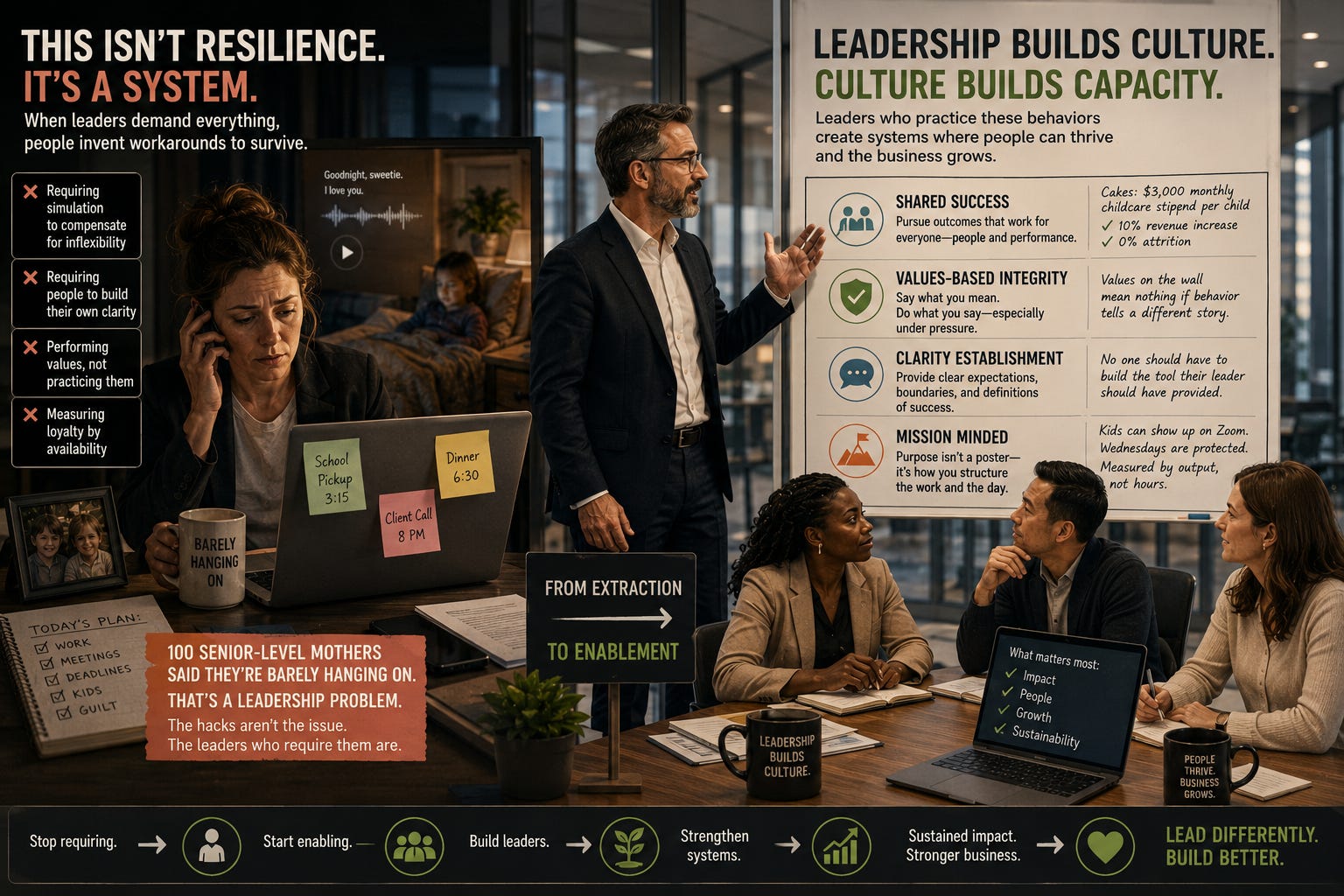
Shared Success.
This behavior is about pursuing outcomes that work for everyone, not just the business, not just the quarter, not just the person with the most leverage in the room. Leaders who practice Shared Success ask a different question than most. Not how do we get the most out of our people but how do we build something our people can actually sustain.
The Fast Company piece profiles a company called Cakes that offers a $3,000 monthly childcare stipend per child. Since implementing it they’ve seen a 10% revenue increase and zero attrition. That’s not a feel-good story. That’s Shared Success producing a measurable business outcome.
Most leaders look at that and say we can’t afford to do that. The data says they can’t afford not to.
Values-Based Integrity and Authenticity.
This one is about the gap between what leaders say and what they build.
A lot of organizations have values on the wall that include words like family, balance, people first. And then they schedule 8pm calls, penalize people for school pickup, and promote the person who never logs off.
That’s not a values problem. That’s an integrity problem. Values-Based Integrity means your behavior, especially under pressure, matches what you say you believe. When it doesn’t, the people around you notice. They just stop telling you.
The mothers in this article aren’t hiding their hacks because they’re ashamed. They’re hiding them because they’ve learned that visibility is a liability.
Clarity Establishment.
One of the mothers in the piece sends a Get To Know Me deck to everyone she works with. It includes her best meeting times, her kids’ school schedule, her deadline communication preferences. She built the tool her leader should have created.
Clarity Establishment is the leader’s job. Clear expectations, clear boundaries, and clear definitions of what success looks like so people aren’t left guessing (or building their own workarounds just to function).
When clarity is absent, the people with the least margin pay the highest price. And right now, that’s senior-level mothers.
Mission Minded.
This is the behavior that asks why does this work matter and then actually builds the answer into how the team operates.
The Cakes example again: their employee handbook states that kids can unexpectedly appear on Zoom. That Wednesdays are protected from meetings. That the culture is measured by output, not hours. That’s Mission Minded leadership operationalized. Purpose isn’t a poster. It shows up in how you structure the day.
When mission is real, people can bring their whole lives to work, not just the parts that are convenient for everyone else.
I want to be careful here about something.
This isn’t an article about what working mothers need to do differently. They’ve already written 48,000 words on that. They’re exhausted and still showing up.
This is an article about what leaders need to stop requiring.
Stop requiring people to simulate their presence to compensate for your inflexibility.
Stop requiring people to build their own clarity because you never provided it.
Stop performing values you don’t actually practice under pressure.
Stop measuring loyalty by availability and calling it culture.
The system isn’t broken for everyone. It’s working exactly as designed for some people…and costing everyone else everything they have just to stay in it.
That’s a leadership problem. And leadership problems have behavioral solutions.
The Fast Company article that sparked this piece is linked below. It’s worth reading in full, not just for the data, but for the 48,000 words worth of human cost behind it.
https://www.fastcompany.com/91541720/corporate-america-is-crushing-senior-level-mothers
🚦

Subscribe to The Ready Set
By Ryan Carnes | A data-backed development experience
Providing executive caliber leadership content and resources to everyone. Subscribe free and get new behavioral-based leader insights every week.
Plus two Ready Set resources to put to work immediately.