


Compliance looks good on paper. Tasks are completed. Deadlines are met. Rules are followed. Boxes are checked. Metrics are hit. From a distance, a compliant team can look like a high-performing team. Everything is getting done, people are showing up, and the work is moving forward.
But engagement? Engagement is what actually moves organizations forward.
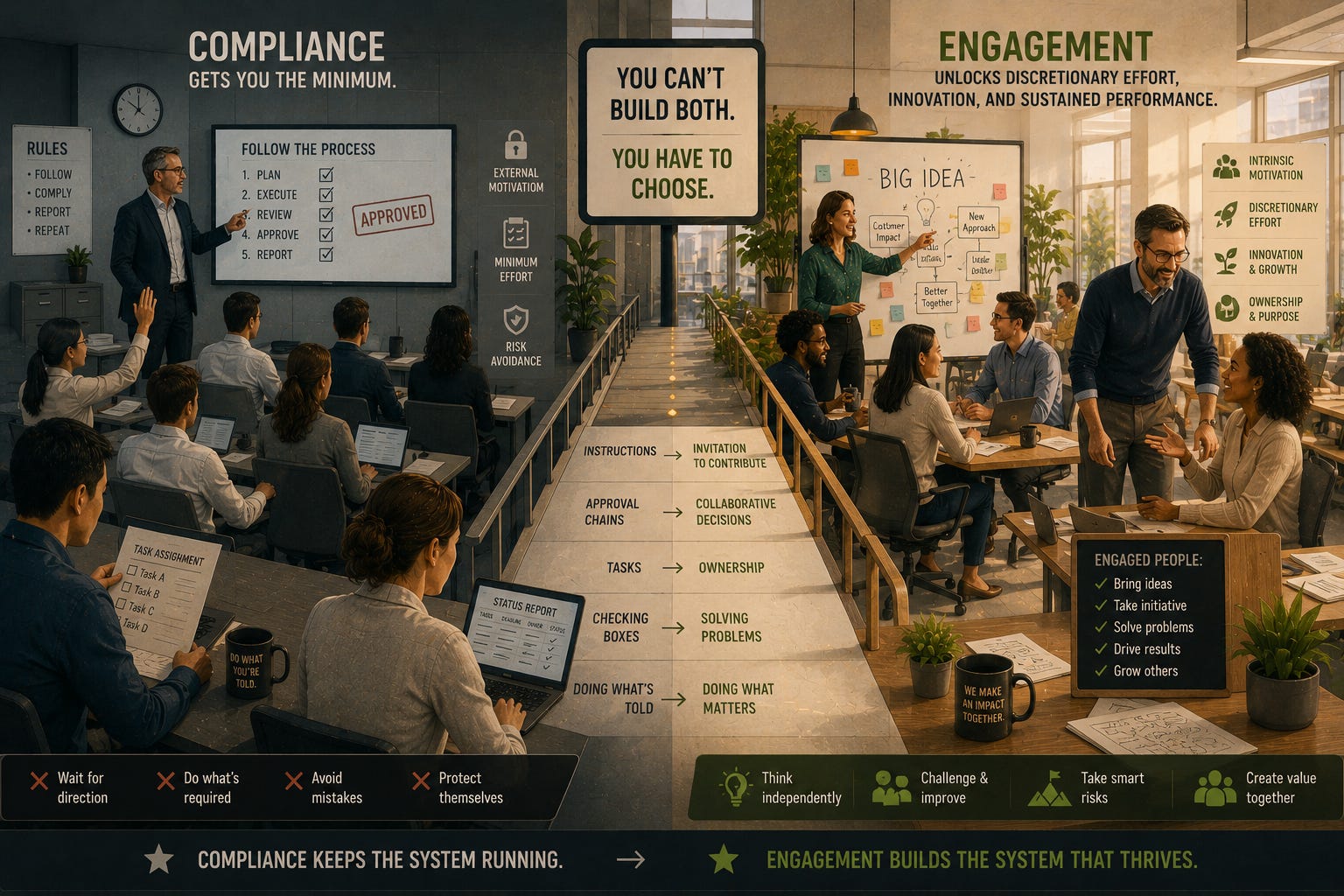
And here’s what most leaders miss: You can’t build both at the same time. The behaviors that create compliance actively undermine engagement. The leadership that generates engagement doesn’t rely on compliance. At some point, often without realizing it, every leader makes a choice between the two.
The question is: which are you choosing?
The Difference Most Leaders Miss
Compliance is external motivation, minimum effort, and risk avoidance. People do what they’re told because they’re supposed to. They follow the process because that’s the expectation. They hit the standard because that’s what keeps them out of trouble. It’s transactional. You tell me what to do, I do it, and we both move on.
Engagement is ownership, initiative, and commitment. People care about the outcome, not just the task. They look for ways to improve things, not just complete them. They bring discretionary effort, the energy and creativity they’re not required to give but choose to anyway because they’re invested in the work.
You can command compliance. You earn engagement.
That’s the fundamental difference. Compliance can be mandated. “Here’s the policy. Follow it.” Engagement can’t. You can’t force someone to care. You can’t require them to bring their best thinking. You can’t demand initiative. Those things only show up when people feel connected to the work, trusted by their leaders, and valued for more than just executing tasks.
Why Compliance Is a Leadership Ceiling
Compliant teams do what’s asked. They rarely challenge assumptions and they avoid risk. They follow the script, stick to the plan, and don’t color outside the lines.
And in stable, predictable environments where the script works and the plan is sound, that might be fine. But in fast-changing environments where assumptions break, where innovation matters, where adaptability is survival, compliance is dangerous.
Compliant teams don’t innovate, they don’t experiment, and they don’t stretch. They don’t flag problems early because raising concerns feels risky. They don’t offer ideas because offering ideas means sticking your neck out, and compliant cultures punish that.
I worked with a team at an oil and gas company where compliance was the unspoken standard. People showed up on time, completed their assignments, followed every process to the letter. Turnover was low and performance reviews were fine. On the surface, everything looked functional.
But when the market shifted and the company needed to move faster, to try new approaches, to adapt quickly, guess what happened? That’s right, the team froze. They waited for permission. They asked for detailed instructions. They wanted to know the exact process for the new situation before they’d act. They’d been trained so thoroughly to comply that they’d lost the ability to think independently.
And the leader, frustrated, kept asking, “Why won’t they take initiative?” But initiative had been conditioned out of them. Every time someone had tried something new and it didn’t work perfectly, they’d been corrected. Every time someone questioned a process, they’d been reminded to follow it. And every time someone took a risk, they’d been asked to justify it.
The team had learned: compliance is safe. Initiative is risky. So they chose compliance. And the organization paid the price in missed opportunities, slow adaptation, and declining competitiveness.
As author and business thinker Peter Drucker observed, “Management is doing things right; leadership is doing the right things.”
Compliance cultures optimize for doing things right according to the existing playbook. Engaged cultures empower people to figure out what the right things are, even when the playbook doesn’t have an answer yet.
How Leaders Accidentally Create Compliance Cultures
Most leaders don’t set out to build compliance cultures. It happens by accident, through small decisions that add up over time.
It happens through over-control. When leaders monitor everything, approve everything, and stay involved in every detail, people learn that their job is to execute, not to think. Initiative fades because it’s not needed, or rewarded.
It happens through punishing mistakes. When failure is treated as unacceptable rather than as part of learning, people stop taking risks. They play it safe. They do only what they’re certain will work. Innovation dies.
It happens through rewarding silence over candor. When leaders respond defensively to feedback, when dissenting voices are dismissed, when challenging ideas is seen as disloyalty, people learn to keep their mouths shut. The best ideas never surface because it’s not safe to offer them.
It happens through valuing obedience more than contribution. When promotions, recognition, and rewards go to people who follow instructions well rather than people who think critically and add value, the message is clear: compliance is what we actually want, even if we say we want innovation.
None of it is intentional. But all of it is common. And the cumulative effect is a culture where people show up, do what they’re told, and save their best thinking for somewhere else.
What Engaging Leaders Do Differently
Engaging leaders create conditions where people want to contribute, not just comply. They do this through specific, consistent behaviors:
They invite ideas early. Before decisions are finalized, before the plan is locked, they ask: “What are we missing?” “What concerns do you have?” “What would you do differently?” They make it clear that input matters and will actually shape the outcome.
They encourage ownership. They give people real authority over their work. Not just responsibility to execute someone else’s plan, but ownership to shape how the work gets done, to make calls, to improve processes. Ownership creates investment. Investment creates engagement.
They respond well to challenge. When someone pushes back on an idea, questions a decision, or surfaces a risk, engaging leaders don’t get defensive. They lean in. They ask clarifying questions. They explore the concern. They model that challenge makes thinking better, not that it’s a personal attack.
They connect work to purpose. They consistently help people see how their work connects to something meaningful, to customers, to the mission, to impact. Purpose fuels engagement. Tasks fuel compliance.
They don’t just set expectations. They create meaning. And meaning is what transforms compliance into commitment.
A Telling Leadership Moment
Here’s a scenario that reveals which culture you’re building:
A team member spots a risk in an upcoming project. It’s not a catastrophic risk, but it’s real. It could cause delays, or quality issues, or customer frustration if not addressed.
In a compliance culture, they stay quiet. Because raising the issue might make them look negative. It might slow things down. It might create friction. And in compliance cultures, friction is punished. So they keep their head down, do their part, and hope someone else notices.
In an engagement culture, they speak up. Because they know it’s safe to flag concerns. They know the leader will listen. They know raising the issue won’t be held against them, it will be valued as contribution. So they bring it up early, when it’s still manageable.
That difference, whether people feel safe to speak up or feel safer staying quiet, determines whether organizations learn from problems or repeat them. It determines whether you catch issues early or discover them late when they’ve become crises.
And it all comes down to how leaders respond to candor.
Why Engagement Drives Performance
Engaged people solve problems proactively. They don’t wait to be told something’s broken, they notice it and fix it. They see inefficiencies and improve them, and they anticipate customer needs and address them before they become complaints.
Engaged people care about outcomes, not just tasks. They’re not just checking boxes, they’re thinking about whether the work is actually achieving what it’s supposed to achieve. And when it’s not, they adjust.
Engaged people go beyond role boundaries. They help colleagues without being asked. They share knowledge freely. They step in where they see gaps because they’re invested in the team’s success, not just their own individual performance.
They don’t need to be pushed. They pull themselves forward. And that difference, between push and pull, is everything.
Research from Gallup’s State of the Global Workplace report shows that highly engaged teams are 23% more profitable, have 10% higher customer ratings, and experience 81% lower absenteeism than disengaged teams. But engagement isn’t created through perks or policies. It’s created through leadership behavior, day after day, interaction after interaction.
Engagement Is Built Through Behavior
Engagement grows when leaders listen deeply. Not listening to respond or to defend, but listening to understand. When people feel genuinely heard, they lean in.
Engagement grows when leaders respond thoughtfully. When someone brings an idea or concern, engaging leaders don’t dismiss it reflexively. They consider it. They ask questions. They take it seriously, even if they ultimately decide differently. That respect builds trust.
Engagement grows when leaders act consistently. When values aren’t just posters on the wall but actual guides for how decisions get made. When the leader does what they said they’d do. When there’s alignment between words and actions. Consistency builds credibility, and credibility builds engagement.
Engagement grows when leaders show trust. When they give people autonomy, when they let them make decisions, when they don’t micromanage every detail. Trust begets trust. When you trust people with real responsibility, they rise to it.
It’s not created through perks or slogans. You can’t engage people with ping-pong tables and free snacks. You engage them by making them feel that their thinking matters, their contribution counts, and their growth is supported.
The Leadership Choice That Matters Most
Every leader chooses, often unconsciously, between control or trust, safety or silence, compliance or commitment.
Control or trust. Do you maintain tight oversight because you’re afraid of what might happen if you don’t? Or do you trust people to use good judgment and step in only when needed?
Safety or silence. Do you create environments where people can speak honestly, even when it’s uncomfortable? Or do you inadvertently punish candor and reward people who tell you what you want to hear?
Compliance or commitment. Do you optimize for people following instructions? Or do you optimize for people caring about the outcome and bringing their full capability to achieving it?
Only one scales. Only one lasts. Only one unlocks the discretionary effort, the creative problem-solving, the adaptive thinking that organizations need to thrive in complexity.
You can build a compliant organization. People will show up, do what they’re told, and meet the minimum standard. But when the market shifts, when competitors innovate, when challenges arise that the playbook doesn’t cover, compliance won’t save you.
Engagement will. Because engaged people don’t just execute. They think. They adapt. They own. They care. And that’s what actually moves organizations forward.
Reflection Questions
To ground this in your own leadership:
Does your team comply, or commit? When you look at how people show up, are they doing what’s required, or are they bringing discretionary effort and genuine investment?
How safe is it to challenge ideas around you? When someone pushes back on a plan or questions a decision, how do you typically respond? Does that response encourage more candor or discourage it?
What behaviors do you reward most? When you recognize people, celebrate wins, or make promotion decisions, what actually gets rewarded? Execution? Initiative? Risk-taking? Candor? The answer reveals what you’re really optimizing for.
Where might control be limiting engagement? Are there places where your need to maintain oversight is preventing people from taking ownership and bringing their best thinking?
What would shift if trust became the default? If you started from a place of trusting people to make good calls instead of requiring them to prove themselves first, what would change about how you lead?
Compliance gets you the minimum. People will show up, follow the rules, and do what’s asked. That’s not nothing. But it’s not enough. Not in environments where adaptability, innovation, and sustained performance matter.
Engagement gets you people’s best. Their creativity, their initiative, their commitment, their resilience. The things that can’t be commanded or required. The things that only show up when people feel trusted, valued, and connected to something meaningful.
You can’t build both. The leadership that creates compliance undermines engagement. The leadership that builds engagement doesn’t rely on compliance.
So you have to choose. And the organizations that thrive in uncertainty, that innovate under pressure, that build cultures people want to be part of—they’re the ones whose leaders chose engagement.
What about you? Where do you see the difference between compliance and engagement playing out in your organization? What helps you build one versus the other? I’d love to hear your thoughts in the comments.
That completes the five-article series on the New Leadership Model! We’ve covered:
From Planning to Inspiring - Why vision beats control
From Directing to Enabling - Why letting go creates more control
From Controlling to Facilitating - How leaders unlock collective intelligence
From Managing to Developing - Why leaders must stop being the system
Engagement vs. Compliance - Why leaders must choose one
Development is hard.
Not because the concepts are complicated, but because most people don’t know where to actually focus. They read, they reflect, they nod at the right moments, and then they go back to leading the same way they always have. Not from laziness, but because without a clear picture of where they actually stand, effort tends to scatter rather than compound.
That’s the problem I’ve been working on. A data-backed, self-led, developmental experience.

Subscribe to The Ready Set
By Ryan Carnes | A data-backed development experience
Providing executive caliber leadership content and resources to everyone. Subscribe free and get new behavioral-based leader insights every week.
Plus two Ready Set resources to put to work immediately.