


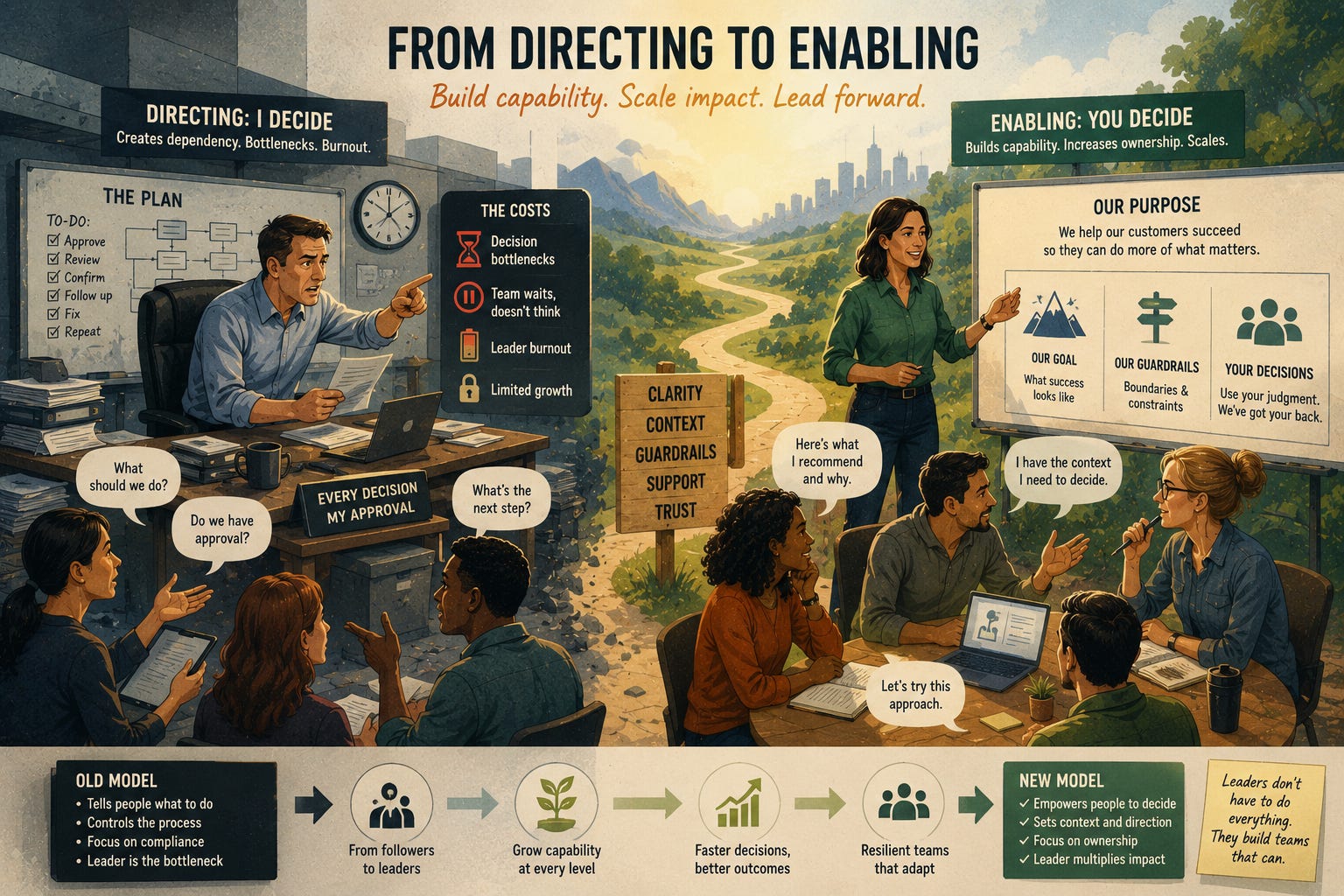
For a long time, leadership meant giving direction. Clear instructions, defined steps, and explicit expectations. Tell people what to do, monitor whether they do it, and course-correct when they don’t. The logic was simple: leaders have the experience, the knowledge, and the accountability, so they should be the ones deciding how work gets done.
And when work was predictable, that worked. When tasks were repeatable and conditions were stable, directing made sense. You could see the path clearly, you could map out the steps, and you could tell people exactly what to do to get from A to B.
But in today’s environment, direction alone creates dependency. And dependency is a slow-motion disaster that most leaders don’t see coming until they’re drowning in it.
Why Directing Breaks Down at Scale
Directing assumes the leader has the best answer, the situation won’t change midstream, and people just need clarity to execute. But modern work is dynamic, interdependent, and ambiguous. The leader doesn’t always have the best answer because they’re not closest to the work. The situation changes constantly because markets shift, priorities evolve, and new information surfaces daily. And on top of all that, people need more than clarity. They need context, autonomy, and the ability to think for themselves.
When leaders direct too much, decisions bottleneck at the top. We see it all the time! Every question comes to you. Every adjustment requires your approval. Every deviation from the plan needs your sign-off. Teams wait instead of think because they’ve learned that their job is to execute, not to decide.
And what happens is leaders burn out trying to stay ahead of everything. You become the system. You’re in every meeting, on every email thread, involved in every decision because nothing can move without you. You’re working 60-hour weeks just to keep the machine running, and the moment you step away, everything grinds to a halt.
Systems like that don’t scale. And they don’t survive. Because when the leader becomes the constraint, growth becomes impossible.
I watched this happen with a VP who led a finance team at a defense company. He was sharp, experienced, and deeply committed to doing things right. He’d built his career on being the person who could diagnose problems quickly, make the right call, and steer his team through complexity.
But as the company grew and the team expanded from 10 people to 40, his directing style stopped working. His calendar was wall-to-wall meetings. His inbox was flooded with questions and team members would stand outside his office waiting to ask him simple things because they’d learned not to decide without checking with him first.
He was exhausted. His team was frustrated. And despite everyone working hard, progress felt slow. The bottleneck wasn’t talent or effort, it was the VP himself. He’d become the system, and the system couldn’t keep up.
As writer William Gibson once said, “The future is already here, it’s just not evenly distributed.”
The same is true for leadership capacity. If all the decision-making capability is concentrated in one person, the rest of the team is underutilized, underdeveloped, and unable to respond when that person isn’t available.
What Enabling Leadership Actually Is
Enabling leadership shifts the role from “Here’s what to do” to “Here’s what matter, now decide.”
Enabling leaders provide context, not prescriptions. They explain the goal, the constraints, and the tradeoffs, then they trust their people to figure out the best path forward. They set guardrails instead of rules: boundaries that protect against catastrophic errors while leaving room for judgment, experimentation, and learning.
They don’t abdicate responsibility, they distribute it. There’s a huge difference. Abdication is throwing your hands up and saying “you figure it out” without giving people the tools or context to succeed. Enabling is saying “here’s what you need to know, here’s the authority you have, and here’s how I’ll support you, now make the call.”
Enabling leaders ask questions like:
“What options are you considering?”
“What tradeoffs do you see?”
“What would you recommend, and why?”
They coach decisions instead of making them and they build capacity instead of just delivering outcomes.
A Common Fear Leaders Have
Here’s the fear that stops most leaders from enabling: “If I stop directing, things will fall apart.”
That fear is understandable, but most certainly incomplete. What actually happens when enabling is done well isn’t chaos. It’s growth. Decision quality improves because the people closest to the work are making the calls. Ownership increases because people aren’t just executing someone else’s plan, they’re shaping the outcome. And leaders regain capacity because they’re not in the middle of every decision anymore.
But here’s the key: clarity before autonomy. You can’t just stop directing and hope people figure it out. You have to give them the context, the decision rights, and the support they need to succeed. Without that foundation, autonomy becomes abandonment.
Research from Gallup shows that employees who strongly agree they have the autonomy to do what they do best are 70% less likely to experience burnout and significantly more engaged in their work. But that autonomy has to be paired with clarity about what success looks like and what constraints exist. Otherwise, it’s just ambiguity disguised as empowerment.
A Real-World Example
Let’s go back to the VP I mentioned. After months of being the bottleneck, he finally realized something had to change. He couldn’t keep directing every decision, not because he didn’t want to, but because it was physically impossible.
So he tried something different. He started asking himself before every decision request: “What information would this person need to make this call without me?”
Then he started providing that information proactively. He clarified objectives, constraints, and decision rights. He said things like, “You own decisions about how we handle customer escalations as long as they don’t involve refunds over $500 or contract changes. For those, loop me in. Everything else is yours.”
At first, people still came to him. Old habits die hard, of course. But David would redirect: “You have the context. What do you think we should do?” And then he’d listen, ask a few coaching questions, and let them decide.
Within a few months, the bottleneck started to clear. Decisions happened faster, and more importantly, the team’s confidence grew. And the VP got his life back. Not because he stopped caring about the work, but because he enabled his team to carry more of it.
Why Enabling Builds Stronger Leaders Around You
Directing builds followers. Enabling builds leaders. Directing gets you compliance. Enabling increases capability and engagement.
People grow when they’re trusted, when they’re allowed to decide, and when they learn from outcomes, both the wins and the mistakes. If you’re always making the call for them, they never develop the muscle to make calls themselves. And when the complexity increases or you’re not available, they’re stuck.
But when you enable people, you’re not just getting work done. You’re building leadership capacity across your team. You’re creating a bench of people who can think strategically, make sound decisions, and lead others. That’s how organizations scale. That’s how you build something sustainable.
As leadership expert John Maxwell put it, “A leader is great, not because of his or her power, but because of his or her ability to empower others.”
Directing might get you compliance. Enabling gets you capability.
How Leaders Develop an Enabling Mindset
Enabling leadership grows through practice, and it requires letting go of some deeply ingrained habits.
Let others struggle productively. When someone comes to you with a problem, resist the urge to solve it for them. Instead, help them think it through. Ask questions. Offer perspective. But let them do the work of figuring it out. That productive struggle is where growth happens.
Resist the urge to rescue. When things aren’t going perfectly, the instinct is to jump in and fix it. Sometimes that’s necessary. But more often, it’s your discomfort with uncertainty, not an actual crisis. Let people work through the messiness. That’s how they learn.
Coach decisions instead of making them. When someone asks “What should I do?” turn it around: “What options are you considering? What’s the tradeoff between them? What would you recommend?” Help them develop their judgment instead of just giving them yours.
Ask better questions. The quality of your questions determines the quality of their thinking. “What tradeoffs do you see?” “What would success look like?” “What assumptions are you making?” These questions force deeper thinking and build decision-making muscles over time.
The shift from directing to enabling isn’t easy. It requires patience when you’d rather just give the answer. It requires trust when you’re not sure they’ll get it right. And it requires discipline to coach instead of control.
But the payoff is massive.
Why This Shift Matters Now
The future demands leaders who think independently, adapt quickly, and own outcomes. That can’t happen if leaders stay in directive mode. You can’t build that capability by telling people what to do. You have to let them practice deciding, adjusting, and owning the results.
Enabling isn’t losing control. It’s creating capability. And capability is the only thing that scales.
When you enable your team, you’re not just making them better at their jobs. You’re making them better leaders. You’re building the capacity that allows your organization to grow without breaking and you’re creating a system that doesn’t depend on you being in the middle of everything.
And honestly? You’re giving yourself the space to actually lead instead of just managing an endless stream of tactical decisions.
Reflection Questions
To ground this in your own leadership:
Where do decisions still depend too heavily on you? What calls are people making that they could make themselves if they had more clarity or authority?
What would break, and what would grow, if you enabled more? Be honest. Some things might stumble at first. But what capability would develop over time if you let people practice?
How clear are your guardrails? Do people know where they have authority to decide and where they need to escalate? Or is it ambiguous, so they default to asking you everything?
When was the last time you coached a decision instead of making it? Can you think of a recent moment where you could have asked questions instead of giving answers?
Who on your team is ready for more autonomy right now? And what would it look like to give them that autonomy with the right context and support?
Directing feels like leadership because it’s visible, active, and immediate. You make the call, people execute, and things get done. But enabling is what actually builds something that lasts. It’s what creates teams that don’t fall apart when you’re not there. It’s what allows organizations to scale without everything running through one person.
The best leaders aren’t the ones with all the answers. They’re the ones who build teams full of people who can find answers themselves. And that shift, from directing to enabling, is how you get there.
What about you? Where have you seen enabling leadership work well? Or where have you struggled to let go of directing? I’d love to hear your experience in the comments.
Development is hard.
Not because the concepts are complicated, but because most people don’t know where to actually focus. They read, they reflect, they nod at the right moments, and then they go back to leading the same way they always have. Not from laziness, but because without a clear picture of where they actually stand, effort tends to scatter rather than compound.
That’s the problem I’ve been working on. A data-backed, self-led, developmental experience.

Subscribe to The Ready Set
By Ryan Carnes | A data-backed development experience
Providing executive caliber leadership content and resources to everyone. Subscribe free and get new behavioral-based leader insights every week.
Plus two Ready Set resources to put to work immediately.