


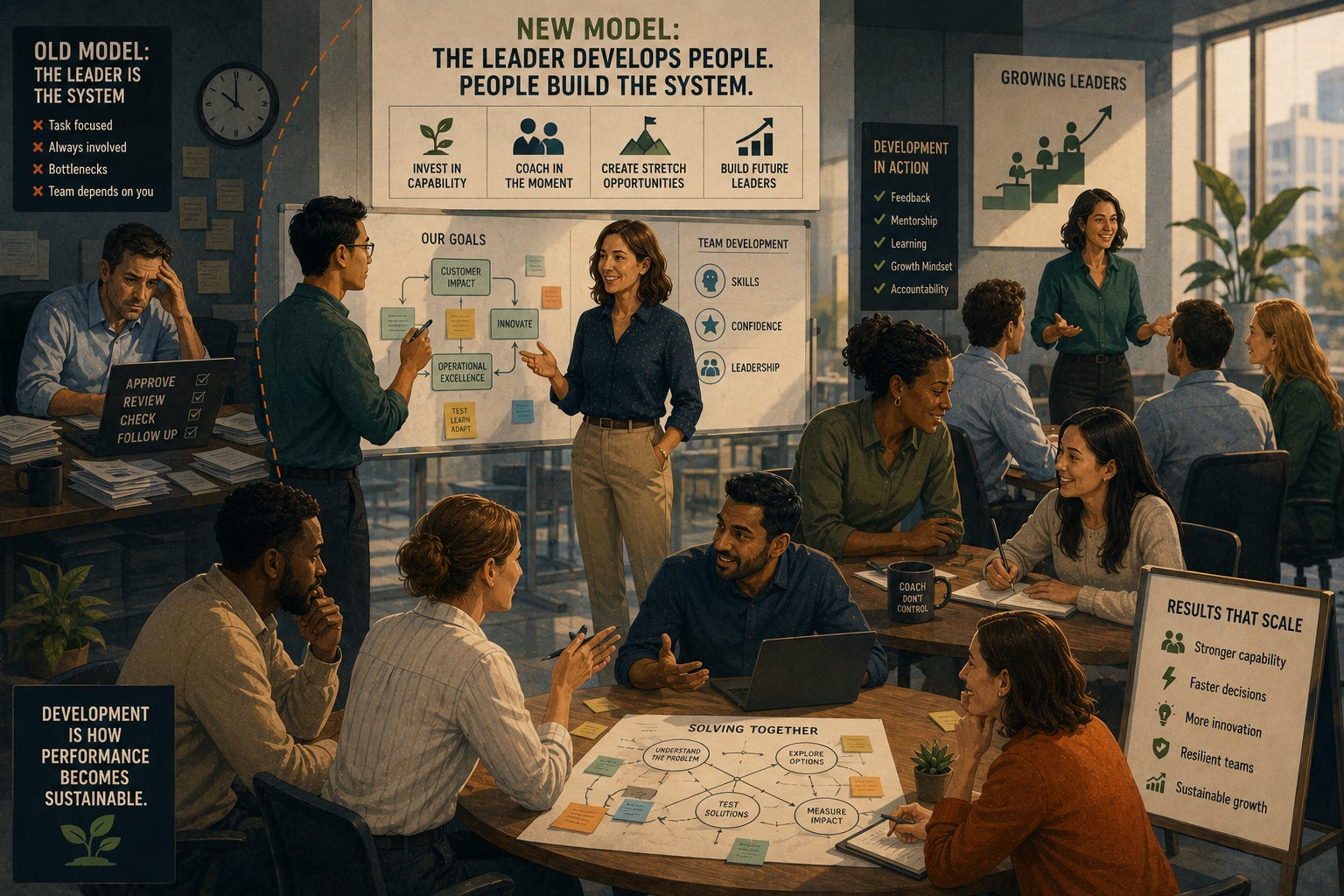
Most leaders were trained to manage. Manage tasks. Manage timelines. Manage performance. Manage problems. Get things done on time, on budget, and according to spec. Keep the machine running smoothly. Make sure nothing falls through the cracks.
And for a long time, that worked. When success was mostly about execution, managing made sense. You needed people who could organize work, track progress, hold others accountable, and keep things moving. Management was the job.
But here’s the hard truth of modern leadership: If you are the system, the system will always be limited by you.
Your capacity becomes the ceiling. Your availability becomes the constraint. Your knowledge becomes the boundary of what’s possible. And when the complexity increases or the pace accelerates or you’re not available, everything grinds to a halt because the team hasn’t learned to function without you.
Why Managing Is No Longer Enough
Managing focuses on tasks over people, efficiency over growth, and compliance over capability.
Managers ask:
“Is this done?”
“Did you follow the process?”
“Are you meeting expectations?”
Those aren’t bad questions. They matter, but they’re insufficient. Because they focus entirely on output and ignore the capacity being built, or not built, along the way.
Developing leaders ask different questions:
“What are you learning?”
“Where are you growing?”
“What capability are we building next?”
The difference is subtle but profound. Managing keeps the system running today. Developing builds the system that can run tomorrow without you.
When I work with leaders who are stuck in management mode, they usually have a few things in common: they’re working long hours, they’re involved in everything, and they’re frustrated that their team doesn’t take more initiative. And when we dig into it, the pattern is always the same: the team has learned that their job is to execute, not to think, because the leader manages everything instead of developing anyone.
The Hidden Cost of Over-Managing
When leaders stay in management mode, teams wait for direction. They don’t step up with ideas because they’ve learned the leader already has the answer. They don’t make decisions because they know the leader will just override them anyway. They execute tasks efficiently but don’t evolve as professionals.
Growth stalls. And not just individual growth, but organizational growth as well because when everyone is focused on getting today’s tasks done, no one is building the capability needed for tomorrow’s challenges.
And leaders become overloaded. They’re the ones triaging every issue, making every call, and answering every question. They become the bottleneck not because they’re incompetent, but because they’ve built a system where everything depends on them.
I saw this with a leader named “Marcus” who ran a finance/risk team at a port company. Marcus was exceptional at execution. He could manage a projects from inception to completion flawlessly. He knew every detail, tracked every metric, and caught every mistake before it became a problem.
But as the company scaled and the team grew, Marcus couldn’t keep up. He was working 70-hour weeks, reviewing every piece of information, attending every client meeting, approving every asset. His team was capable, but they’d learned to wait for Marcus. They’d bring him problems instead of solutions. They’d ask permission instead of making calls. and ultimately they’d execute his vision instead of developing their own.
And when Marcus took a vacation, things fell apart. Not because the team was incompetent, but because they’d never been developed to lead without him. They could manage tasks when given direction, but they couldn’t think strategically, make tough calls, or navigate ambiguity on their own.
Marcus had managed them well. But he hadn’t developed them at all. And the cost of that showed up the moment he stepped away.
As leadership author Simon Sinek has noted, “Leadership is not about being in charge. It’s about taking care of those in your charge.”
Managing takes care of the work. Developing takes care of the people. And only one of those creates sustainable performance.
What Developing Leadership Actually Means
Developing leadership doesn’t mean lowering standards, slowing execution, or avoiding accountability. It’s not about being soft or letting people off the hook.
It means investing in people while delivering results. It means coaching in the flow of work instead of treating development as something that happens in a training room once a year. It means helping others think, not just do.
Development isn’t separate from performance. It’s how performance becomes sustainable.
Developing leaders do a few things differently:
They invest time in capability, not just capacity. Capacity is about getting more work done. Capability is about expanding what people can do. When you develop someone’s capability, their capacity grows naturally. But when you just push for more capacity without building capability, people burn out doing the same level of work faster.
They coach after action, not just during crisis. After a project wraps, after a meeting ends, after a decision gets made, developing leaders ask: “What did you learn from that?” “What would you do differently next time?” “What surprised you?” Those reflective questions turn experience into expertise.
They give feedback early and often. Not just during annual reviews or when something goes wrong, but continuously. Real-time feedback that helps people adjust while the work is still happening. “Here’s what I noticed. Here’s what worked. Here’s what to try differently.”
They create stretch opportunities. They give people assignments slightly beyond their current capability because that’s where growth happens. Not so far beyond that they’re set up to fail, but far enough that they have to stretch, learn, and develop new muscles.
They normalize learning, not perfection. Developing leaders make it safe to make mistakes, ask questions, and admit when you don’t know something. They model that behavior themselves. They don’t punish people for learning curves, they expect them.
A Familiar Leadership Trap
Here’s the trap most leaders fall into: A team member makes a mistake or struggles with something, and the leader thinks, “It’s faster if I just fix it.”
Short-term? That’s true. You probably can do it faster. You’ve done it before. You know the shortcuts. You can knock it out in 20 minutes while it might take them an hour.
Long-term? That decision is costly. Because every time you fix instead of coach, you solve today’s problem but create tomorrow’s dependency. You reinforce that when things get hard, they should come to you. You rob them of the chance to develop the capability to solve it themselves next time.
Development requires patience. But it pays compound interest. The 20 minutes you invest in coaching someone through a problem today saves you hours down the road when they can solve it, and problems like it, without you.
Research from Gallup shows that employees who strongly agree their manager helps them develop their strengths are 30% more engaged and teams with managers who focus on strengths have 12.5% higher productivity on average. But that doesn’t happen by accident. It happens when leaders prioritize development over just getting the task done.
Why This Shift Changes Everything
When leaders develop instead of manage, teams become more resilient. They don’t fall apart when conditions change or when the leader isn’t available. They’ve learned to adapt, to think, to lead from wherever they sit.
Leaders regain time and energy. They’re not in the middle of everything anymore because their team can handle more independently which means they can focus on the strategic work that actually requires their level of experience instead of being stuck in tactical firefighting.
Organizations build bench strength. You have a pipeline of people ready to step into bigger roles because they’ve been developed along the way. Succession becomes safer. Promotions become easier. Growth becomes possible.
Succession planning is no longer a spreadsheet exercise of hoping the right names are in the right boxes. It’s a lived practice of developing people continuously so when opportunities open up, you have capable leaders ready to step in.
And performance becomes scalable. You’re not limited by your own capacity anymore because you’ve built capacity across the team. That’s how organizations grow without breaking.
Developing Leadership as a Daily Practice
This shift happens when leaders treat every interaction as a development moment. Not in a heavy-handed way, but in a mindset that asks: “Is this just about getting the task done, or is this also a chance to help someone grow?”
Coach before correcting. When someone brings you a problem, resist the urge to solve it immediately. Ask: “What options have you considered?” “What do you think we should do?” Help them think it through before you offer your answer.
Let others struggle productively. Watching someone work through a difficult problem can be uncomfortable. You want to jump in and make it easier. But that struggle is where capability develops. As long as they’re not heading toward catastrophe, let them work through it. Be available to support, but don’t rescue prematurely.
Celebrate growth, not just results. When someone handles a situation better than they did last time, name it. “I noticed you stayed calm in that meeting when things got tense. That’s real growth.” Recognition of development reinforces that growth matters, not just outcomes.
Model continuous learning yourself. Talk about what you’re learning. Share when you made a mistake and what you took from it. Ask for feedback from your team. When leaders model being learners, it creates permission for everyone else to learn too.
Development isn’t a program you run once a year. It’s a posture you take every day.
Why This Matters for the Future
The future of work demands people who can think independently, navigate ambiguity, make sound decisions, and lead without a title. You can’t build those capabilities by managing tasks. You have to develop people.
And if you want to lead at scale, if you want to build something that grows beyond your own capacity, you have to stop being the system. You have to build systems made of capable people who can think, decide, and lead themselves.
As author and educator Stephen Covey once said, “Always treat your employees exactly as you want them to treat your best customers.”
If you want your team to develop others, coach others, and invest in others, you have to model that with them first.
Reflection Questions
To ground this in your own leadership:
Where might you be managing instead of developing? Are there places where you’re focused entirely on task completion and ignoring the capability being built (or not built)?
Who depends on you more than they should? Which team members still come to you for decisions they could make themselves if they had more development and context?
What capability does your team need next, not just output? If you look six months ahead, what skills, mindsets, or behaviors does your team need to develop to be ready for what’s coming?
How often do you coach in real time? Are you giving feedback and asking reflective questions in the flow of work, or only during formal reviews?
What would change if development became part of daily work? Not a separate program, but woven into how you show up in meetings, conversations, and decisions every day.
Managing keeps things running. Developing builds the people who can run things without you. Both matter, but only one creates sustainable performance.
The shift from managing to developing isn’t about doing less. It’s about investing differently. It’s about recognizing that your job isn’t just to deliver results today—it’s to build the people who can deliver results tomorrow, next quarter, and long after you’ve moved on to something else.
When you develop your team, you’re not just making them better at their jobs. You’re building future leaders. You’re creating organizational resilience. You’re making it possible to scale without breaking. And you’re giving yourself the capacity to actually lead instead of just managing an endless stream of tasks.
What about you? Where have you seen the difference between managing and developing play out? What helps you shift from one to the other? I’d love to hear your experience in the comments.
Development is hard.
Not because the concepts are complicated, but because most people don’t know where to actually focus. They read, they reflect, they nod at the right moments, and then they go back to leading the same way they always have. Not from laziness, but because without a clear picture of where they actually stand, effort tends to scatter rather than compound.
That’s the problem I’ve been working on. A data-backed, self-led, developmental experience.
Subscribe to The Ready Set
By Ryan Carnes | A data-backed development experience
Providing executive caliber leadership content and resources to everyone. Subscribe free and get new behavioral-based leader insights every week.
Plus two Ready Set resources to put to work immediately.