


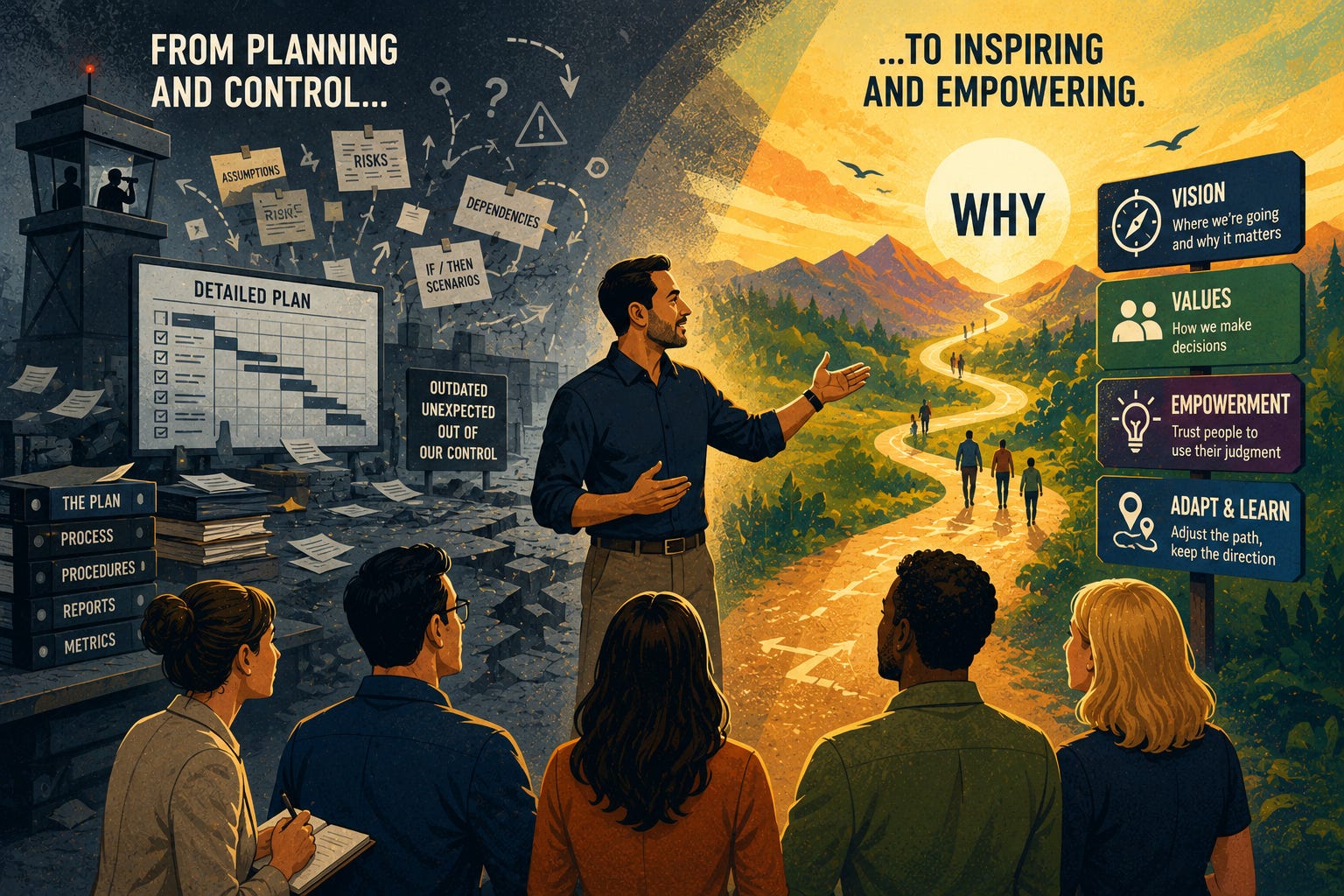
Traditional leadership puts planning at the center. Define the path. Reduce surprises. Stick to the roadmap. The logic is simple: if you can predict what’s coming and map out every step, you can control the outcome. And for a long time, that worked.
But in today’s world, detailed plans age quickly. Markets shift overnight and technology rewrites assumptions before the ink dries on your strategy deck. Teams are distributed across time zones, navigating complexity that no single leader can fully see or anticipate. By the time you’ve finished your 47-slide quarterly plan, half the assumptions you built it on are already outdated.
What lasts longer than a plan is inspiration. Vision doesn’t expire when conditions change. Purpose doesn’t become irrelevant when the path shifts. And when leaders anchor their teams in why we’re doing this instead of just how we’re doing it, people can adapt without losing direction.
This isn’t about abandoning planning. It’s about repositioning it. Plans are useful, but they’re tools, not anchors. Vision is (or should be) the anchor. And leaders who confuse the two end up with teams that follow instructions beautifully but can’t think for themselves when the instructions stop working.
Why Planning Alone Isn’t Enough Anymore
Plans assume stable conditions, known variables, and predictable timelines. Modern work assumes none of that. The pace is too fast. The variables are too dynamic. The unknowns are too numerous.
When leaders over-index on planning, teams wait for direction. Adaptation slows because people are looking for the next instruction instead of thinking independently. Creativity narrows because the plan becomes the constraint, not the starting point. And people follow the plan even when it no longer fits reality, because that’s what they were told to do.
I saw this with a leader named Karen who ran HR for a mid-sized LNG company. Karen was exceptional at planning. She could map out a quarter in granular detail, anticipate bottlenecks before they happened, and communicate timelines with precision. Her team executed flawlessly, as long as conditions stayed stable.
But when the market shifted and employee experience patterns changed seemingly overnight, Karen’s carefully constructed plans fell apart. Instead of adapting, her team froze. They kept asking, “What’s the new plan?” and “Should we still follow the old roadmap?” They’d been trained to execute plans, not to think beyond them. And because Karen had always been the one with the plan, they didn’t know how to move forward without one.
The problem wasn’t that Karen’s team lacked capability. It was that they’d been led with plans for so long, they’d never developed the muscle to navigate uncertainty with vision and judgment instead.
As author Antoine de Saint-Exupéry once wrote, “A goal without a plan is just a wish.”
That’s true. But a plan without vision is just instructions. And instructions don’t inspire people to think, adapt, or care when the path gets hard.
What Inspiring Leadership Actually Looks Like
Inspiring leaders don’t abandon planning. They reposition it. Instead of leading with “Here’s the exact path,” they lead with “Here’s where we’re going and why it matters.”
They start with purpose. They connect the work to impact. They help people see how what they’re doing today contributes to something bigger tomorrow. And then they give people enough context and clarity to make good decisions independently when the plan inevitably changes.
Vision creates alignment when the path changes. Plans create alignment when the path stays the same. Guess which one is more useful right now.
Inspiring leaders say things like, “We’re solving this problem because it matters to our customers in ways that competitors aren’t addressing. Here’s what success looks like. Here are the constraints we’re working within. Now use your judgment.” They set direction without prescribing every step. They trust their people to figure out the how as long as the why is clear.
And here’s what’s powerful about that approach: when conditions shift and the original plan no longer makes sense, teams don’t freeze. They adjust. Because they understand the destination, they can reroute themselves without waiting for new instructions.
Why Inspiration Drives Better Decisions
When people understand the purpose, the desired outcome, and the values guiding choices, they don’t need constant direction. They can make better decisions independently, adjust intelligently when conditions change, and stay aligned even without oversight.
Inspiration scales. Control doesn’t.
Think about it: if you’re the only person who can make decisions because you’re the only person who understands the plan, you’ve created a bottleneck. Every question comes to you. Every adjustment requires your approval. You become the constraint on your own team’s progress.
But when people are inspired by a clear vision, they can make calls in real time. They can say, “Here’s what the situation requires, here’s how it aligns with where we’re headed, and here’s what I’m doing about it.” They don’t need you in the middle of every decision because they have the context to decide well on their own.
Research backs this up. Gallup’s data shows that employees who find their work meaningful are three times more likely to stay with their organization and report significantly higher levels of engagement and productivity. But here’s the key: meaning doesn’t come from detailed task lists. It comes from understanding how the work connects to something that matters.
A Real-World Contrast
Here’s how this shows up in practice:
A planning-driven leader says: “Follow the steps. Here’s the process. Execute it exactly as I’ve outlined.”
An inspiring leader says: “Here’s the problem we’re solving and why it matters. Here’s what success looks like. Use your judgment to figure out the best path forward.”
One creates compliance. The other creates ownership. One builds followers. The other builds leaders.
The planning-driven approach works when you have total visibility and control. But how often do you actually have that? In complex environments with distributed teams and fast-changing conditions, the inspiring approach wins because it empowers people to think, not just execute.
As Maya Angelou said, “People will forget what you said, people will forget what you did, but people will never forget how you made them feel.”
Inspiring leaders make people feel like their work matters, like they’re part of something bigger, like they have agency in shaping the outcome. That feeling sustains people through difficulty in ways that detailed plans never can.
Why Inspiration Is a Leadership Multiplier
Inspiration activates intrinsic motivation. People don’t just work because they’re supposed to, they work because they care. It builds resilience during uncertainty because when the path gets murky, people hold onto the purpose that got them started. And it keeps people engaged when plans shift, because the vision hasn’t changed even if the tactics have.
People don’t need certainty. They need meaning and direction. Give them that, and they’ll navigate the uncertainty themselves. Take it away, and no amount of detailed planning will make them care.
How Leaders Learn to Inspire (Without Becoming Performative)
Here’s the fear a lot of leaders have about inspiration: “I’m not a charismatic speaker. I’m not good at rallying the troops. I can’t inspire people.”
But inspiration isn’t about charisma. It’s about clarity. You don’t need to deliver TED Talks to inspire your team. You just need to help them see why the work matters and where it’s headed.
Leaders inspire by:
Articulating purpose simply. Not in corporate jargon or vague platitudes, but in plain language that connects the work to real impact. “We’re building this so customers can spend less time on admin and more time on the work they actually care about.”
Connecting work to impact. Show people the downstream effect of what they’re doing. Who benefits? What changes because of this? How does it move the organization forward?
Sharing conviction without exaggeration. You don’t have to oversell it. Just be genuine about why you believe this matters and why you’re committed to it.
Living the values they talk about. Inspiration dies the moment people see a gap between what you say and what you do. Consistency inspires more than speeches ever will.
You don’t need to be the loudest voice in the room. You just need to be the clearest and the most consistent.
Why This Shift Matters Right Now
As change accelerates, plans will break. Assumptions will fail. Certainty will be rare. That’s not pessimism, it’s just reality. And in that reality, leaders who inspire create teams that adapt without waiting to be told how.
A team anchored in vision doesn’t fall apart when the plan changes. They recalibrate and they adjust. They keep moving because they know where they’re going, even if the route is different than expected.
That’s the future of leadership. Not perfect plans. Not total control. Just clear vision, strong purpose, and trust that your people can figure out the path if you give them the direction.
Reflection Questions
To ground this in your own leadership:
Do you lead more with plans, or with purpose? When you communicate with your team, are you walking them through the steps or helping them see the destination?
How well does your team understand why their work matters? Can they articulate the impact of what they’re doing beyond just completing tasks?
What decisions could your team make without you, if vision were clearer? Where are you the bottleneck simply because people don’t have enough context to decide on their own?
Where might over-planning be limiting adaptability? Are there places where your attachment to the plan is preventing your team from responding to what’s actually happening?
What would it look like to inspire direction instead of prescribing steps? How would your communication change if you focused on the why and let people figure out the how?
Planning has its place. But in a world that won’t stop changing, vision matters more. Leaders who inspire don’t have to control every move because their teams are aligned on something deeper than a roadmap. They’re aligned on purpose. And that’s the kind of alignment that lasts.
What about you? How do you balance planning with inspiration in your own leadership? I’d love to hear your experience in the comments.
Before you go, something worth saying:
Development is hard. Not because the concepts are complicated, but because most people don’t know where to actually focus. They read, they reflect, they nod at the right moments, and then they go back to leading the same way they always have. Not from laziness, but because without a clear picture of where they actually stand, effort tends to scatter rather than compound. That’s the problem I’ve been working on. A full developmental experience. Learn more. Click the button below.
Great piece. This distinction between planning and vision is one that deserves more attention than it usually gets.
I have found that leaders don't stay stuck in planning-as-control because they don't understand vision. They stay there because uncertainty activates a nervous system trained to resolve discomfort fast.
The plan isn't just a tool. It's a regulation strategy. When it breaks, leaders who haven't built the capacity to stay with not-knowing will freeze, over-function, or reach for a new plan before the signal from the old one finishes. And you can't think your way out of that. It's not a knowledge problem — it's a conditions problem.
The question I'd add to your reflection list: When the plan breaks, what happens inside you before you respond? That gap — between stimulus and action — is where leadership actually lives.
Vision outlasts plans because it guides judgment when conditions change, empowering teams to adapt without waiting for constant instructions.