


Signal Forward is a series inside The Ready Set. The same publication, different altitude. The Ready Set is for leaders. Signal Forward is for everyone else: the individual contributors, specialists, and practitioners whose behavioral patterns determine whether their contribution gets seen, valued, and rewarded, regardless of title or tenure.
New here? Start with the first article. In People or HR? Pass this along to your team.
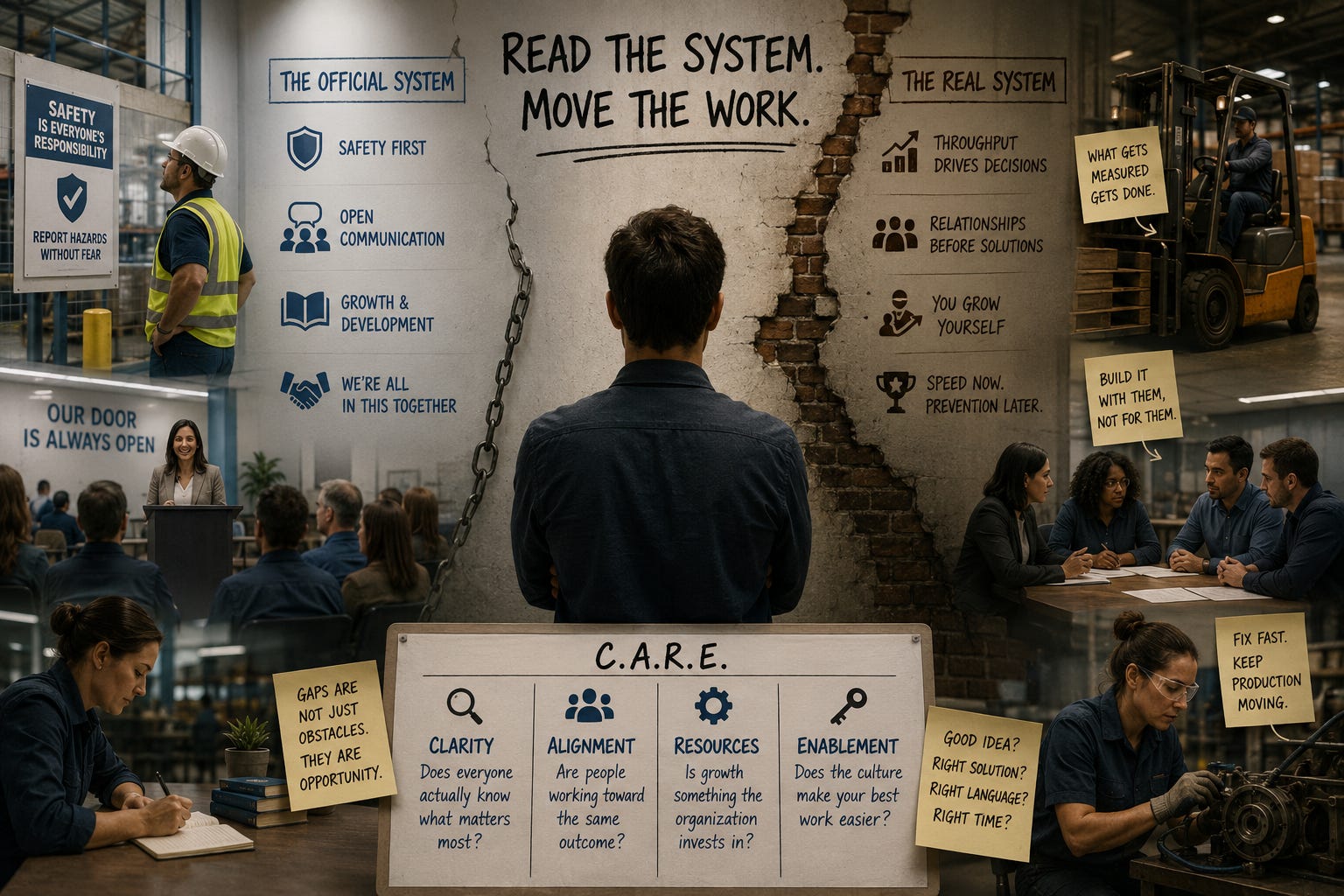
Tomás and Elena started their new jobs the same week. Different industries, different cities, different job descriptions. But somewhere around week three, they both walked into the same invisible wall.
The place they worked was not the place they’d been told about.
The Wall
Tomás was a new warehouse team lead at a distribution center. Safety posters on every surface. A handbook with a full section on reporting hazards without fear of retaliation. A safety briefing at the top of every shift. The message was consistent and loud: this organization takes safety seriously.
So when Tomás noticed the loading dock team stacking pallets in a way that would eventually put a forklift operator in a bad situation, he did what any reasonable person would do. He raised it at the shift meeting.
His supervisor nodded. Good catch, we’ll look at it.
Nothing happened.
He raised it again the following week. Same nod. Same nothing.
Third week, a senior team member pulled him aside after the meeting. Quietly. The way people do when they’re about to say something the room won’t say out loud. Look, they do care about safety. But that dock layout was set up by the ops director. It’s not moving based on a new lead’s suggestion. You want to fix it? Put numbers to it. Show them what it costs in throughput. That’s the language that actually moves things here.
Tomás had been operating in the official system, the one on the posters. The real system ran on a completely different currency.
Elena’s wall looked different but was made of the same material.
She was a project coordinator at a healthcare company with a stated culture of open communication. Town halls, accessible leaders, feedback actively encouraged. Our door is always open. In her second month, she spotted something genuinely worth fixing: patient intake data being entered inconsistently across three clinics, creating downstream chaos for the billing team. She had the data. She had the solution. She brought it to her manager.
Her manager loved it. Told her to take it to the cross-clinic meeting.
She did. The coordinators from the other clinics listened politely, then explained, each in turn, why the solution wouldn’t quite work for their site. Different workflow here. Different constraint there. The meeting ended with a collective nod toward “continuing the conversation”, which is organizational language for this is going nowhere.
Elena was baffled. The problem was obvious. The fix was straightforward. What was happening?
A colleague who’d been there five years gave her the translation: The open door is real. People do listen. But this organization decides by consensus, not directive. You walked in with your solution. What they needed was to feel like they helped build it. Go to each of them individually first. Learn their workflow. Come back with something that has their fingerprints on it. The meeting would have gone completely differently.
Elena’s idea wasn’t wrong. Her read of the environment was.
The Invisible Operating System
Every organization has one. Not a secret one, nobody designed it deliberately and locked it in a drawer somewhere. It’s emergent. It grows over time from accumulated decisions, unwritten norms, and behavioral patterns until it becomes the actual logic the place runs on. The official version lives in the handbook. The real version lives in how things actually get done.
Most individual contributors never clearly see it. They operate in it, get frustrated by it, occasionally get flattened by it, but rarely stop to study it the way you’d study anything else you needed to navigate well.
And that’s expensive. Not in any dramatic way, your career doesn’t crater overnight because you misread the system. It just quietly limits you. Good ideas go nowhere. Concerns get acknowledged and ignored. You start to wonder if the organization is broken, or leadership is checked out, or your work simply isn’t valued.
Sometimes that’s accurate. But more often, the idea was fine and the delivery was wrong for the environment. Those are completely different problems with completely different solutions.
Four Questions That Change How You See the Place You Work
There’s a simple framework for reading any organizational system, regardless of what industry you’re in or what kind of work you do. Four questions. We call it C.A.R.E.: Clarity, Alignment, Resources, Enablement.
The name matters. The professionals who ask these questions consistently are the ones who signal they care about more than their own corner of the work. That’s not a small thing. It’s visible. And visible caring, demonstrated through behavior rather than announced, is a signal all by itself.
Clarity: Does everyone actually know what matters most?
Not what the stated values say. Not what leadership emphasized in the last all-hands. What actually wins when priorities compete for the same resources, the same attention, the same decision.
Tomás ran a quick test early on. He asked three people on his team what the facility’s top priority was. Safety. Throughput. Customer satisfaction. All three answers were correct. None of them told him which one would win in a fight. That gap, between stated priorities and operational ones, is where confusion lives and where effort gets wasted.
It’s also where the individual contributor who can read it becomes genuinely valuable. Not by exposing the gap, but by navigating it intelligently. By knowing which language moves things.
Alignment: Are people actually working toward the same outcome?
Elena’s three clinics operated under the same organizational umbrella with different workflows, different norms, and different working definitions of what good looked like. Nobody had declared a misalignment. It had simply grown, quietly, over time. Alignment was assumed because it was never tested.
Understanding that gap told Elena something specific: she needed to build cross-clinic relationships before proposing cross-clinic solutions. Go in with a solution first, and you’re asking people to accept someone else’s answer to a problem they haven’t finished defining. Go in with curiosity first, learn their world, earn their trust, incorporate their input, and the solution that comes out the other side doesn’t feel like yours anymore. It feels like everyone’s. That’s not manipulation. That’s how adoption actually works.
Resources: Is growth something the organization invests in, or something you’re expected to pursue yourself?
The honest answer in most environments is somewhere in the middle, and leaning toward the latter. Training exists for compliance and certification. Development for career growth is mostly self-directed, whether the organization will admit that or not.
Tomás learned this by watching the people who had advanced. Without exception, they were the ones who hadn’t waited for a program to develop them. They’d sought out skills, taken on experiences, and built capability on their own initiative. The organization rewarded that. It just didn’t create the conditions for it.
Knowing this changes your posture. If you’re waiting for the system to grow you, you’ll wait longer than you should. The individual contributor who owns their own development, who doesn’t sit around hoping someone will notice what they need, is sending a fundamentally different signal than the one who waits.
Enablement: Does the culture make your best work easier, or does it quietly work against it?
Carmen’s manufacturing plant valued speed of repair above everything else. That cultural priority was so deeply embedded it actually discouraged the preventive maintenance conversations that would have reduced breakdowns in the first place. The culture enabled fast reaction. It quietly penalized proactive prevention, not through policy, but through what got celebrated and what got ignored.
Once Carmen understood that, she stopped framing her recommendations around prevention. She started framing them around speed. If we replace this bearing during Saturday’s scheduled downtime, we avoid four hours of unplanned downtime next week. Same recommendation. Different framing. The culture could receive it.
The idea didn’t change. The delivery did.
The Gap Is the Canvas
Here’s the reframe that changes everything.
Most people experience organizational dysfunction as a ceiling, evidence that the place doesn’t value good ideas, that leadership is too rigid, that contribution doesn’t matter unless you have a title. And sometimes that’s true. Genuinely broken organizations exist and no amount of reading saves you from one.
But in most cases, the ceiling isn’t the organization. It’s the distance between how you’re delivering your contribution and what the system is actually built to receive.
The gaps, the confusions, the misalignments, they’re not just obstacles. They’re opportunity. Every gap in the system is a space where the person who reads it accurately can contribute in ways others can’t. Because most people are too frustrated by the gap to study it.
Tomás reframed his safety concern as a throughput issue. The dock layout changed within two weeks. More importantly, he earned a reputation as someone who understood how the facility actually worked, not just how the handbook said it did. That reputation traveled further than the fix.
Elena went back to each clinic coordinator individually. She learned their workflows, incorporated their input, and brought a revised proposal to the next cross-clinic meeting, not as her solution, but as a shared one. It passed unanimously. She became known as someone who could move things across organizational lines. That’s exactly the signal that opens larger doors.
Carmen started translating every maintenance recommendation into production time saved. Six months later, the production manager started including her in planning meetings. A technician. In planning meetings. Because she’d stopped speaking technician and started speaking the language the room understood.
None of them changed what they were trying to contribute. They changed how they delivered it into the environment that had to receive it.
That’s not compromise. That’s sophistication. And it’s a signal almost nothing else replicates.
Think about the last good idea you had that went nowhere. Was it a bad idea, or was it a good idea that arrived in a language the system wasn’t built to hear?
That’s usually the more interesting question. I’d love to hear what you think in the comments.

Subscribe to The Ready Set
By Ryan Carnes | A data-backed development experience
Providing executive caliber leadership and talent content and resources to everyone. Subscribe free and get new behavioral-based leader and talent insights every week.
Plus two Ready Set resources to put to work immediately.