


Signal Forward is a series inside The Ready Set. The same publication, different altitude. The Ready Set is for leaders. Signal Forward is for everyone else: the individual contributors, specialists, and practitioners whose behavioral patterns determine whether their contribution gets seen, valued, and rewarded, regardless of title or tenure.
New here? Start with the first article. In People or HR? Pass this along to your team.
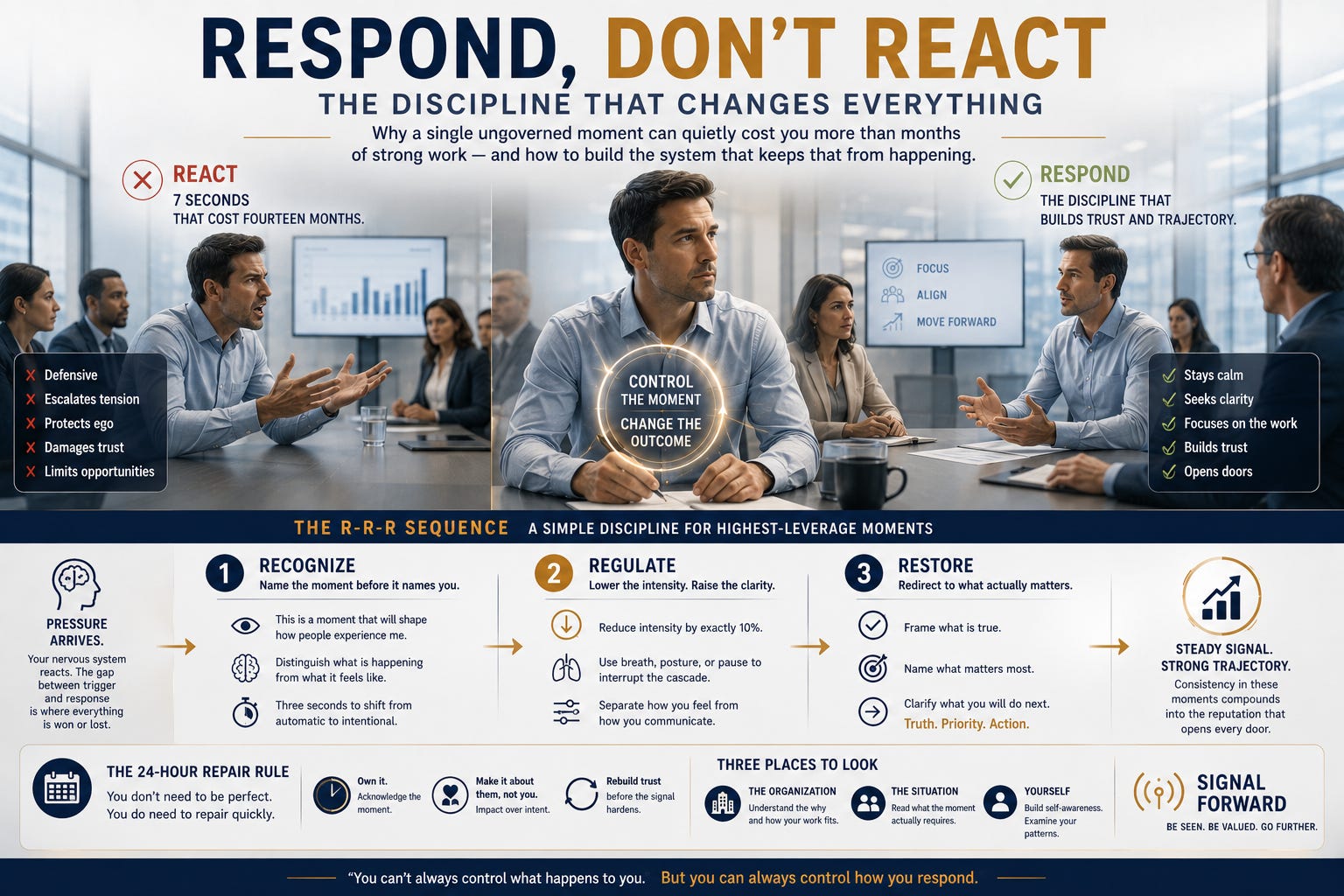
Alec was having a good career.
Project manager. Strong track record. Stakeholders trusted his timelines. Well-liked, competent, the kind of person who gets described in performance reviews as a “consistent contributor”, which sounds underwhelming but is actually harder to achieve than most people realize.
On a Thursday afternoon, in a cross-functional status meeting, a senior stakeholder publicly challenged the timeline Alec had committed to. The challenge was legitimate and based on new information Alec hadn’t yet received. But it didn’t feel legitimate. It felt like an ambush in front of fifteen people who were all now watching to see what he’d do.
Alec felt the heat rise. His jaw tightened.
What happened next took seven seconds and cost him fourteen months.
He fired back. His tone sharp and words defensive. Body language broadcasting exactly what his nervous system was feeling: threat. He challenged the stakeholder’s data. Questioned the timing of the critique. Made it personal when the situation was entirely professional. The room went quiet. And not the productive kind, where people are absorbing something important, but the uncomfortable kind, where people are watching someone damage themselves in real time.
The meeting moved on. Alec recovered his composure within minutes. He probably assumed it had blown over.
It hadn’t.
The following week, his name came up in a leadership conversation about a senior program manager role. The feedback was brief and fatal: Strong executor, but I’m not sure he can handle the pressure at the next level. Did you see the status meeting? The role went to someone with a thinner resume and a steadier signal.
Alec didn’t learn any of this until fourteen months later, when a colleague mentioned it in passing. Fourteen months of wondering why the call never came. Fourteen months of attributing the silence to politics, timing, etc. You know, the usual explanations people reach for when the real explanation is too uncomfortable to see clearly.
The cause was seven seconds of ungoverned reaction in a room full of people who were paying closer attention than he realized.
The Biology You Are Fighting
Before we get into the fix, it’s worth understanding what you’re actually up against. Because the problem isn’t Alec’s character. It isn’t a flaw in his professionalism. It’s his hardware, and it’s yours too.
When pressure arrives (a public critique, a missed deadline, a sudden priority change, a conflict with a peer, a question that feels like an accusation) your nervous system does what it has been doing for thousands of years. It prepares for threat. Stress hormones release. Cognitive bandwidth narrows. The prefrontal cortex, the part of your brain responsible for nuanced judgment, perspective-taking, and thinking through consequences, goes partially offline. Your emotional system moves into the driver’s seat. And it is a terrible driver, interpreting ambiguous signals as threatening, defaulting to defense, prioritizing speed over accuracy.
None of this is a character flaw. It’s the architecture. And the question isn’t whether it activates, it will. The question is whether you have a system for governing what happens in the gap between activation and response.
Here’s where it gets specific to individual contributors: executives who react poorly have something you don’t, authority. An executive who snaps in a meeting may damage trust, but they still hold power. The room adjusts around them and recovery is assumed.
When you react, there’s no cushion. There’s only the moment and the observation. A sharp response to a peer becomes a reputation. A defensive answer to a leader becomes a judgment about your maturity. Visible frustration during a priority change becomes evidence about your adaptability. The stakes of reaction at the individual contributor level aren’t organizational, they’re personal, directly and immediately linked to how people experience you and what opportunities follow.
This is why the ability to respond instead of react is arguably more important for you than for the executives above you. Less room for recovery. Fewer formal channels for repair. A reputation forming in real time with every observed interaction.
The R-R-R Sequence
There’s a three-move discipline for governing these moments. Not eliminating pressure, that’s not available. Not suppressing the reaction, that’s not sustainable. Just governing what happens next.
Recognize. Regulate. Restore.
Recognize: Name the moment before it names you.
Before you respond to anything that creates heat, name it internally. This is a moment that will shape how people experience me. That’s it. Not a lengthy internal monologue. One sentence, directed inward, before anything comes out.
The recognition itself changes the response. It reactivates the prefrontal cortex that pressure partially took offline. It shifts you from automatic to intentional. Three seconds, maybe less.
The specific skill here is learning to distinguish between what is happening and what it feels like is happening. Your leader publicly redirects your approach in a meeting. What is happening: feedback on a work product. What it feels like: a personal attack in front of peers. The gap between those two interpretations is where reaction lives. Recognition closes the gap before reaction can fill it.
A useful practice is in any moment of pressure, ask one question internally before speaking externally: What is actually happening here, and what signal do I want to send? That pause is the difference between a response that builds your reputation and a reaction that quietly dismantles it.
Regulate: Lower the intensity, raise the clarity.
Not just “by about ten percent”. By exactly ten percent. Slightly slower pace. Slightly more deliberate word choice. Slightly more space before responding. That specific, small adjustment changes how the room reads you. Not less engaged, more governable. Not less passionate, more trustworthy.
The discipline here is separating emotional processing from professional communication. You can feel frustrated and respond professionally. You can feel blindsided and ask a clarifying question. You can feel genuinely disrespected and still maintain your standard. The feelings are real. The discipline isn’t suppressing them, it’s sequencing them. Feel now. Process later. Respond well in the moment.
One physical interruption helps more than most people expect: a single deliberate breath, a shift in posture, picking up a pen. The physical break interrupts the neurobiological cascade. It buys two or three seconds. Two or three seconds, used well, is enough.
Restore: Redirect to what actually matters.
Frame what is true. Name what matters most. Clarify what you will do next. In that order, every time: truth first, then priority, then action.
Under pressure, the most common failure for individual contributors is defending position instead of advancing the work. Alec did this. He defended his timeline instead of addressing the new information that had changed the situation. He protected his ego when the moment needed him to solve a problem.
Restoration sounds like this: I hear the concern. Here’s what I understand the priority to be. Here’s what I’ll do next. That sequence, delivered calmly under genuine pressure, sends a signal worth more than any technical contribution in the same meeting. It says: this person can absorb difficulty, maintain clarity, and move forward. Repeated across dozens of pressure moments, it becomes the behavioral evidence that opens every door that matters.
The 24-Hour Repair Rule
Nobody responds perfectly every time. Some reactions will happen, the heat arrives faster than the recognition, the moment passes before the regulation kicks in, and something comes out that shouldn’t have.
The discipline isn’t avoiding all reactions. It’s repairing the ones that get through within 24 hours, before the signal they created has time to harden into a reputation.
Unrepaired reactions don’t stay isolated. They become data points. A sharp response to a colleague that goes unaddressed teaches two things to everyone who witnessed it: the sharpness is your default, and the colleague’s experience in that moment wasn’t important enough to acknowledge. Neither lesson was intended. Both will be acted on.
Repair within 24 hours teaches the opposite. That you hold yourself accountable to your impact, not just your intent. That mistakes get acknowledged rather than rationalized. That the experience of working with you actually matters to you.
Repair sounds like this: I want to go back to yesterday’s conversation. I was sharper than the situation warranted, and that was about my frustration, not about you or the work. I value this, and I want to make sure my reaction didn’t cost us trust. That statement takes ninety seconds to deliver and is worth more than months of strong execution in rebuilding what a single reaction can erode.
What This Actually Produces
Here’s what’s counterintuitive about this discipline: the people who benefit most from it rarely look like they’re doing anything remarkable in the moment.
They just don’t react when everyone expects them to. They stay level when the room gets tense. They ask a clarifying question when the instinct is to defend. They absorb a public redirect without matching the energy. And in a room full of people who are watching , always watching, even when they look like they’re staring at a laptop, that steadiness becomes the most reliable signal of readiness for more.
Alec got his next opportunity eventually. But the fourteen months he lost to one ungoverned Thursday afternoon are gone. The role went to someone steadier. Not more talented. Not more experienced. Steadier.
That’s what’s available when you build this discipline. Not perfection under pressure, nobody has that. Just a system that governs the moments that define you before they define you in ways you didn’t intend.
Think about the last time you reacted when you meant to respond. What triggered it, what came out, and, if you’re honest, what signal did the people in the room take away? I’d love to hear what you’re working on in the comments.
One more thing before you go.
Everything in this series, the signal, the three I’s, the disciplines, the traits, is being built into something larger.
Later this year, we’re releasing a significant update to The Ready Set experience. What’s coming is an extension of the AI Ready Set Coach that will meet you exactly where you are, whether you’re two years into your first real role or two levels from the executive suite, and grow with you as you move.
For individual contributors, that means the full Signal Forward framework: the behaviors, the disciplines, the trait development, and guided content built specifically for people who are doing excellent work and trying to make sure it doesn’t stay invisible.
For emerging leaders and managers, it bridges the gap. The moment when your contribution shifts from personal performance to collective performance, and the skills that got you here stop being sufficient for where you’re going.
For experienced leaders, it’s the full Ready Set framework: the ten behaviors, the diagnostic, the coaching, and the development architecture that drives what leadership actually looks like at scale.
One experience. Every level. Built to progress with you.
We’ll have more details as we get closer. If you’re already a paid member, you’ll be among the first to know, and the first to access it.
More Signal Forward coming soon. Stay with us.

Subscribe to The Ready Set
By Ryan Carnes | A data-backed development experience
Providing executive caliber leadership and talent content and resources to everyone. Subscribe free and get new behavioral-based leader and talent insights every week.
Plus two Ready Set resources to put to work immediately.
A very thoughtful analysis. Seen this happen often, was the offended party as well, and burnt bridges because of it. Learned the stoic wisdom: no one can offend you, if you do not allow it. You are complicit in how you deal with such situations.