


This is it, behavior ten of ten, and the day I’m opening paid membership. If you want to skip ahead to that, scroll to the bottom. If you want to finish the series first, which I’d recommend, it’ll be waiting for you there.

The Leader Who Brings Others Along
There’s a moment most leaders encounter somewhere in their career, usually after a significant win, where they look around and realize the room is empty. The goal was achieved. The numbers landed. The project closed. And yet something feels off, like the victory belongs to a spreadsheet rather than to a group of people who built something together.
That moment is the clearest signal that success, on its own, isn’t enough.
The tenth and final behavior in The Ready Set isn’t about individual achievement. It’s about what happens when leaders stop treating success as a finish line they cross alone and start treating it as something that only fully counts when others cross it with them.
That’s Shared Success. And it’s not soft. It’s strategic.
What the Research Actually Says
Before we get into what this behavior looks like in practice, it’s worth grounding it in reality, because Shared Success is the behavior most likely to be dismissed as idealistic by leaders who’ve spent years in competitive, performance-driven environments.
The data pushes back on that dismissal pretty hard.
Deloitte’s 2026 Global Human Capital Trends research found that competitive advantage is now primarily less driven by technology differentiation and more by cultivating what they call the “human edge”, the distinctly human capacity for adaptivity, creativity, and judgment that emerges when people feel genuinely invested in collective outcomes.* Technology is replicable. A team that trusts each other and wins together is not.
McKinsey research found that 48% of employees who chose to stay in a role cited working with people who trust and care for one another as a primary factor**, ranking above compensation adjustments and title changes. People don’t stay for the win. They stay for who they’re winning with.
The late author and poet Maya Angelou said it in a way that cuts through any corporate framing: “You can only become truly accomplished at something you love. Don’t make money your goal. Instead pursue the things you love doing, and then do them so well that people can’t take their eyes off of you.”
The leaders who build cultures of Shared Success aren’t chasing loyalty. They’re creating conditions where people can’t imagine doing their best work anywhere else.
What Shared Success Actually Is
Shared Success is the leader’s commitment to pursuing outcomes that advance personal, team, and organizational goals while also actively supporting the well-being and growth of others along the way.
The critical word there is actively. This isn’t passive goodwill. It’s not being a nice person or celebrating wins in a team meeting. It’s a behavioral orientation (observable, consistent, and deliberate) toward solutions that create mutual gain rather than individual advantage.
Leaders strong in this behavior operate from a fundamentally different assumption than most. They don’t believe success is finite. They don’t treat collaboration as a threat to their own advancement. They’ve internalized something that takes most high achievers years to learn: that the leaders who rise the furthest are almost never the ones who hoarded opportunity. They’re the ones who multiplied it.
What It Looks Like When It’s Missing
The absence of Shared Success rarely announces itself loudly. It shows up in subtle patterns that compound over time.
It’s the leader who accepts credit graciously but never distributes it. The one who collaborates freely when it’s convenient and goes silent when it isn’t. The one whose team performs well on paper but experiences quiet, steady turnover, because people can feel when their growth isn’t part of the equation.
It’s also the leader who wins negotiations by making sure the other side loses. Who frames every cross-functional conversation as a competition for resources rather than a shared problem to solve. Who builds a strong team in isolation while systematically undermining the teams around them.
None of these behaviors read as villainous in the moment. They often read as competitive, efficient, and focused. But they erode trust at a rate that performance metrics rarely capture, until the day the best people start leaving, and no one can quite explain why.
The philosopher Albert Camus, who admittedly is not typically quoted in leadership circles, captured the underlying tension well: “Don’t walk in front of me, I may not follow. Don’t walk behind me, I may not lead. Walk beside me and just be my friend.”
Strip away the poetry and what’s left is a straightforward behavioral principle: people give more when they feel alongside you, not beneath you.
The Behaviors That Signal It
Shared Success shows up in patterns that are specific enough to recognize, and to build.
Leaders who demonstrate it consistently look for win-win solutions before defaulting to compromise. They offer help without being asked and normalize asking for help themselves, because a leader who never needs anything signals to their team that needing something is weakness. They navigate disagreements by anchoring to shared outcomes rather than personal positions. And they build cultures where helping is unremarkable, not celebrated as exceptional, but expected as standard.
That last one is the most telling. In a culture of Shared Success, you don’t hear people say “she really went above and beyond to help me.” You hear them say “that’s just how we work here.” When helping becomes invisible because it’s so consistent, the culture has actually taken hold.
Developing It Intentionally
Like every behavior in The Ready Set, Shared Success is learnable. But it requires confronting an assumption that high performers often carry without realizing it: that their success is primarily the result of their own effort, insight, and capability.
That assumption isn’t entirely wrong. But it’s incomplete in ways that limit what’s possible.
Start with a simple practice: in any decision, negotiation, or difficult conversation, add one question before you move forward. Who else is affected by this outcome, and what would success look like for them? Not to give away ground you need. Not to sacrifice your objectives. Just to make sure you have a complete picture of what’s actually at stake before you act.
From there, make the wins visible and shared. When your team delivers, name the specific contributions of specific people — not as a performance for optics, but because accuracy matters. People know when credit is distributed genuinely and when it’s distributed strategically. The former builds loyalty. The latter builds cynicism.
Finally, invest in the success of someone who can’t immediately return the favor. A junior team member. A peer in another department navigating something hard. A new hire who doesn’t yet know the unwritten rules. The return on that investment is rarely direct or immediate. But it compounds in the form of trust, reputation, and culture in ways that outlast any single project or performance cycle.
Ten Behaviors. One Question.
That’s the series. Ten behaviors: Inclusive Authority, Clarity Establishment, Cognitive Empathy, Challenge Driven, Mission Minded, Critical Path Thinking, Values-Based Integrity and Authenticity, Resilience, Adaptive Thinking, and Shared Success.
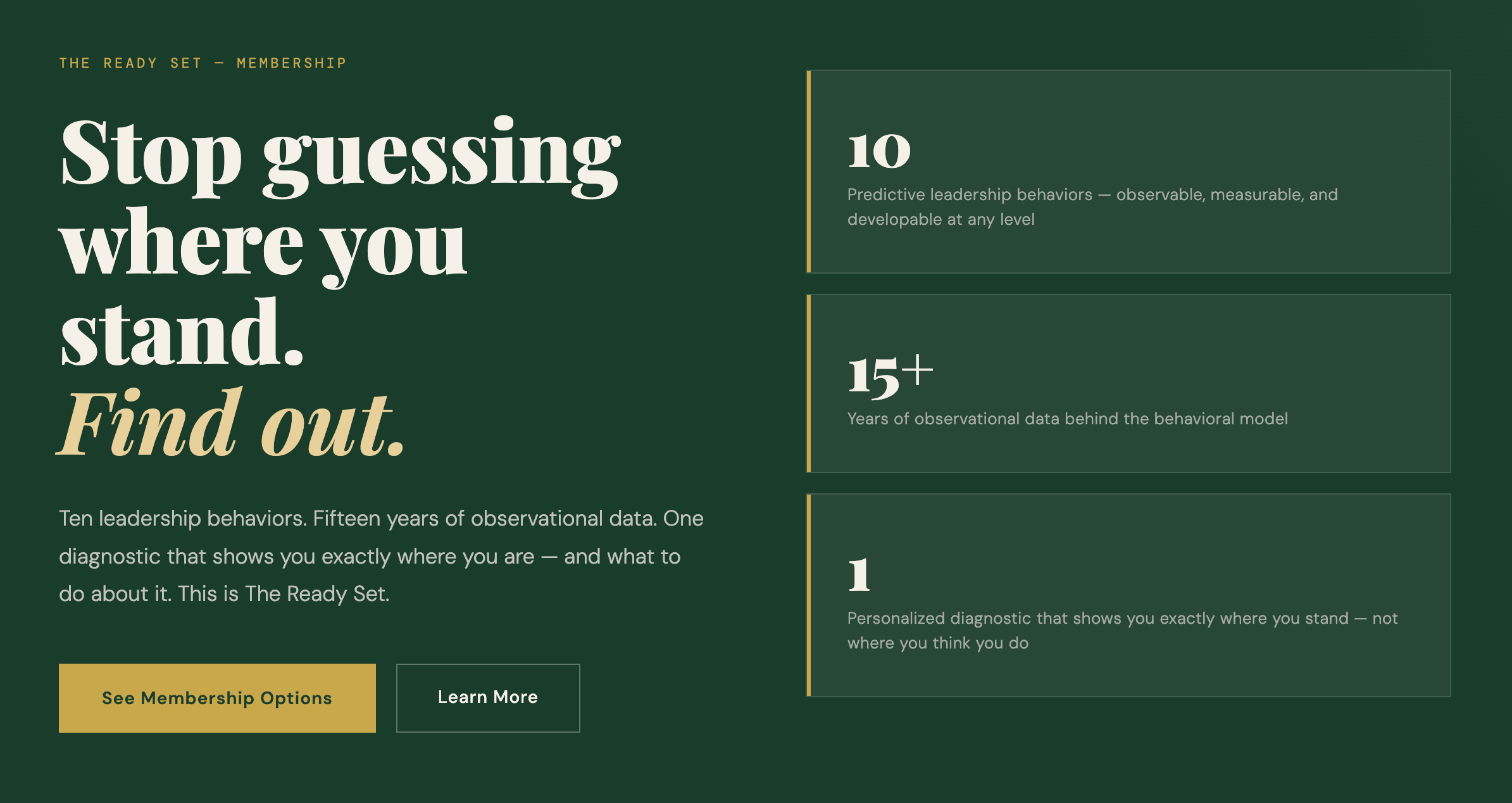
If you’ve been reading since the beginning, you’ve spent ten weeks inside a behavioral model built on 15 years of observational data. You know what these behaviors look like when they’re present, what they cost when they’re absent, and roughly where your own instincts tell you you stand.
But instincts aren’t data. And knowing the model isn’t the same as knowing yourself inside it.
That’s the gap I built KLIR to close.
Introducing KLIR — and Paid Membership
KLIR (Key Leader Impact and Readiness) is a diagnostic tool built around the ten behaviors you’ve just spent ten weeks studying. It takes roughly fifteen minutes to complete and produces a personalized report showing you where you score across all ten behaviors, which ones represent your strongest leadership assets, where your development opportunities are, and what a focused growth path looks like for your specific profile.
Not a generic leadership archetype. Not a personality type. A behavioral picture of you, grounded in the same model this series has been built on.
Starting today, KLIR is available exclusively to paid subscribers of The Ready Set.
Paid membership is $12/month or $96/year.
For the next seven days, I’m opening 25 charter member spots at a 38% discount — locked at that rate for as long as you stay subscribed. This isn’t a promotional discount. It’s a permanent rate for the people who’ve been here from the beginning, and I mean that literally. Once those 25 spots are gone, they’re gone.
Here’s what paid membership includes: full access to the KLIR diagnostic and your personalized report, access to the AI Ready Set Coach for working through your results and building a development plan, monthly behavior-focused content that goes deeper than what’s available to free subscribers, and quarterly KLIR rechecks so you can track your own growth over time.
There’s also more to gain in the paid membership (360 access and Ready Set Online Courses), so I encourage you to check out the membership page yourself before making any decision.
If you’ve read this series and found yourself nodding, arguing, or quietly taking stock of your own leadership, this is where that reflection becomes action.
[Become a Charter Member — 25 spots at 38% off]
If the timing isn’t right, no pressure. The series will stay here. The free content continues. But if you’re ready to stop guessing where you stand and actually find out, the door is open.
Thanks for ten weeks of reading. Now let’s get to work!
*https://www.deloitte.com/us/en/insights/topics/talent/human-capital-trends.html
**https://www.mckinsey.com/capabilities/people-and-organizational-performance/our-insights/the-organization-blog/the-great-attrition-the-power-of-adaptability