


Signal Forward is a series inside The Ready Set, same publication, different altitude. The Ready Set is for leaders. Signal Forward is for everyone else: the individual contributors, specialists, and practitioners whose behavioral patterns determine whether their contribution gets seen, valued, and rewarded, regardless of title or tenure.
New here? Start with the first article. In People or HR? Pass this along to your team.
Everything in this series has been about building something. Signal. Trajectory. Reputation. Compounding returns on consistent behavioral investment.
This article is about not destroying it.
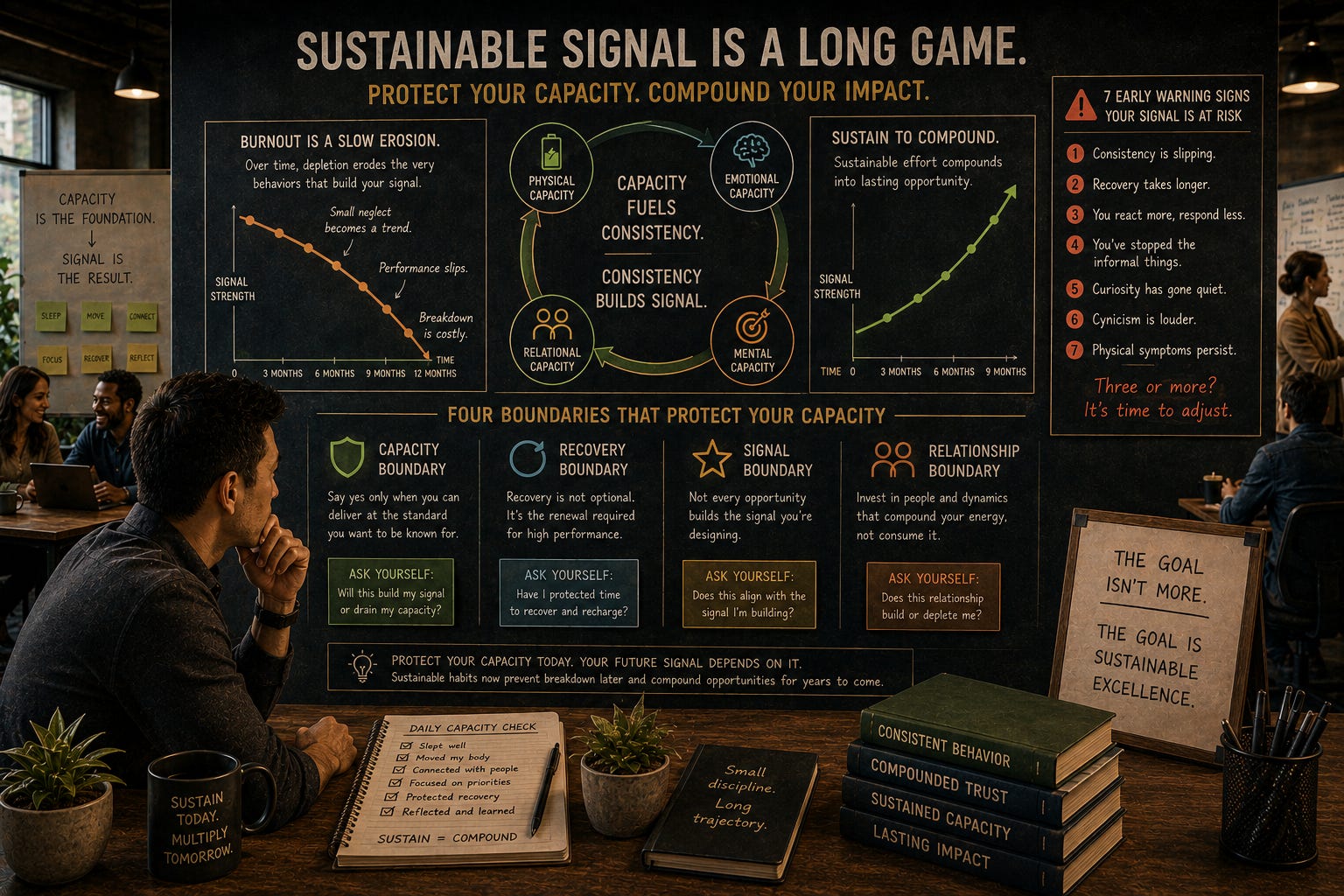
Because here’s what the career development industry almost never tells you: the same drive that builds a strong signal can burn the whole thing down if it isn’t governed. The disciplines in the previous articles require capacity to run. Capacity is finite. And the individual contributor who treats their capacity as an infinite resource they can draw against indefinitely is building on a foundation that will eventually crack, usually at the worst possible moment, and usually in ways that are visible to everyone before they’re visible to the person it’s happening to.
This isn’t about work-life balance. That framing implies two separate pools that need to stay equal. They’re not separate. Your personal capacity and your professional signal are parts of the same system. When one degrades, the other follows. That’s not philosophy. It’s just how it works.
Jordan
Jordan was a facilities coordinator at a hospital system. Known for being the person who always said yes. Weekend coverage? Jordan would handle it. Emergency repair at eleven at night? Jordan was on the way. Scheduling crisis during her daughter’s recital? Jordan rearranged.
For eighteen months, her signal with leadership was probably as strong as it gets. Reliable and committed. Always available. The kind of person organizations lean on without fully realizing how much weight they’re putting on one person.
Then Jordan stopped showing up entirely. Not gradually. Suddenly. Medical leave for stress-related symptoms her doctor told her had been building for over a year.
The hospital lost their most dependable coordinator. Jordan lost six months to recovery. And the signal she’d spent eighteen months building didn’t survive her absence the way she expected it to. Organizations adjust and coverage gets figured out. The person who was indispensable becomes a cautionary note in a staffing conversation about single points of failure.
Jordan’s collapse wasn’t sudden. It was the visible end of eighteen months of invisible degradation. Her irritability with the team had increased. Her decision quality under pressure had declined. Her behavioral consistency, the thing that made her signal strong, had been slipping for months before the medical leave made it official. The people around her saw it forming. She didn’t, because she was too depleted to read her own signals clearly.
That’s how burnout actually works. Not as a sudden event. As a slow erosion of exactly the capabilities this series has been built around: behavioral consistency, relational awareness, judgment under pressure, adaptability. By the time it announces itself, the damage has been accumulating for a long time.
What Burnout Actually Is
Burnout is not just being tired. It’s not solved by a long weekend. And it’s not a character weakness in people who can’t handle pressure.
It’s what happens when the demands placed on you (whether external or self-imposed) consistently exceed your capacity to meet them over a sustained period. The system doesn’t fail all at once. It degrades. And it degrades first in the areas that matter most: the behavioral disciplines you’ve been building, the relational awareness you’ve been developing, the judgment you depend on to navigate pressure well.
Three forms of capacity feed everything else.
Physical capacity is the most obvious and the most ignored. Sleep deprivation, poor nutrition, chronic stress activation, these don’t just make you tired, they degrade every cognitive and emotional capability you rely on to maintain your signal. Sound judgment requires a rested brain. Adaptability requires a nervous system that isn’t already maxed out. Relational awareness requires the cognitive bandwidth to read social cues accurately. When physical capacity is depleted, every other discipline in this series operates at reduced function.
Emotional capacity is the reservoir that the R-R-R sequence draws from. Regulation requires energy. When emotional capacity is depleted, regulation fails. Not because you stopped caring about responding instead of reacting, but because the tank is empty. The reactions that start showing up aren’t character. They’re essentially depletion.
Relational capacity is the one that degrades most quietly. Dani, the supply chain coordinator, hit this in a stretch where she was overextended across three simultaneous projects. She stopped doing the informal check-ins that had been building her cross-functional relationships. She declined invitations. She minimized every interaction to the transactional minimum. It looked like efficiency. It was actually early-stage relational depletion. The signal she’d built through consistent small investments started eroding through consistent small withdrawals. Nobody said anything directly. But the read on her shifted from “high value contributor” to “stretched.” That’s not the signal that leads to more opportunity.
Rashid’s Map
Rashid was a software developer at a mid-sized technology company. Strong individual signal, high output, genuinely capable. Also quietly running at unsustainable capacity for months before his manager said anything about it.
After the conversation with his manager, Rashid did something that changed his entire operating model. He mapped his best professional weeks against what his personal life looked like during those weeks. The pattern was immediate and undeniable. His strongest work, the contributions that built his signal most effectively, happened during weeks when he’d slept well, moved his body, spent real time with people he cared about, and protected his weekends.
His worst work correlated with weeks where he’d depleted his personal capacity in service of professional output. The late-night code that had to be rewritten. The meeting where he snapped at a colleague. The decision he regretted within twenty-four hours. All of it landed in the depleted weeks.
The conclusion he drew from that data was simple: his personal life wasn’t in competition with his professional signal. It was the foundation of it. When he treated personal capacity as disposable, his signal degraded. When he protected it, his signal strengthened.
He made one structural change. Sundays were non-negotiable recovery time. No work, no Slack, no email. Just recovery. His output Monday through Saturday stayed high. But it was sustainable high, built on a foundation that could hold it.
The Boundary Problem
The word “boundaries” creates resistance in high performers. It sounds like limitation. Like opting out of opportunity. Like choosing comfort over ambition.
That resistance is based on a misread of what boundaries actually do. Boundaries don’t limit performance. They protect the capacity required to sustain it. The professional who operates without them isn’t demonstrating commitment. They’re demonstrating poor self-governance. And poor self-governance is a signal that predicts breakdown, to everyone who’s paying attention.
Kenji, the financial analyst, figured this out through a simple exercise. He tracked every commitment he made over two weeks and sorted each one into three categories: signal-building, maintenance, and depletion. Activities that built his professional signal. Activities required for baseline performance. Activities that consumed capacity without producing professional value.
The results: thirty-five percent signal-building, forty-five percent maintenance, twenty percent pure depletion. A fifth of his time and energy was going into activities that actively degraded his capacity without producing anything worth having. That twenty percent was the margin between sustainable performance and burnout.
He set one filter: before saying yes to anything new, he asked whether it built his signal, fulfilled a genuine requirement, or depleted capacity without return. If the answer was the third option, the answer was no.
Within sixty days, his depletion category dropped to five percent. His signal-building increased to fifty. His energy improved. His 4.8 standard, which had been slipping toward 4.5 during the period of maximum depletion, returned and then exceeded it.
The boundary didn’t limit his performance. It unleashed it.
Four Boundaries Worth Building
These aren’t rules. They’re filters. Each one protects a different dimension of the capacity your signal depends on.
The Capacity Boundary. Before taking on anything new, ask whether you can do it at the standard you want to be known for. Not whether you can just fit it in. Whether you can do it well enough that it builds rather than damages your signal. Jordan’s collapse came from violating this boundary repeatedly, every time she said yes to coverage requests that drew from a reserve that wasn’t replenishing.
The Recovery Boundary. Recovery isn’t optional. It’s the biological requirement for sustained high performance. Tomás watched the most effective shift supervisor at his facility take a full lunch break every single day, off the floor, away from his phone, thirty minutes without exception. He asked him once if he ever felt pressure to skip it when things were busy. The supervisor said the thirty minutes made him more effective for the remaining seven and a half hours than if he’d worked straight through at eighty percent. A rested brain makes better decisions. Better decisions prevent problems. Problem prevention saves more time than skipping lunch ever could.
The Signal Boundary. Not every opportunity builds the signal you’re designing. Elena was invited to join a task force on facility improvements, legitimate exposure to senior leadership, but completely outside the signal she’d been deliberately building around cross-functional process coordination. She declined clearly: “Right now I’m focused on building deep expertise in process coordination, and I want to make sure I’m investing my development time there.” That boundary reinforced her signal to the person who invited her and protected her capacity to keep building it. Six months later, when a role opened directly in her domain, she was the first call.
The Relationship Boundary. Some professional relationships compound. They build your signal, expand your thinking, and restore energy. Others deplete because the dynamic costs more than it produces. Carmen realized one particular operator left her drained after every interaction. Every conversation became a negotiation. Every handoff required extra emotional labor. She stopped trying to fix it. She made the relationship transactional, brief, and documented, and redirected the relational capacity that had been consumed by it toward relationships that actually compounded. Her overall signal improved because she stopped depleting herself trying to repair what wasn’t fixable.
The Early Warning System
Burnout doesn’t announce itself. It accumulates. And the signals that predict it are usually visible to the people around you before they’re visible to you.
Seven patterns worth watching for. Not as a checklist to complete, just as an honest read on your current state.
Your signal consistency is slipping. The 4.8 you maintained for months has been sitting at 4.5, then 4.2. You keep telling yourself it’s temporary. Consistency is the first thing that degrades when capacity is depleted. Temporary is rarely the right word.
Recovery is taking longer. You used to bounce back from a difficult week over a weekend. Now it takes most of the following week to feel functional again. That gap is your system telling you that depletion is exceeding replenishment.
You’re reacting more and responding less. The R-R-R discipline that used to feel automatic now requires conscious effort. That’s not a character failure. It’s a capacity signal.
You’ve stopped doing the informal things. The check-ins, the hallway conversations, the small relational investments that have been building your network. You’re minimizing everything to the transactional minimum and telling yourself it’s efficiency.
Curiosity has gone quiet. You’ve stopped asking why. You’re executing but not growing. That narrowing isn’t focus. It’s depleted cognitive bandwidth presenting itself as focus.
Cynicism is louder than usual. The initiatives feel pointless. The feedback feels like criticism. The work feels like a grind. Cynicism is not insight. It’s the psychological defense mechanism that activates when you’ve been operating past sustainable capacity for too long.
Physical symptoms are showing up. Sleep disruption. Tension. Unexplained fatigue. Your body has been trying to communicate what your mind has been rationalizing away. At some point it stops asking and starts insisting.
If three or more of those are active right now, this is not a temporary rough patch. The discipline is not to push through. It’s to make an adjustment before the system forces one.
The Long Game
Signal Forward is built for people who want careers with momentum. Momentum requires time. Time requires sustainability. And sustainability requires protecting your capacity with the same rigor you apply to building your signal.
A strong signal built on a depleted foundation is a temporary structure. The signals you’ve been building across this series, the prepared contribution, the steady presence under pressure, the altitude ladder, the team investment, all of them require capacity to run. Protect the capacity, and the signal compounds for years. Deplete it, and the whole structure gets rebuilt from scratch, usually on a timeline you didn’t choose.
The career you’re building is supposed to be worth having. Not just professionally, but actually worth having. If the signal you build costs you everything else that makes your life functional, you haven’t built a career. You’ve built a high-performing dead end.
Jordan came back from medical leave with a completely different operating model. She no longer said yes to every request. She scheduled recovery with the same discipline she’d previously applied only to work commitments. Her reputation shifted from “always available” to “consistently excellent when engaged.” The second reputation was worth more. It built trust without building dependency. And it was sustainable in a way the first one never was.
That’s the target. Not the sprint, the signal that holds.
Honest question for this week: Which of the seven warning signs is most active for you right now? And if you’re seeing more than two or three of them, what’s the one boundary you could set in the next seven days that would start to reverse it?
I’d love to hear what comes up in the comments.
One more thing before you go.
Everything in this series is being built into something larger. Later this year, we’re releasing a significant update to The Ready Set experience, an extension of the AI Ready Set Coach that will meet you exactly where you are, whether you’re two years into your first real role or two levels from the executive suite, and grow with you as you move. For individual contributors, that means the full Signal Forward framework: the behaviors, the disciplines, the trait development, and guided content built specifically for people doing excellent work who want to make sure it doesn’t stay invisible. More details coming soon. If you’re already a paid member, you’ll be among the first to know.
More Signal Forward coming soon. Stay with us.

Subscribe to The Ready Set
By Ryan Carnes | A data-backed development experience
Providing executive caliber leadership and talent content and resources to everyone. Subscribe free and get new behavioral-based leader and talent insights every week.
Plus two Ready Set resources to put to work immediately.