


Signal Forward is a series inside The Ready Set, same publication, different altitude. The Ready Set is for leaders. Signal Forward is for everyone else: the individual contributors, specialists, and practitioners whose behavioral patterns determine whether their contribution gets seen, valued, and rewarded, regardless of title or tenure.
New here? Start with the first article. In People or HR? Pass this along to your team.
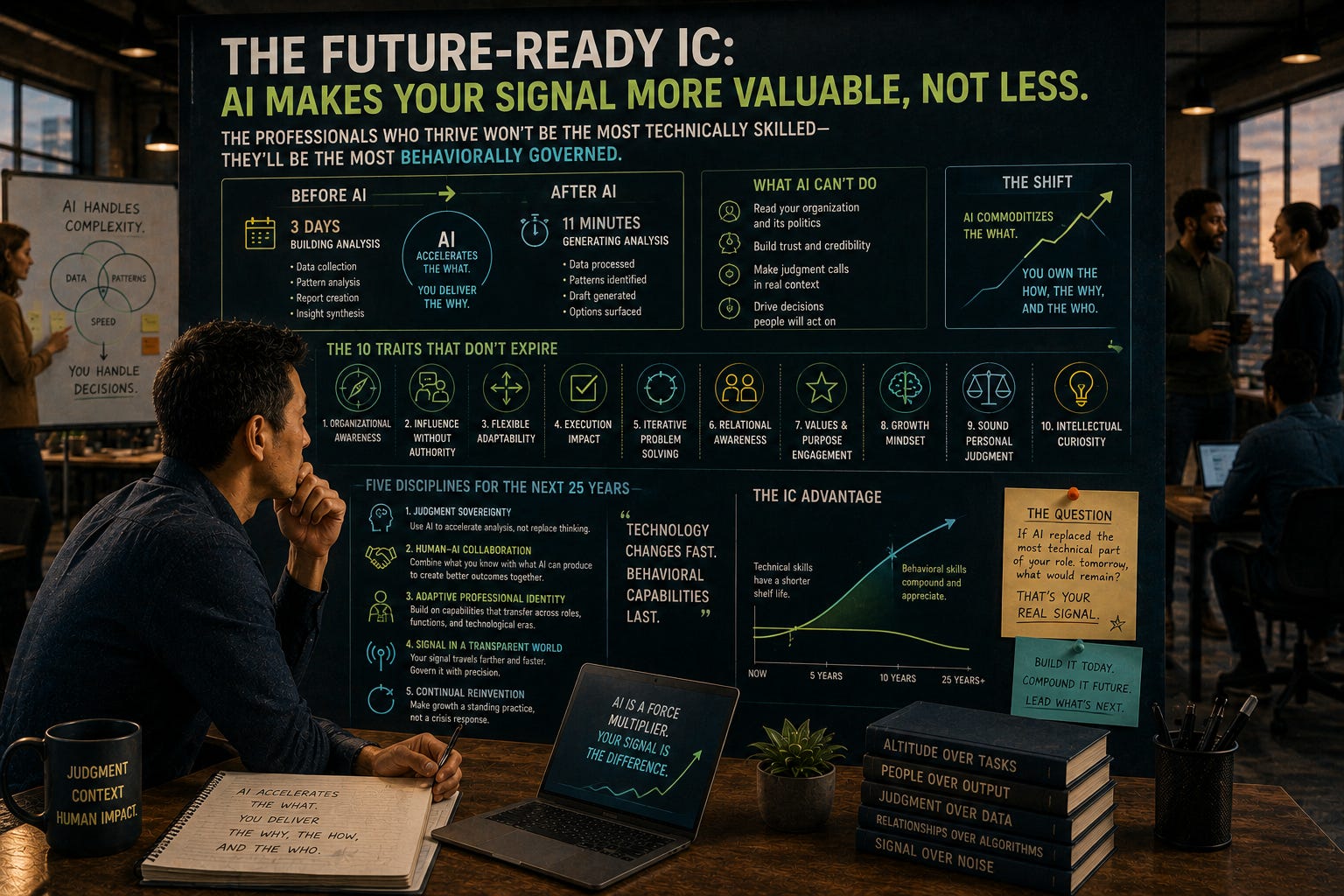
In 2024, Kenji spent three days building a competitive market analysis. Sharp synthesis. Sound recommendations. The kind of work that, six months earlier, had taken his team a week and a half.
Six months after he finished it, his firm deployed an AI system that produced comparable analysis in eleven minutes.
Two possible reactions to that moment. Fear: my value is being replaced. Or recognition: the part of that work that was purely analytical just became a commodity. The part that wasn’t, the judgment about what the analysis means, the ability to read how the board will receive it, the skill at driving decisions rather than just informing them, that part just became more valuable.
Kenji chose recognition. He stopped being the person who produces the analysis and became the person who interprets it, contextualizes it, and translates it into action the organization can actually take. His signal went up. The AI didn’t replace him. It elevated him, because he let it.
That’s the whole article, honestly. But let’s go a little deeper.
What AI Actually Changes
The pattern is consistent across every function where AI is being deployed: it commoditizes the what of work and elevates the how, the why, and the who.
AI can produce the report. It can’t determine what the report means for the specific political dynamics of your organization at this specific moment. AI can generate options. It can’t read the room and know which option the team will actually execute versus which one they’ll agree to and quietly ignore. AI can flag a risk. It can’t build the trust required for the person who needs to act on the risk to actually believe it.
The work that survives commoditization is human judgment applied in real contexts with real relationships and real stakes. Which means the behavioral disciplines in this series, the signal you send, the altitude you operate at, the way you govern yourself under pressure, the team contribution you make, the capacity you protect, those aren’t just career tools for right now. They’re the architecture for a future where technical skills have a shorter shelf life than they’ve ever had.
I’ve spent a fair amount of time in organizational environments watching this shift happen in real time. What I’ve noticed is that the people who panic about AI are almost always the ones whose professional identity is built entirely on a technical skill. And the people who get more valuable as AI arrives are almost always the ones who built their identity around something harder to automate: judgment, relationships, communication, the ability to make a room more capable by being in it.
That gap was always there. AI just made it impossible to ignore.
The Skills That Don’t Expire
Ten traits sit at the foundation of Signal Forward. We’ve referenced them throughout this series and we’ll go deep on each one in the next three articles. But it’s worth naming them here in the context of what AI changes, because every single one of them becomes more valuable in an AI-augmented world, not less.
Organizational Awareness
Influence Without Authority
Flexible Adaptability
Execution Impact
Iterative Problem Solvin
Relational Awareness
Values and Purpose Engagement
Growth Mindset
Sound Personal Judgment
Intellectual Curiosity.
Run through that list and ask yourself: which of those can an AI replace? Which of them gets commoditized when a system can produce an analysis in eleven minutes?
None of them. Because none of them are about producing outputs. They’re about how you operate in human systems under real pressure with real consequences. That’s not a skill. It’s a behavioral architecture. And behavioral architecture is the one thing AI can’t replicate, because it’s built through lived experience, governing yourself across hundreds of imperfect situations, and choosing repeatedly to respond rather than react.
The ten traits aren’t a current framework that will age out when the technology advances. They’re a future-proof investment in the capabilities that will be most scarce and most valued in exactly the world that AI is building.
Five Disciplines for the Next Twenty-Five Years
These aren’t predictions. They’re patterns already visible in the environments where AI augmentation is most advanced. The professionals who are thriving in those environments share five specific orientations.
Judgment sovereignty. Using AI to accelerate analysis without letting it replace thinking. The core talent who reflexively accepts what the AI produces has traded the most valuable part of their contribution for efficiency. The one who uses AI output as a starting point, interrogates it, contextualizes it, applies human judgment to determine what it means in this specific situation, is the one who becomes more valuable as AI gets more capable.
This is harder than it sounds. AI produces confident, well-structured output. It takes discipline to look at something that reads well and ask whether it’s actually right for your context. That discipline, intellectual independence in the face of plausible-sounding information, is one of the rarest things in any organization right now.
Human-AI collaboration. The highest-value professional of the next decade combines what they know with what AI can produce to create outcomes neither achieves alone. This isn’t about being good at prompting. It’s about understanding clearly which part of the work requires human judgment and which part AI can accelerate, and keeping those categories from bleeding into each other.
Kenji’s repositioning was exactly this. AI handles production. He handles judgment. The combination produces something better than either alone. That’s the model. And it requires being clear about what your actual contribution is, which is a question a lot of people have never had to answer directly before.
Adaptive professional identity. The career of the next twenty-five years isn’t linear. It’s a series of reinventions, not starting over from scratch each time, but deepening and broadening a signal that transfers across roles, functions, and technological eras.
The professionals who navigate that well are the ones whose identity is built on behavioral capabilities rather than specific technical skills. Not “I am a financial analyst” but “I translate complex information into decisions organizations can act on.” Not “I am a supply chain coordinator” but “I make systems more reliable and more visible to the people depending on them.” The behavioral identity transfers. The technical identity expires.
Signal in a transparent world. Your signal travels faster and farther than it ever has. Something you do in a cross-functional meeting gets referenced in a conversation you’ll never be part of. A reputation you build, or damage, in one organization follows you into the next one through people who move between them. The 4.8 Standard and the R-R-R discipline aren’t just performance tools. They’re governance systems for a world where every interaction is potentially visible to people you’ve never met.
This cuts both ways. A strong signal amplifies faster than it used to. So does a weak one. The transparency that makes positive behavioral evidence travel farther makes negative behavioral evidence travel just as far. Governing your signal carefully isn’t caution. It’s accuracy about the world you’re actually operating in.
Continual reinvention. Not as a response to disruption, just as a standing practice. The Altitude Ladder, the Three I’s, and the CPP cadence give you the architecture for this. You don’t need a crisis to trigger growth. You build the capacity for reinvention into the way you operate every quarter, so when the environment shifts, and it will shift, repeatedly, you’re not starting from zero.
The professionals who get disrupted are the ones who treated development as something they’d get to eventually. The ones who thrive are the ones who treated it as a standing operating practice, regardless of whether the environment was forcing it.
The Thing Worth Saying Plainly
The future doesn’t belong to the most technically skilled people in the room. It belongs to the most behaviorally governed.
AI will commoditize skills. It cannot commoditize judgment, or the ability to build trust across organizational lines, or the steadiness to govern yourself under genuine pressure, or the relational intelligence to know what a room needs before anyone says it out loud. Those capabilities are what this series has been building toward. They’re what the ten trait deep-dives in the next three articles will go deep on.
The core talent who arrives at that future with a strong behavioral signal, a clear professional identity, and the discipline to keep developing independently, that person doesn’t get disrupted by AI. They get elevated by it. The same way Kenji did.
Not because they were lucky. Because they’d already built the right foundation.
A question worth sitting with this week: If AI replaced the most purely technical part of your current role tomorrow, what would remain? What would your actual contribution be?
That answer is your real signal. And if you’re not sure what the answer is, that’s probably the most useful thing this article offered. I’d love to hear what comes up in the comments.
One more thing before you go.
Everything in this series is being built into something larger. Later this year, we’re releasing a significant update to The Ready Set experience, an extension of the AI Ready Set Coach that will meet you exactly where you are, whether you’re two years into your first real role or two levels from the executive suite, and grow with you as you move. For individual contributors, that means the full Signal Forward framework: the behaviors, the disciplines, the trait development, and guided content built specifically for people doing excellent work who want to make sure it doesn’t stay invisible. More details coming soon. If you’re already a paid member, you’ll be among the first to know.
More Signal Forward coming soon. Stay with us.
Subscribe to The Ready Set
By Ryan Carnes | A data-backed development experience
Providing executive caliber leadership and talent content and resources to everyone. Subscribe free and get new behavioral-based leader and talent insights every week.
Plus two Ready Set resources to put to work immediately.