


This is Article 2 in the Succession Readiness series. If you missed Article 1, start there. New here? Subscribe to The Ready Set so you don’t miss what’s coming.
There’s a moment in most talent review sessions that goes something like this.
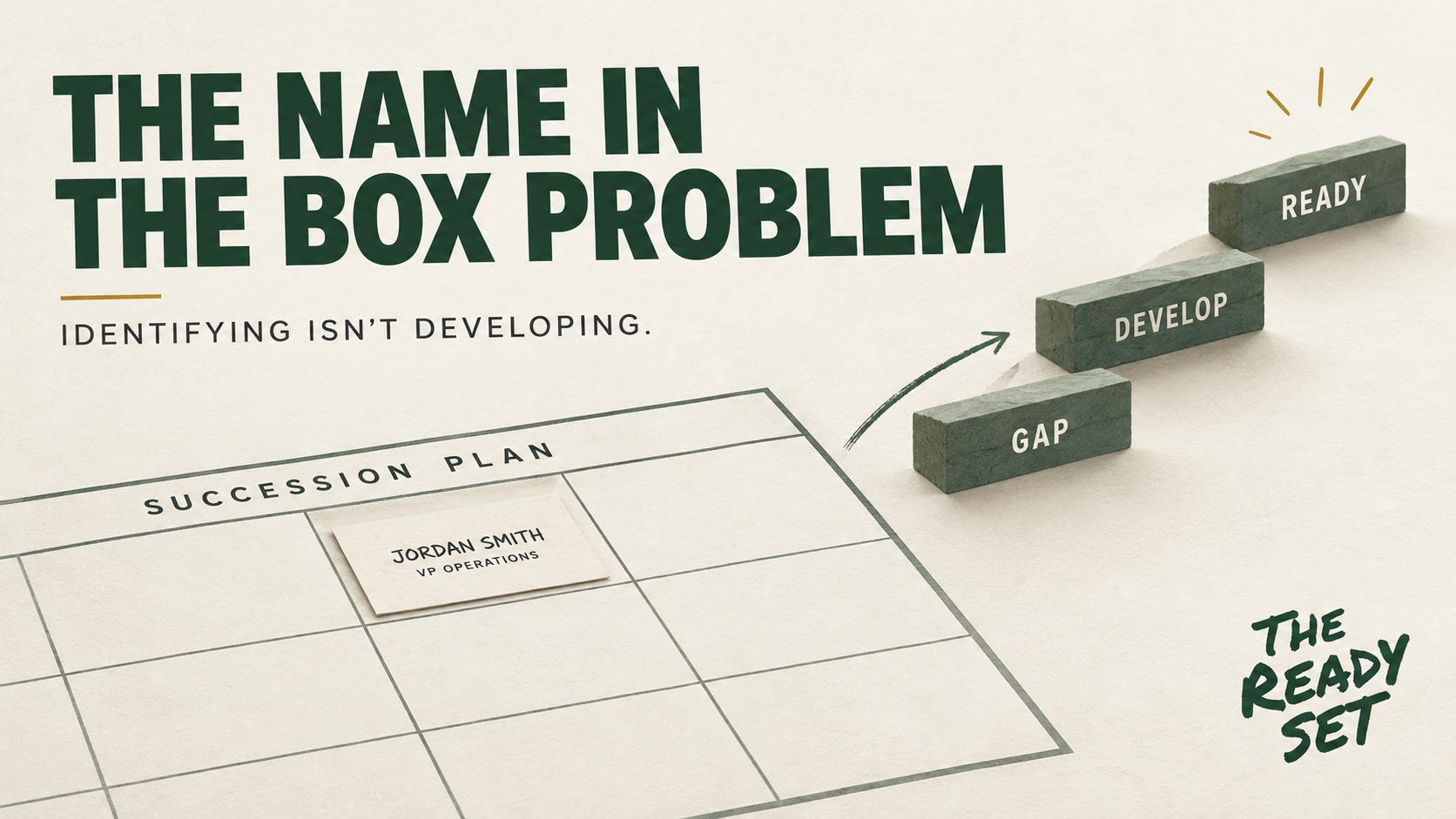
Someone asks about the Director of Supply Chain role. Who’s the backup if she leaves? A few names get floated. One rises to the top. Someone says “she’s ready in about eighteen months” and the room nods. The name goes in the box. The conversation moves on.
What just happened in that room feels like succession planning. It has the vocabulary of succession planning. It produces the output of succession planning: a name, a rating, a timeline.
What it doesn’t produce is any commitment to actually develop that person into readiness. No specific behavioral gaps were identified. No development investment was agreed to. No one was assigned to own that person’s growth between now and the eighteen-month mark. The person whose name is in the box probably doesn’t even know the conversation happened.
The name is in the box. The box is empty.
The Identification Trap
Organizations gravitate toward identification because it’s concrete, it’s fast, and it produces something that looks like a deliverable. You leave the talent review with a document. The document has names in it and leadership feels like the future is accounted for.
The problem isn’t the identification. Knowing who has potential is genuinely useful. The problem is treating identification as the end of the process rather than the beginning of it.
Potential and readiness are not the same thing. Potential is what someone might be capable of under the right conditions, with the right development, given enough time and investment. Readiness is what they can actually do right now, or within a defined window, having already received that investment. The gap between those two things is not closed by writing a name in a box. It’s closed by deliberate, sustained, behaviorally specific development. And that’s the part most succession processes skip entirely.
I’ve worked with organizations that had beautifully designed succession frameworks. Nine-box grids, readiness ratings, color-coded bench depth reports. The documentation was thorough. The development infrastructure behind it was almost nonexistent. When a critical role opened, the person at the top of the succession list was technically “ready in twelve months” but had received no coaching, no stretch assignments, and no honest feedback about the behavioral gaps that would actually make or break their performance at the next level. Twelve months of readiness rating with zero months of readiness investment.
The plan looked like something, but was producing nothing.
What Lives in the Gap
Between identifying someone as a potential successor and that person actually being ready, a specific set of things has to happen. Most organizations don’t have a clear picture of what those things are, which means they can’t track whether they’re happening, which means they usually aren’t.
Behavioral gap identification is the first requirement. Not a general sense that someone is “strong” or “high potential,” but a specific understanding of what behaviors, capabilities, and experiences they currently lack relative to what the next role actually requires. This requires someone to think carefully about what the next level genuinely demands, not just what the current job description says.
A director stepping into a VP role isn’t just doing a bigger version of what they’re already doing. The nature of the contribution changes. The altitude of thinking required changes. The relational complexity changes. The behavioral profile of someone who excels at director-level work is not identical to the behavioral profile of someone who excels at VP-level work. If no one has clearly articulated the delta, there’s no map for closing it.
Deliberate development investment is the second requirement. Stretch assignments that expose the person to the complexity of the next level before they’re in the role. Coaching that addresses the specific behavioral gaps, not just general professional development. Feedback that’s honest enough to be useful, delivered often enough to be actionable. Exposure to the stakeholders, the decisions, and the organizational dynamics that the next role operates in.
This investment has to be intentional. It doesn’t happen as a byproduct of doing a current job well. It requires someone to create the conditions for it, to assign the right experiences, and to stay close enough to the person’s development to adjust when something isn’t working.
Ownership is the third requirement. Someone, usually a direct leader, has to hold themselves accountable for that person’s readiness in a real way. Not by completing an annual form, but by treating development as an ongoing responsibility that exists between talent reviews, not just during them.
When any of these three are missing, the gap between identified and ready stays exactly where it is. Which is why so many organizations open a succession plan during a leadership transition and discover that the names in the boxes haven’t moved any closer to the boxes they’re supposed to fill.
The Person in the Box Doesn’t Know They’re in It
This is the part that doesn’t get talked about enough.
In many organizations, high-potential employees are identified in closed-door talent reviews and never told. They’re on the succession plan. They have a readiness rating. Leaders have discussed their future in detail. And the person has no idea any of it happened.
The reasoning, when there is one, usually goes something like this: we don’t want to overpromise. We don’t want to create expectations we can’t meet. We don’t want to destabilize the situation if plans change.
All of that is understandable. None of it is good development practice.
A person who doesn’t know they’re being developed for the next level can’t orient their own growth toward it. They can’t ask the right questions. They can’t seek the right experiences. They can’t have honest conversations with their leader about the gaps they need to close. They’re being prepared for something in the dark, which is to say they’re not really being prepared at all.
The transparency question is one of the more uncomfortable ones in succession planning, because it requires leaders to have direct conversations about future roles, timelines, and expectations in a world where nothing is guaranteed. Those conversations are harder than a talent review. They’re also where actual development begins.
When someone knows they’re being developed toward a specific level of leadership, they can become an active participant in that development rather than a passive recipient of whatever investment the organization gets around to making. That shift, from passive to active, changes the pace and quality of readiness in ways that documentation alone never will.
What “Ready Now” Actually Means
The readiness ratings most organizations use, “ready now,” “ready in one to two years,” “ready in three or more years,” were designed to communicate urgency and timeline to leadership teams. They communicate something else too, though usually unintentionally.
They communicate that readiness is a fixed state that gets assessed periodically rather than a dynamic condition that’s being actively built or eroded depending on what’s happening in the person’s development.
Someone rated “ready in eighteen months” on January 1st is not automatically closer to ready on July 1st unless something specific has happened in those six months to close the gap. And if nothing has happened, they’re not eighteen months minus six months away from ready. They’re still eighteen months away, just with less time before someone expects them to be there.
Readiness ratings become fiction the moment they’re disconnected from active development investment. They describe a potential timeline in a world where everything goes right. They don’t account for the reality that most development investments don’t happen on schedule, that stretch assignments get deferred when operations get busy, that coaching conversations lose priority when things get hard.
The rating stays in the box. The readiness doesn’t accumulate.
A Different Question to Ask
Most organizations run their talent reviews around the question: who is ready, and when?
The more useful question is: what have we done since the last review to actually move someone toward readiness, and how do we know?
That question reorients the talent review from a snapshot to an accountability conversation. It requires leaders to report on development investment, not just potential assessments. It surfaces the gap between who’s in the box and what’s actually been built. And it creates a different kind of organizational pressure: not to identify successors, but to develop them.
It’s a harder conversation. It’s the one worth having.
The name in the box is a starting point, not an achievement. What happens between talent reviews is what determines whether the box means anything when the moment arrives.
A question worth sitting with: Pick one person currently on your succession plan or in a development track. What specific investments have been made in their readiness since the last time their name came up in a leadership conversation? And if the honest answer is not much, what does that tell you about what the succession plan is actually producing?
I’d love to hear what comes up in the comments.

Subscribe to The Ready Set
By Ryan Carnes | A data-backed development experience
Providing executive caliber leadership and talent content and resources to everyone. Subscribe free and get new behavioral-based leader and talent insights every week.
Plus two Ready Set resources to put to work immediately.