


Quick note: Today is the last day to lock in Charter Member pricing on The Ready Set — 38%, permanently. After tonight it goes to standard pricing and doesn’t come back. If you’ve been thinking about it, now’s the time. → [become a charter member]
Learn more about the member at the end of the article.
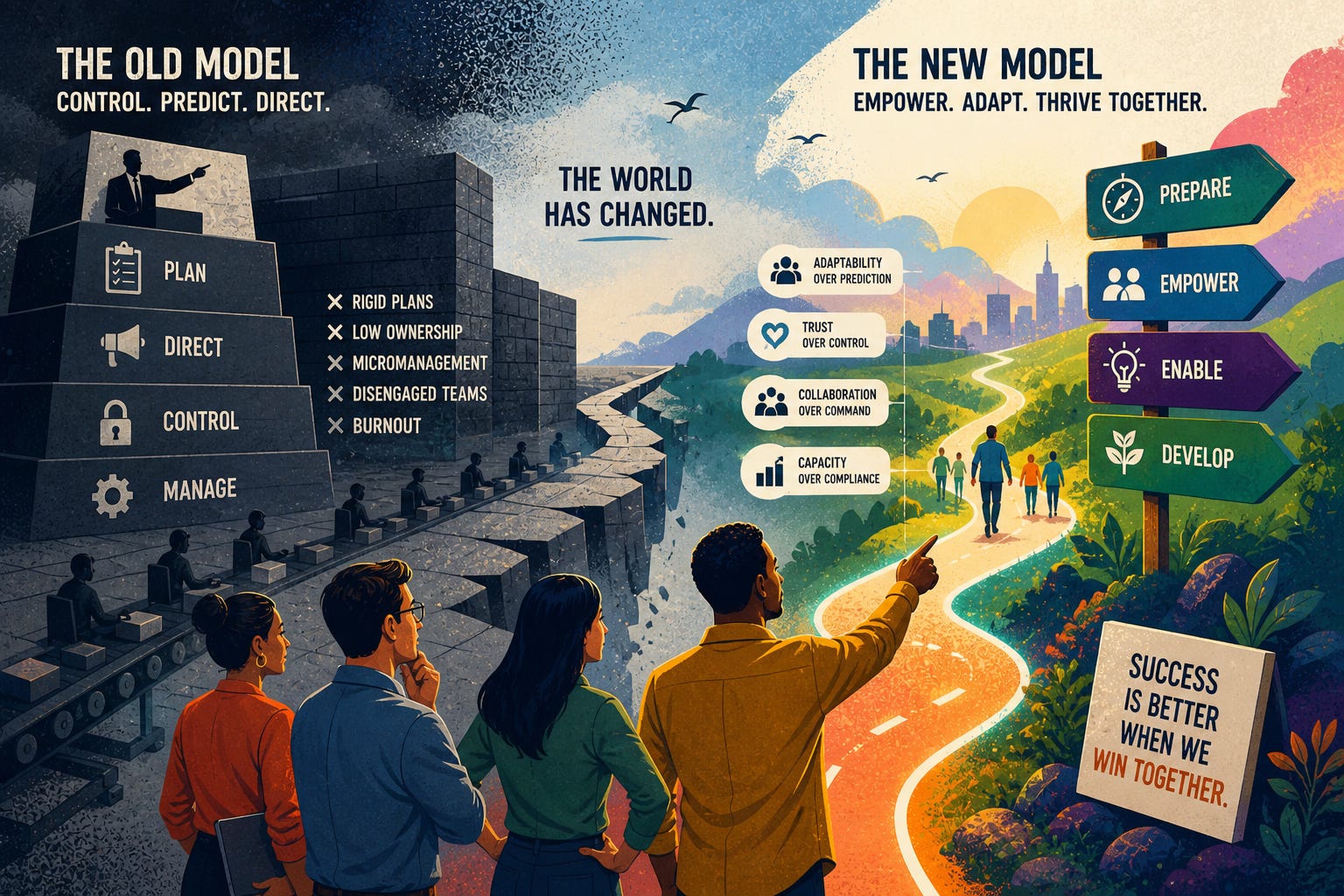
Most of us are still leading with a playbook we never consciously chose. We inherited it. We absorbed it from the leaders we worked under, the organizations we grew up in, and the cultural stories we were told about what good leadership looks like.
And here’s the thing: for a long time, that playbook worked. It came from a time when work was predictable, change was slow, control created efficiency, and compliance was enough. Leaders who mastered that model built empires. They scaled organizations. They delivered results.
The problem isn’t that the old model was wrong. The problem is that it’s outdated. The world it was designed for doesn’t exist anymore. And leaders who keep running the same plays in a completely different game are finding that what used to create momentum now creates friction. What used to build alignment now creates resistance. What used to feel like leadership now feels like fighting gravity.
The Leadership Model We Inherited
Traditional leadership was built on four pillars: planning, directing, controlling, and managing.
Leaders were expected to have answers, reduce variability, enforce standards, and maintain order. The job was to design the system, tell people what to do, monitor execution closely, and course-correct when things drifted off track. It was top-down, hierarchical, and deeply rooted in the belief that the leader’s primary value was certainty in an uncertain world.
In stable environments, that approach scaled beautifully. If you could predict what was coming, you could plan for it. If you could break work into repeatable tasks, you could optimize for efficiency. If you could control the variables, you could minimize risk. And if you managed the process tightly enough, you could deliver consistent results.
But here’s the catch: stability is no longer the operating condition. The world that model was built for has fundamentally changed, and most leaders are still trying to apply industrial-age logic to information-age problems.
Why the Old Model Is Breaking Down
Today’s work is complex, not linear. It’s fast-moving, not predictable. It’s human-centered, not mechanical. And in this environment, the old model doesn’t just become less effective. It actively works against you.
Rigid plans fall apart quickly. You can spend weeks building the perfect roadmap, and by the time you’re ready to execute, half your assumptions are already outdated. The pace of change has accelerated to the point where planning feels like trying to build a bridge while the river keeps shifting course.
Directives without context kill ownership. When you just tell people what to do without explaining why it matters or how it fits into the bigger picture, they comply but they don’t commit. They execute, but they don’t engage. And the moment something unexpected happens, they freeze, because they were never given the context to make good decisions on their own.
Control suppresses innovation. When leaders micromanage every decision and monitor every move, they send a clear message: I don’t trust you to figure this out. And when people don’t feel trusted, they stop taking initiative. They stop experimenting. They stop bringing ideas. They just do what they’re told and wait for the next instruction.
Managing tasks without developing people creates fragility. You might hit short-term goals by staying focused on execution, but if you’re not building the capability of your team along the way, you end up with a system that only works when you’re in the middle of it. And the moment you step away or the complexity increases, everything falls apart.
The old model optimizes for efficiency. The new reality demands adaptability. And you can’t adapt your way out of rigidity by just working harder within the same framework.
As physicist Albert Einstein reportedly said, “We cannot solve our problems with the same thinking we used when we created them.”
Leadership is no different. The model that got us here won’t take us forward, no matter how hard we try to make it fit.
The Cost of Holding On Too Long
Leaders who cling to the old model, whether out of habit, fear, or a belief that control is the only path to results, often experience a predictable set of consequences.
They end up in constant firefighting mode, reacting to one crisis after another instead of building systems that prevent crises in the first place. They suffer from decision fatigue because they’re making every call themselves instead of empowering their teams to make decisions at the right level. Their teams become disengaged because people don’t feel ownership over the work, they just feel managed. And eventually, burnout sets in, both for the leader and for the organization, because the system is running on unsustainable effort instead of sustainable structure.
The irony is painful: the more complex things become, the less control actually works. But instead of loosening the grip, many leaders tighten it, convinced that if they just push harder or monitor more closely, they can force the old model to deliver. And all that does is accelerate the breakdown.
I watched this play out with a director I knew, someone named Chris who led a product team at a fast-growing defense-tech company. Chris was brilliant, experienced, and deeply committed to getting things right. He’d built his career on being the person who could plan meticulously, execute flawlessly, and deliver on time no matter what.
But as the company scaled and the market shifted, that approach stopped working. Projects that used to take three months to plan were outdated by the time they launched. The team, which used to execute with precision, started missing deadlines and making mistakes. Morale dropped. Turnover spiked.
Chris’ response? Work harder. Plan more. Tighten oversight. He started attending every meeting, reviewing every decision, and staying late to make sure nothing slipped through the cracks. He genuinely believed that if he just controlled the variables more tightly, the system would stabilize.
Instead, it collapsed. His best people started leaving. The team that remained stopped bringing him problems because they knew he’d either solve it himself or micromanage them through it. And Chris, despite working long-hour weeks, couldn’t understand why everything felt like it was falling apart.
The model he was running worked beautifully in 2015. But in 2025, it was like trying to steer a speedboat with the controls from a cargo ship. The environment had changed. The model hadn’t.
A Leadership Tension Many Feel (But Rarely Name)
Here’s the tension that sits underneath all of this, the thing most leaders feel but rarely say out loud: “I’m responsible for outcomes, but I can’t possibly control everything.”
That tension creates deep anxiety. Because if you’re accountable for results but you can’t control all the variables, what’s left? How do you lead?
Some leaders respond by tightening their grip. They double down on control, convinced that if they just manage harder, they can force certainty into an uncertain system. Others withdraw. They throw their hands up, abdicate responsibility, and hope their teams figure it out on their own.
Neither approach builds capacity. One crushes autonomy. The other abandons accountability. And both leave teams stuck in the gap between a leader who won’t let go and a leader who’s already gone.
As writer James Baldwin once said, “Not everything that is faced can be changed, but nothing can be changed until it is faced.”
The first step in shifting leadership models is facing the fact that the old one, no matter how well it served you in the past, isn’t serving you now.
Why Leadership Must Shift at the Model Level
This isn’t about tweaking a few skills or adding a workshop on delegation. It’s about changing the underlying assumptions of what leadership is for and how it creates value.
The shift looks like this:
From predicting to preparing. You can’t predict the future anymore, not with any real accuracy. But you can prepare your team to respond effectively when conditions change. That means building adaptability, not building perfect plans.
From controlling to enabling. Your job isn’t to make every decision or monitor every action. It’s to create the conditions where good decisions can happen at every level. That means building clarity, trust, and capability, not building tighter oversight.
From managing work to developing people. If all you do is manage tasks, you might hit short-term goals. But you’ll never build the long-term capacity that allows your team to handle complexity without you in the middle of every decision. Leadership isn’t about managing work. It’s about developing the people who do the work.
The goal is no longer to eliminate uncertainty. It’s to lead through it. And that requires a fundamentally different set of muscles than the ones most of us have been building our entire careers.
What This Means for Modern Leaders
Leadership now requires trust over control. You have to believe that your team, given the right context and support, can make good decisions without you hovering. That’s hard for leaders who built their careers on being the smartest person in the room or the one who could see problems before anyone else. But control doesn’t scale. Trust does.
It requires context over commands. Instead of just telling people what to do, you have to help them understand why it matters, how it fits into the bigger picture, and what success looks like. That takes more time upfront. But it creates ownership, not just compliance.
It requires learning over certainty. Leaders used to be valued for having answers. Now, they’re valued for asking better questions, creating space for experimentation, and helping teams learn faster than the market is changing. You don’t have to know everything. You just have to be willing to figure it out together.
The leader’s role shifts from “I make things happen” to “I create the conditions for things to happen.” That’s not a retreat from responsibility. It’s a different kind of responsibility, one that’s harder to see in the moment but far more powerful in the long run.
As leadership expert Peter Drucker once said, “Management is doing things right; leadership is doing the right things.”
The old model taught us to manage well. The new model requires us to lead differently.
Reflection Questions
To ground this in your own experience, consider:
Which parts of the old leadership model do you still rely on most? Are you still planning like the future is predictable? Still controlling like certainty is possible? Still managing tasks instead of developing people?
Where does control feel necessary, and where might it be limiting? There are moments when control is the right tool. But where are you holding on out of habit or fear instead of necessity?
How comfortable are you leading without full certainty? Can you make decisions with incomplete information? Can you shift direction when new data shows up? Or does ambiguity paralyze you?
What assumptions about leadership deserve to be challenged? What beliefs about your role, your responsibility, or what “good leadership” looks like might be outdated?
What would change if your role shifted from controlling outcomes to enabling capacity? How would you spend your time differently? What would you let go of? What would you invest in instead?
The old leadership model got us here. It built industries. It scaled organizations. It created the foundation we’re all standing on. But it won’t take us forward. The world has changed too much. The pace is too fast. The complexity is too high. And the people we’re leading expect something different.
The question isn’t whether the model will shift. It already is. The question is whether you’ll shift with it, or whether you’ll keep running plays from a playbook that no longer matches the game you’re in.
The leaders who thrive in what comes next won’t be the ones who had all the answers. They’ll be the ones who built the capacity for their teams to find answers together. They’ll be the ones who let go of control and created trust. They’ll be the ones who stopped managing tasks and started developing people.
That’s the shift. And it starts with naming the model you’re actually running, not the one you think you’re running, and deciding whether it’s still the right one for where you’re trying to go.
What about you? Where do you see the old model still showing up in your leadership? And what would it look like to start building the new one? I’d love to hear your thoughts in the comments.
One last note: Charter Member pricing closes tonight. Everything inside: KLIR Diagnostic, AI Ready Set Coach, the course suite, and LeadView at Level 360 for annual subscribers. Locked rate, for life, for the people who join before midnight. → [Become a Charter Member]
Loved the line "fighting against gravity rather than creating momentum."
I've seen that exact posture in founders who built in a supportive market, then tried to scale it with the same techniques. The systems that got you to $1M won't scale to $10M, and it's easy to fall into the pattern of "just try harder"
The tension you named in the middle is the one that drives the tightening — responsible for outcomes but unable to control all the variables. Most leaders respond by gripping harder rather than building differently. The grip feels like leadership. It isn't.