


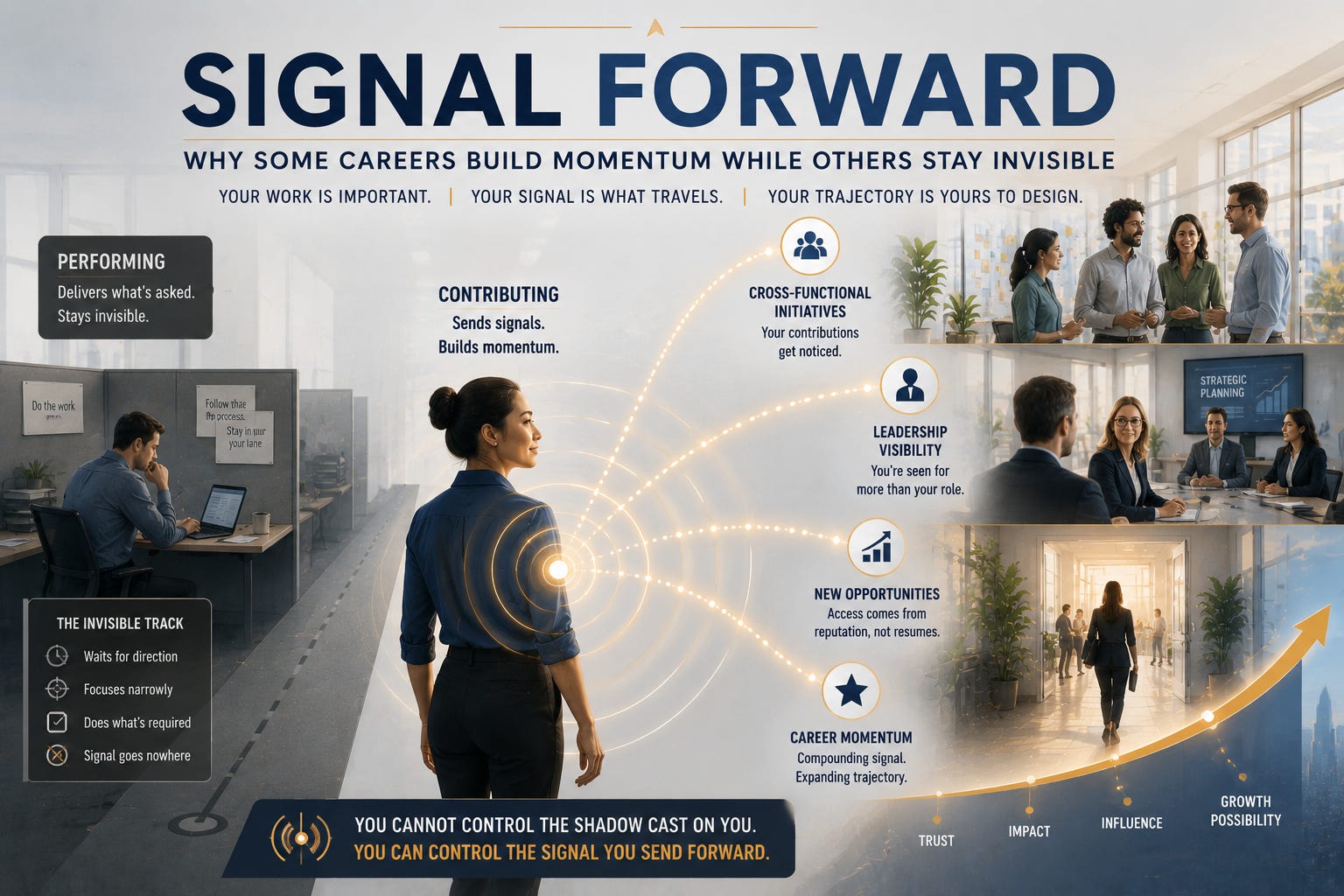
Introducing Signal Forward
A quick note before we start.
Most of what gets published here, and most of what gets published anywhere, is written for leaders. People with teams, titles, and positional authority. The Ready Set is built around that. The ten behaviors, the framework, the research, it’s aimed at the people responsible for leading others.
But a lot of you aren’t there yet. And some of you never want to be. You’re individual contributors. Specialists. Early-career professionals figuring out why solid work isn’t creating the momentum you expected. Mid-career practitioners who are excellent at what they do and quietly frustrated that it doesn’t seem to be enough. Experienced people who’ve watched less capable colleagues get pulled into opportunities they should have had.
This series, which will be ongoing, is for you.
Signal Forward runs alongside The Ready Set content. Same publication, different altitude. Where The Ready Set focuses on the behaviors that make leaders effective, Signal Forward focuses on the behavioral patterns that determine whether your contribution gets seen, valued, and rewarded, regardless of whether you manage anyone.
After this initial Signal Forward launch series, we’ll publish to this series on a rotating basis. You don’t need to read them in order, but if you do, they build on each other.
Now. Let’s get into it.
Two Careers, Same Organization
This is a story about two people. Same company. Same function. Same level. Comparable skills, similar tenure, overlapping responsibilities. Neither manages anyone. Both are described as strong performers.
In eighteen months, their careers will be in fundamentally different positions.
Maya will have been pulled into a cross-functional initiative she never applied for. Given exposure to senior leadership. Mentioned in a succession conversation she knows nothing about.
Jared will have received another solid performance review, a standard merit increase, and the quiet, corrosive sense that his contribution is invisible.
Nothing dramatic will separate them. No single defining moment. No lucky break. No political maneuver.
What will separate them is something far more consequential and far less discussed: the signal each of them has been sending, every day, in every interaction, without knowing it.
What Maya Does That Jared Doesn’t
Maya arrives at a routine status meeting. She’s prepared, not because the meeting requires it, but because that’s how she operates. When a peer raises a concern about a process handoff, Maya doesn’t wait for someone to assign ownership. She says she’s seen the pattern too and offers two options she’s already thought through. The meeting moves forward.
She doesn’t know that the director observing the meeting made a mental note. Not about the solution, about the behavior.
Maya operates with initiative in low-stakes environments. That predicts how she’ll operate in high-stakes ones.
The director doesn’t articulate this consciously. But the note is made and the signal has been received.
Jared arrives at the same meeting. He’s competent, prepared enough, contributes when called on directly. When the process concern is raised, he waits to see who will take it. Nobody assigns it to him, so it’s not his problem. He offers a thoughtful comment when the group discusses next steps.
His contribution is fine and, well, forgettable.
Jared isn’t a poor performer. He’s just an invisible one. Not because his work lacks quality, but because his signal lacks intentionality. He shows up to perform. Maya shows up to contribute. That difference, performed consistently across hundreds of small interactions, is the difference between a career that builds momentum and one that maintains position.
The Evaluation That Never Stops
Here’s what most individual contributors never learn: you are being evaluated constantly, and almost never through formal systems.
The performance review captures a fraction of what the organization knows about you. The real evaluation happens in the observations people make every day: how you respond when a deadline moves, how you handle ambiguity, whether you take initiative or wait for instruction, how you treat people who can’t help your career, what you do with feedback, how you behave in meetings where no one senior is watching.
These observations accumulate into a reputation. That reputation travels. It enters conversations you’re not part of. It shapes decisions about opportunities you don’t know exist. It answers questions about you that no one ever asks you directly:
Can this person handle more? Will they step up under pressure? Do they see beyond their own role? Would I want them on my team?
Your signal is the answer to those questions. And you’re providing the answer right now, whether you’ve designed it or not.
The Chain That Runs Your Career
Predictive Performance operates through a chain: Traits drive Behavior. Behavior creates your Signal. Signal shapes what Activity follows. Activity determines your Trajectory.
At the individual contributor level, that chain is your career’s operating system. And the critical piece most people miss: you may not control how leadership intent reaches you. But you absolutely control the signal you send outward.
You cannot control the shadow cast on you. You can absolutely control the signal you cast forward.
Why This Works Even With Poor Leadership
The most common objection to owning your own trajectory is also the most understandable: What if my leader is the problem? What if I’m doing excellent work and no one above me sees it, values it, or creates conditions where it can thrive?
This is a real condition. Poor leadership suppresses initiative, distorts feedback, and makes good work invisible. Plenty of people reading this are working in exactly that environment right now.
But here’s what the leadership industry never tells you: even in the most dysfunctional environment, signal travels. Your peers observe you. Adjacent leaders observe you. People who leave your organization carry your reputation with them. The person two levels above your leader, who you’ve never met, is forming an impression of you based on the behavioral evidence that reaches them through the system.
Bad leadership can slow the recognition of your signal. It cannot prevent your signal from forming.
The Maya-and-Jared divergence happens under good leadership and bad leadership alike. The difference isn’t whether the signal is received. It’s whether you designed one worth receiving.
What This Series Covers
Over the next several months, Signal Forward will go deep on the specific behaviors, disciplines, and frameworks that govern individual contributor performance and trajectory. Not productivity hacks. Not how to manage your boss. Not how to survive a bad team. The behavioral architecture of a career that builds momentum on its own terms.
We’ll cover how to read the system you operate in. How to govern your response under pressure instead of reacting to it. How to expand your contribution beyond your defined scope. How to own your own development without waiting for your organization to do it for you. How to build a signal that compounds over time into a reputation that opens doors you didn’t know existed.
And we’ll go deep on the ten specific traits that predict whether an individual contributor thrives, stalls, or derails, regardless of industry, function, or the quality of leadership above them.
The shelf of books written specifically for you has always been nearly empty.
This series exists to change that.
A question to start: Think about the last week of work. Were you showing up to perform, or to contribute? There’s a difference, and the people around you already know which one you’re doing. I’d love to hear your honest answer in the comments.

Subscribe to The Ready Set
By Ryan Carnes | A data-backed development experience
Providing executive caliber leadership and talent content and resources to everyone. Subscribe free and get new behavioral-based leader and talent insights every week.
Plus two Ready Set resources to put to work immediately.
The Maya/Jared distinction is the whole thing in miniature. She arrives with solutions pre-considered. He contributes when asked. Same skill level, completely different trajectory. The signal difference isn't volume.. its intent.