


This is the first article in a six-part series on Succession Readiness. Over the next six weeks we’ll cover why the current model fails, what genuine readiness looks like, and what both organizations and individuals need to do differently. New here? Subscribe to The Ready Set so you don’t miss what’s coming.
Every fall, in organizations across every industry, the same ritual plays out.
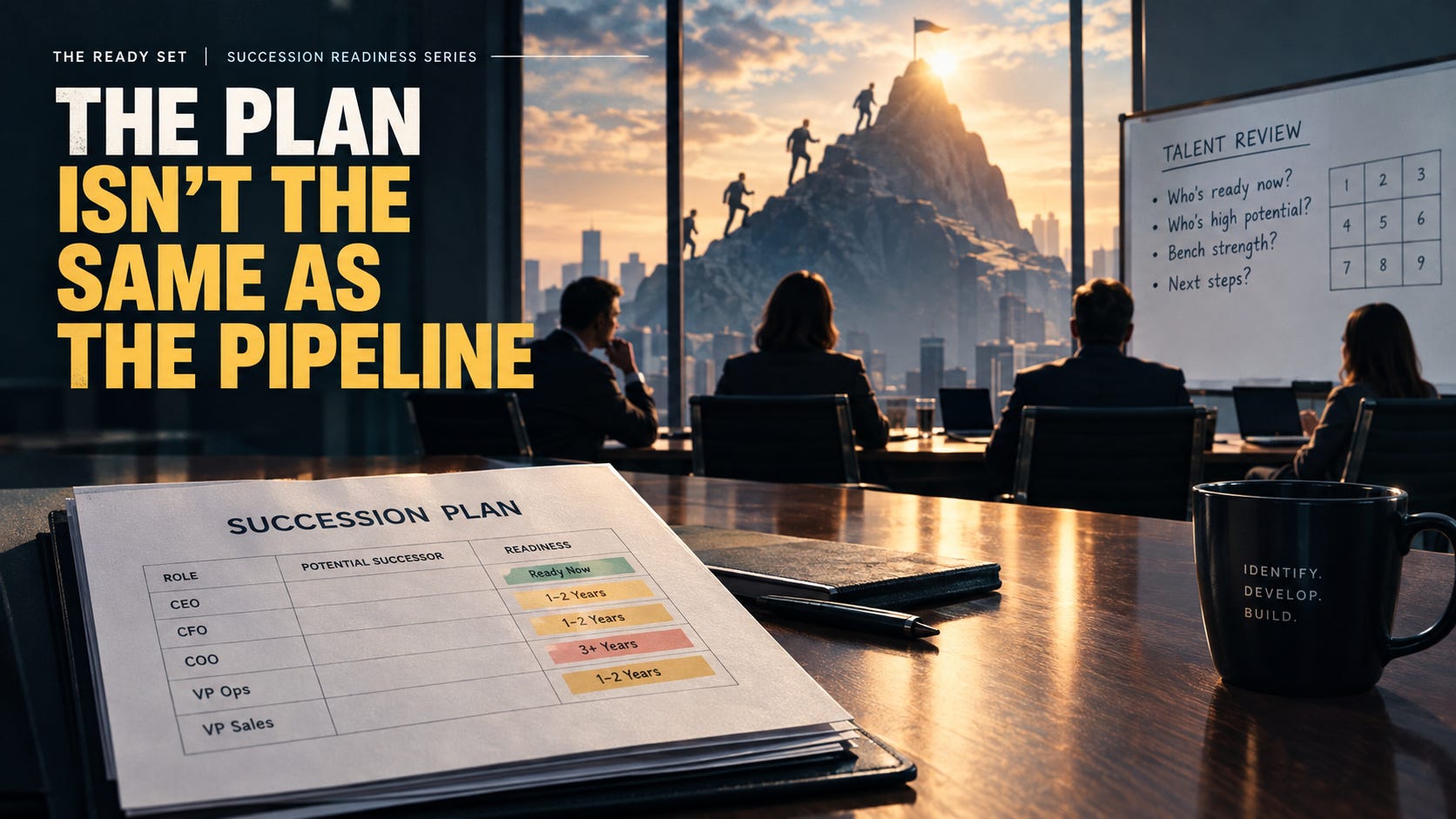
HR schedules the talent review. Leaders gather, in person or on a call, with a spreadsheet or a slide deck populated with names, ratings, and boxes. Nine-box grids get filled in. Readiness ratings get assigned. “Ready now.” “Ready in one to two years.” “High potential.” Someone asks about bench depth for the VP of Operations role and three names get offered with varying degrees of confidence. Notes get taken. The deck gets filed.
And then everyone goes back to work.
Eleven months later, the VP of Operations announces she’s leaving. The organization turns to the succession plan. The first name on the list has taken a role at a competitor. The second has been quietly managed out over the past six months for performance issues nobody addressed during the talent review. The third is technically still there but has received no development investment, no stretch assignments, no preparation for a role that’s now vacant and needs to be filled in ninety days.
The organization scrambles. An executive search gets launched. Institutional knowledge walks out the door and a team that needed stable leadership gets a six-month gap and an interim arrangement nobody is happy with.
The succession plan existed. It was documented, reviewed, and filed. It just didn’t produce what the organization actually needed, readiness. And those two things, it turns out, are not the same.
What Succession Planning Actually Is
Succession planning, as most organizations practice it, is an identification exercise. It answers one question: who might be ready to step into a critical role if it became vacant?
That’s a useful question. It’s just not the right question. Or rather, it’s not sufficient on its own.
Identifying a potential successor tells you who the organization thinks could do the job. It tells you nothing about whether that person has been developed to do it, whether they want it, whether the behavioral gaps between their current level and the next one have been addressed, or whether they’ll still be available and willing when the moment comes.
The plan creates a picture of current potential. It does almost nothing to convert that potential into actual readiness.
I’ve sat in enough talent review sessions across enough different industries to say this with some confidence: the most common output of a succession planning process is a list of names that makes leadership feel better about the organization’s future without doing much to actually secure it. The comfort is real. The readiness behind it is often not.
Why the Model Produces Documentation Instead of Development
Three structural problems keep succession planning stuck at the identification level.
The first is cadence. Annual reviews produce annual snapshots. But readiness doesn’t develop annually. It develops through continuous investment: stretch assignments, deliberate feedback, exposure to complexity at the next level, coaching through the behavioral gaps that separate current performance from next-level performance. An annual conversation about who might be ready produces a list. It doesn’t produce the development that makes the list accurate.
The second is ownership. In most organizations, succession planning is owned by HR, with a little but of executive input sprinkled in. But usually HR schedules it, facilitates it, documents it, and follows up on it. Which means the people most directly responsible for developing successors, the leaders who work alongside them every day, who assign their work, who have the most direct influence on their growth, experience succession planning as something that happens to them once a year rather than something they own continuously.
When succession is an HR program, development is episodic. When succession is a leadership responsibility, development is constant. Most organizations have the first. Almost none have built the second.
The third is the gap between identification and investment. Putting someone’s name on a succession plan doesn’t trigger development. In most organizations, it triggers almost nothing. The name goes in the box. The review ends. The person whose name is in the box may or may not know they’re on the plan. They almost certainly haven’t received a clear picture of what readiness at the next level actually requires from them behaviorally. And the organization hasn’t made any structured commitment to close the gap between where they are and where they’d need to be.
The plan exists. The investment doesn’t follow.
The Real Cost
Organizations tend to measure the cost of succession failure at the moment of crisis. The executive search, the interim arrangement, and the likely productivity loss during the transition. Those costs are real and significant. Estimates for replacing a senior leader consistently run between one and a half and three times annual salary when you factor in search fees, onboarding, and the productivity curve.
But the more corrosive cost is the one that accumulates before the crisis. It’s the high-potential talent that leaves because they never saw a clear path forward. It’s the institutional knowledge that walks out the door with them. It’s the missed opportunities that come from having leaders in roles they weren’t adequately prepared for, making decisions at a level of complexity they weren’t developed to handle. It’s the organizational confidence that erodes when teams experience repeated leadership transitions that could have been managed more smoothly.
Succession failure is rarely a surprise event. It’s the visible end of a long period of invisible underinvestment. The organization didn’t fail to plan, it failed to build. And the difference between those two things is where most succession strategies quietly break down.
What This Series Is About
Succession readiness is not a better version of succession planning. It’s a different orientation entirely.
Planning asks: who could step up if we needed them to?
Readiness asks: who have we actually developed to lead at the next level, and how do we know?
The first question produces a list. The second produces a pipeline. And a pipeline requires daily investment, behavioral specificity, honest assessment, and leadership ownership at every level of the organization.
Over the next five articles we’ll go into what that actually looks like. For the leaders responsible for building the pipeline: what genuine readiness requires, why it has to be owned by the leaders who are closest to the talent, and what organizations that get this right are doing differently. For the individuals who want to understand how succession works from the inside: how to know whether you’re being developed or just labeled, what behaviors actually predict readiness at the next level, and how to position yourself for what’s next before anyone formally offers it.
The succession plan sitting in a folder somewhere isn’t the problem. The assumption that the plan is doing something is.
That’s what this series is about.
A question worth bringing to your next leadership conversation: When was the last time your organization’s succession plan produced a leader who was genuinely ready when the moment came? And if you’re struggling to think of an example, what does that tell you about what the plan is actually producing?

Subscribe to The Ready Set
By Ryan Carnes | A data-backed development experience
Providing executive caliber leadership and talent content and resources to everyone. Subscribe free and get new behavioral-based leader and talent insights every week.
Plus two Ready Set resources to put to work immediately.
Excellent article, and spot on for most organizations. Applies to both public and private sector. Looking forward to the series.