


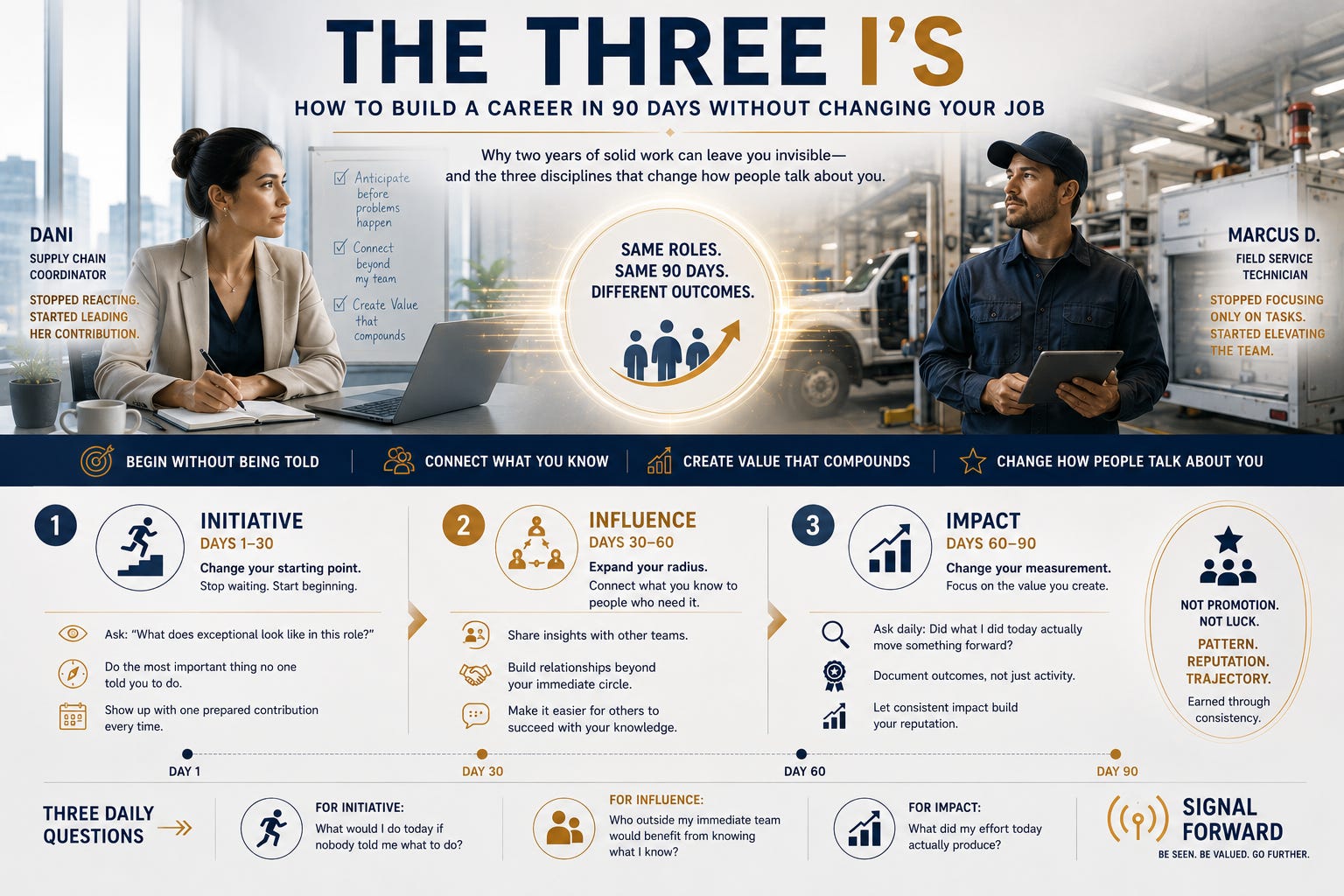
Signal Forward is a series inside The Ready Set, same publication, different altitude. The Ready Set is for leaders. Signal Forward is for everyone else: the individual contributors, specialists, and practitioners whose behavioral patterns determine whether their contribution gets seen, valued, and rewarded, regardless of title or tenure.
New here? Start with the first article. In People or HR? Pass this along to your team.
Dani had been a supply chain coordinator for two years. Solid performer. No complaints. Reliable enough that her manager stopped thinking about her, which is either a compliment or a quiet catastrophe depending on how you look at it.
Marcus D. was a field service technician at a utilities company. Three years of excellent service records. The kind of technician dispatchers were relieved to see on a job because they knew it would get done right. Also invisible. Also going nowhere.
Neither of them was failing. That was almost the problem. Failing would have at least produced feedback. What they were experiencing was quieter and harder to fix: the specific invisibility of someone who meets expectations so consistently that they stop generating any signal at all.
Both decided to run an experiment. Same ninety days. Same roles. No promotion, no title change, no organizational reshuffling. Just a deliberate shift in how they oriented their contribution.
By the end of it, Dani’s manager was calling her strategic. Marcus D.’s supervisor was assigning him the complex jobs, the ones that required coordinating multiple crews, and the rest of the crew had started coming to him for guidance before going to their supervisor. Neither outcome was announced. Neither was orchestrated. Both were earned through a pattern that compounded quietly over three months.
The pattern has three parts.
Part One: Initiative (Days 1–30)
The first question Dani asked her manager was not about her performance review, her development plan, or her career path. It was simpler and more disarming than any of those: What does exceptional look like in this role? Not good, what would have to be true for you to consider me indispensable?
Her manager paused. Then said something that reoriented two years of effort in a single sentence: If you could anticipate problems before they reached me instead of reporting them after they happened, that would change everything.
Dani had been measuring herself by how well she responded to problems. Her manager had been measuring by whether she prevented them. Two years, same job, completely different scorecards, and nobody had ever said so out loud.
Marcus D. asked his crew supervisor a version of the same question before a Monday shift: If I wanted to be considered for the senior tech role, what would you need to see from me that you’re not seeing now?
His supervisor paused too. Then said: Honestly? I need you to stop being the guy who fixes the problem and start being the guy who makes sure the next crew doesn’t run into it. You’re the best technician I’ve got. But the senior role is about making the whole team better, not just being the best individual.
Both of them got the same message, translated for their world: the next level is not a bigger version of your current job. It’s a different kind of contribution entirely.
So both of them made the same three changes. They stopped letting the task list define their day and started asking what the most important thing was that nobody had told them to do. They defined personal goals that reached beyond their job descriptions. And they started arriving at every meeting or shift huddle with one prepared contribution nobody had requested.
Dani’s initiative showed up as providing updates before they were asked for, surfacing a supplier risk on Tuesday instead of waiting for someone to notice it on Friday. Marcus D.’s showed up as a one-page troubleshooting guide he posted in the break room for the next shift, documenting the three recurring issues that sent crews on unnecessary calls.
Different environments. Same reflex: begin without being told.
Initiative is not about working harder. Most people who are invisible are already working hard. It’s about changing your starting point, from what has been assigned to me to what actually needs to happen. That shift, practiced consistently, is the first thing people notice. Not because it’s dramatic, but because it’s rare.
Part Two: Influence (Days 30–60)
By the end of the first month, both of them had changed their starting point. The second month was about expanding their radius.
Dani noticed that her logistics partner was routinely blindsided by priority changes, the kind she could see coming from her position in the supply chain. She started sending a five-minute weekly update. Entirely outside her job description. It made the system work better, so she did it.
Then she did something less obvious: she reached out to a peer in finance and asked how her supply chain metrics translated into the VP’s monthly cost report. For the first time in two years, she understood what her numbers actually meant to the people above her. Not in a political sense, in a practical one. She could now see the downstream effect of her work in a language the organization measured itself by.
Marcus D. noticed that the customer service team was routinely dispatching technicians for problems that a better diagnostic question could have resolved over the phone. He asked his supervisor if he could spend thirty minutes with the dispatch team walking them through the three most common false alarms. His supervisor said yes without hesitating.
That thirty-minute session reduced unnecessary dispatches by fifteen percent in the first month. Marcus D. hadn’t done anything outside his technical expertise. He’d simply shared what he knew with people who needed it. The dispatch supervisor mentioned him by name in the monthly operations meeting. The operations manager made a mental note: this technician thinks beyond his truck.
Influence, at the individual contributor level, isn’t about persuasion or politics or learning how to work a room. It’s simpler than that. It’s expanding your contribution beyond the boundaries of your defined scope by connecting what you know to people who need it. Most people know things that would genuinely help someone else on a different team, in a different function, further up or down the chain. They just don’t share it, because sharing it wasn’t explicitly part of the job.
The people who share it anyway, without being asked, without expectation, without making a production of it, are the ones who start generating signal in rooms they’ve never been in.
Part Three: Impact (Days 60–90)
The third month was about measurement. Not the organization’s measurement — their own.
Dani started a daily three-minute practice: did what I spent time on today actually move something forward, or did it just fill the day? The question was uncomfortable at first. She found that roughly forty percent of her activity was reactive busywork, necessary, maybe, but not the kind of work her manager had described as the difference between good and indispensable. She started reclaiming that time. Not dramatically. Just incrementally, day by day, redirecting effort toward the anticipatory work that actually created value.
By day ninety, something had compounded. Her manager called her strategic. Her logistics partner told a VP that coordination quality had improved. Her finance peer mentioned her name for a cost initiative. None of it was orchestrated. All of it was earned through consistency, through the accumulated weight of a hundred small contributions that pointed in the same direction.
Marcus D. started tracking a single question for every job he completed: did I leave the next technician in a better position than I found it? That meant cleaner documentation. Clearer notes in the work order system. Occasionally a quick text to the next shift — Unit 4 on Elm Street, the access panel is behind the water heater, not where the diagram shows. Save you twenty minutes. Small things. Consistently done.
By day ninety, his supervisor had started assigning him the complex jobs, the ones requiring coordination across multiple crews. The team had started coming to him before going to the supervisor. Nobody had announced this shift. The behavioral evidence had produced it on its own.
Why This Works
Initiative changes your starting point, you stop waiting and start beginning. Influence expands your radius, you connect what you know to people who need it. Impact changes your measurement, you stop counting tasks and start evaluating value created.
Three questions, asked daily, drive all of it:
For Initiative: What would I do today if nobody told me what to do?
For Influence: Who outside my immediate team would benefit from knowing what I know?
For Impact: What did my effort today actually produce?
Those three questions change your contribution patterns within thirty days. They change how people talk about you within sixty. They open trajectory conversations within ninety.
Here’s what’s important to understand about why it works: none of it requires permission. None of it depends on the quality of leadership above you. None of it requires a program, a platform, or a sponsor. Dani proved it from a desk in a supply chain office. Marcus D. proved it from a truck on a service route. The principle doesn’t care where you work.
What it does require is consistency. Not intensity, consistency. The difference between a signal and noise is repetition. A single instance of initiative is interesting. Thirty days of it is a pattern. Ninety days is a reputation.
And reputation, once formed from behavioral evidence, is extraordinarily difficult to undo, in either direction. The question is which direction you’re building in.
Here’s the question worth sitting with this week: Of the three (Initiative, Influence, Impact) which one are you strongest in? And which one, if you’re honest, are you almost entirely skipping?
Most people are strong in one, decent in another, and quietly avoiding the third. The one you’re avoiding is almost always the one that would move things fastest. I’d love to hear which one it is in the comments.
One more thing before you go.
Everything in this series (the signal, the three I’s, the disciplines, the traits) is being built into something larger.
Later this year, we’re releasing a significant update to The Ready Set experience. What’s coming is an extension of the AI Ready Set Coach that will meet you exactly where you are, whether you’re two years into your first real role or two levels from the executive suite, and grow with you as you move.
For individual contributors, that means the full Signal Forward framework: the behaviors, the disciplines, the trait development, and guided content built specifically for people who are doing excellent work and trying to make sure it doesn’t stay invisible.
For emerging leaders and managers, it bridges the gap, the moment when your contribution shifts from personal performance to collective performance, and the skills that got you here stop being sufficient for where you’re going.
For experienced leaders, it’s the full Ready Set framework: the ten behaviors, the diagnostic, the coaching, and the development architecture that drives what leadership actually looks like at scale.
One experience. Every level. Built to progress with you.
We’ll have more details as we get closer. If you’re already a paid member, you’ll be among the first to know, and the first to access it.
More Signal Forward coming soon. Stay with us.

Subscribe to The Ready Set
By Ryan Carnes | A data-backed development experience
Providing executive caliber leadership and talent content and resources to everyone. Subscribe free and get new behavioral-based leader and talent insights every week.
Plus two Ready Set resources to put to work immediately.