



Each week, I come across dozens of articles and think pieces. Most are fine. Some don’t just quite land with me. But a handful? Those stop me in my tracks. They make me think differently, challenge an assumption I didn’t know I had, or give me language for something I’ve been feeling but couldn’t quite name.
This isn’t a comprehensive roundup of “the most important news” or some curated list. It’s just honest. These are the pieces that hit me this week, the ones I bookmarked, commented on or liked, and shared with colleagues. Most are about leadership, teams, and how we show up at work. A few aren’t. But they all mattered.
If even one of these lands for you the way it did for me, that’s a win.
In no particular order, here’s what caught my attention this week:
1. It’s Not the Plan, It’s the Planning
By: Will Thomas
What it’s about: The article draws on a military planning principle to make a straightforward but underappreciated point: the plan itself is almost beside the point, and what actually builds organizational resilience is the thinking that happens while creating it. A good planning process forces leaders to ask hard questions about their context, their resources, their obstacles, and whether the destination they’re aiming for is actually the right one — and that contextual understanding is what allows fast, grounded responses when the plan inevitably meets reality and breaks. The closing reminder matters too: all the questioning and exploring is worthless without the discipline to move from “what if” to actual action.
A Ready Set note: This is Critical Path Thinking and Mission Minded operating together, the planning process is where you identify what actually drives the outcome, and the purpose underneath the plan is what keeps the team oriented when the specifics have to change. The plan gives you something to change from. The purpose gives you something to change toward. Leaders who skip the planning in favor of just having a plan end up with a document. Leaders who do the thinking end up with direction that survives disruption.

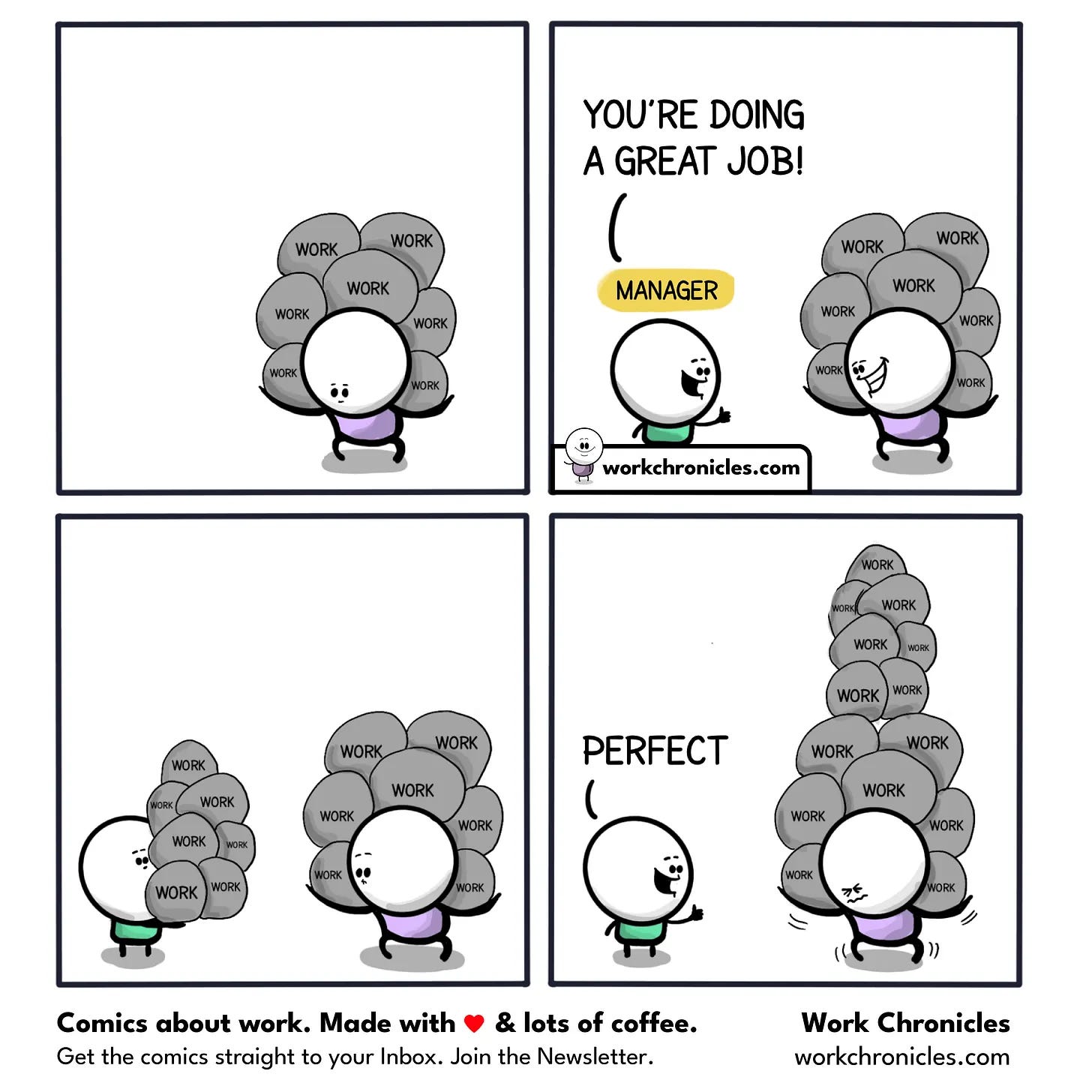
2. (comic) The Reward Trap
By: Work Chronicles
*Obviously not an article. Just funny, and true.

3. Setbacks Happen All the Time. Improvement Doesn’t.
What it’s about: Dr. Jody makes a distinction that most organizations consistently get wrong: setbacks are common, but learning from them is not, because experience alone doesn’t produce improvement. What matters is how deliberately you engage with the experience afterward.
The five-step framework moves from slowing the moment down before it gets compressed into a tidy explanation, to examining the thinking behind the decision rather than just the outcome, to translating insight into one specific behavioral shift, to creating an intentional next attempt before the reflection fades, to making the learning visible so it compounds across the team rather than staying locked inside one person. The closing point is the most honest one: resilience in practice isn’t about avoiding setbacks, it’s about developing the discipline to reflect, adapt, and move forward with better judgment than you had before.
A Ready Set note: This is Resilience as a behavioral discipline, not a personality trait, and the distinction between “I went through something hard” and “I actually learned from it” is exactly where most leader development stalls. The leaders who grow fastest after setbacks aren’t the ones who recover quickest. They’re the ones who slow down long enough to examine what their thinking was doing when things went sideways, make one concrete adjustment, and then go find the next opportunity to apply it before the insight disappears.

4. Who Are You as a Leader? Building Your Personal Leadership Philosophy
What it’s about: The article uses a personal journey from West Point to a manufacturing company turnaround to make the case that compliance-based leadership has a ceiling: people will meet the standard when someone is watching, but they won’t give their best effort simply because you want them to. The shift from compliance to commitment starts with the leader doing their own internal work first: writing a Personal Leadership Philosophy, defining values in behavioral terms rather than pleasant words, and setting a clear organizational direction that gets revisited regularly rather than sitting on a conference room wall. The practical disciplines throughout, the Backbrief to confirm understanding, the one-on-one as the most important meeting on the calendar, translating values into observable daily behaviors, are all grounded in the same principle: culture isn’t what you declare, it’s what you consistently model and reinforce.
A Ready Set note: The photograph of the employee sleeping on a pallet at 3am is the most honest moment in the piece. Someone handing the leader a mirror and saying “this is your culture.” That’s the signal most leaders miss until it’s expensive. Values-Based Integrity and Clarity Establishment aren’t abstract leadership concepts. They’re the daily disciplines that determine whether the culture you say you’re building and the culture your team is actually experiencing are the same thing. When they’re not, someone always knows before you do.

5. Thoughts of the Week: May 22, 2026
Are your dreams big enough?
By: Ultra Successful
What it’s about: The article is a short, direct challenge to examine whether your current goals actually reflect what you want or whether you’ve quietly scaled them down to fit what feels reasonable and safe. The practical push is simple: get the goal out of your head and make it tangible (write it down, map it out, treat it like a destination rather than a wish) because once it exists in front of you, the path becomes more visible and the impossibility starts to shrink. The closing warning is the one worth sitting with: too many people abandon what they really want and slowly adjust themselves to fit comfortable places, never finding out what they were actually capable of.
A Ready Set note: This is Challenge Driven at its most personal level and the drift described here is exactly what the behavioral data shows happening to leaders who stop stretching. Comfort isn’t neutral. It’s a slow narrowing of what you’re willing to attempt, and it compounds over time until the ceiling you settled for starts to feel like the only ceiling that ever existed. The leaders who keep developing don’t avoid hesitation. They just refuse to let it make the decision for them.

6. The Problem With Always Having the Answer
By: Josh Gratsch
What it’s about: The article uses a disarmingly honest observation, Josh stepping in to solve things for his kids not because they need it but because watching them struggle makes him uncomfortable, to name the real reason most leaders default to answering instead of coaching. The pattern inversion principle at the center of it is worth holding: the space a leader occupies is the space the team learns to vacate, which means every problem a leader solves for someone else is a piece of judgment that person never gets to develop. The practical framework moves from pausing before jumping in, to understanding what someone is actually asking for, to asking questions that force thinking rather than providing blueprints that remove it.
A Ready Set note: Inclusive Authority isn’t just about gathering input before making decisions, it’s about resisting the pull to make decisions that belong to someone else. The leaders who build the strongest teams over time aren’t the ones who had the best answers. They’re the ones who got comfortable enough with productive struggle, theirs and their team’s, to let the capability actually develop instead of managing their own discomfort by solving everything in front of them.

7. Do You Need a Leadership Operating System Refresh?
By: The Hidden Side of Leadership
What it’s about: The article argues that every leader is running a leadership operating system, a collection of assumptions, habits, decision patterns, and predispositions that developed through experience, and that system can become outdated without the leader ever noticing, especially when the situation changes faster than the approach adapts.
The Mary story illustrates the failure mode cleanly: a leader whose operating system was built for stability and process control suddenly needed collaboration and change facilitation, and the harder she pushed using her old approach, the worse the results got. The practical diagnostic is straightforward — look at your performance feedback, ask your team what should start, stop, or change, talk to the people who use your team’s work, and have a forward-looking conversation with your supervisor about what’s coming.
A Ready Set note: This is Adaptive Thinking applied to self-development and the leaders who stay effective over time aren’t the ones who found the right approach early, they’re the ones who kept asking whether their current approach still fits what the situation actually requires. The behavioral data is consistent: self-awareness and situational awareness are the two competencies that separate leaders who develop continuously from leaders who plateau. You can’t upgrade a system you don’t know you’re running.
8. Are you as clever as Evolution is?
On the leader you will never out-plan
What it’s about: The article uses Leslie Orgel’s observation that evolution is cleverer than any plan to challenge the way most leaders approach personal development, not by selecting between existing options and refining what already works, but by genuinely introducing variation, trying things that can’t yet be justified, and letting reality do the selecting. The gardener versus architect metaphor captures it well: the architect builds something brilliant and fixed that eventually gets torn down because the world changed around it, while the gardener plants many things, moves what struggles, prunes what dominates, and ends up with something better than what was originally planned.
The practical challenge is honest and uncomfortable: most leaders, if they’re being truthful, spent the last year refining and staying in character rather than running genuine variants on themselves.
A Ready Set note: Adaptive Thinking as a behavior isn’t just about adjusting methods when results stall, it’s about being willing to try something you can’t yet defend, in a role or stance that doesn’t quite fit yet, long enough to find out whether it should. The leaders who develop fastest over time aren’t the ones who found the right approach and refined it. They’re the ones who kept introducing enough variation into their own leadership that reality could keep selecting what actually works, which is almost never identical to what worked before.

Development is hard. Not because the concepts are complicated, but because most people don’t know where to actually focus. They read, they reflect, they nod at the right moments, and then they go back to leading the same way they always have. Not from laziness, but because without a clear picture of where they actually stand, effort tends to scatter rather than compound.
That’s the problem I’ve been working on. A data-backed, self-led, developmental experience.

Subscribe to The Ready Set
By Ryan Carnes | A data-backed development experience
Providing executive caliber leadership content and resources to everyone. Subscribe free and get new behavioral-based leader insights every week.
Plus two Ready Set resources to put to work immediately.
Thank you for sharing these, each one is a gem. 💎
Thanks for sharing these, Ryan. I find new people to learn from every week!