



Each week, I come across dozens of articles and think pieces. Most are fine. Some don’t just quite land with me. But a handful? Those stop me in my tracks. They make me think differently, challenge an assumption I didn’t know I had, or give me language for something I’ve been feeling but couldn’t quite name.
This isn’t a comprehensive roundup of “the most important news” or some curated list. It’s just honest. These are the pieces that hit me this week, the ones I bookmarked, commented on or liked, and shared with colleagues. Most are about leadership, teams, and how we show up at work. A few aren’t. But they all mattered.
If even one of these lands for you the way it did for me, that’s a win.
In no particular order, here’s what caught my attention this week:
1. Hard Conversations
By: From The Climb
What it’s about: The article is a practitioner's reflection on, you guessed it, hard conversations, specifically that leaning into conflict and handling it well are two different skills, and that most difficult conversations go wrong before they even start, through avoidance, delay, or walking in unprepared rather than anything said in the room.
The promotion conversation example cuts to the heart of it: the most useful thing a leader can do isn't deliver feedback or build the case for someone, it's ask them to honestly assess whether they've actually earned it, and put the ownership where it belongs. The closing insight applies across every hard conversation: getting yourself ready for it is the real work, and the conversation itself is usually the easier part.
A Ready Set Note: Hard conversations don't get easier by avoiding them, they get more expensive. Values-Based Integrity is what makes a leader willing to have the conversation. Cognitive Empathy is what makes them able to have it well. The preparation is where both behaviors show up first.

2. Why “Boring” Leaders Build the Best Teams
By: The Good Boss
What it’s about: The article argues that the most effective leaders aren’t the most magnetic, they’re the most consistent, and consistency is what actually compounds into trust, clarity, credibility, performance, and culture over time.
The five areas where steady leadership outperforms charisma all point to the same truth: teams don’t follow what you say once, they follow what you do repeatedly, and the leader whose behavior is predictable, whose priorities stay stable, and whose follow-through is reliable creates the psychological safety that lets people actually do their best work.
The closing point lands exactly right: culture isn’t defined by value statements, it’s defined by what leaders consistently allow, reward, and repeat.
A Ready Set Note: This is the behavioral data in action. The ten Ready Set behaviors aren't about being inspiring in the big moments, they're about being consistent in the small ones. Values-Based Integrity and Authenticity, Clarity Establishment, Resilience, none of them are one-time performances. They're daily disciplines that either compound into trust or quietly erode it. The leaders who build the strongest teams aren't the ones who show up brilliantly occasionally. They're the ones who show up the same way every time.

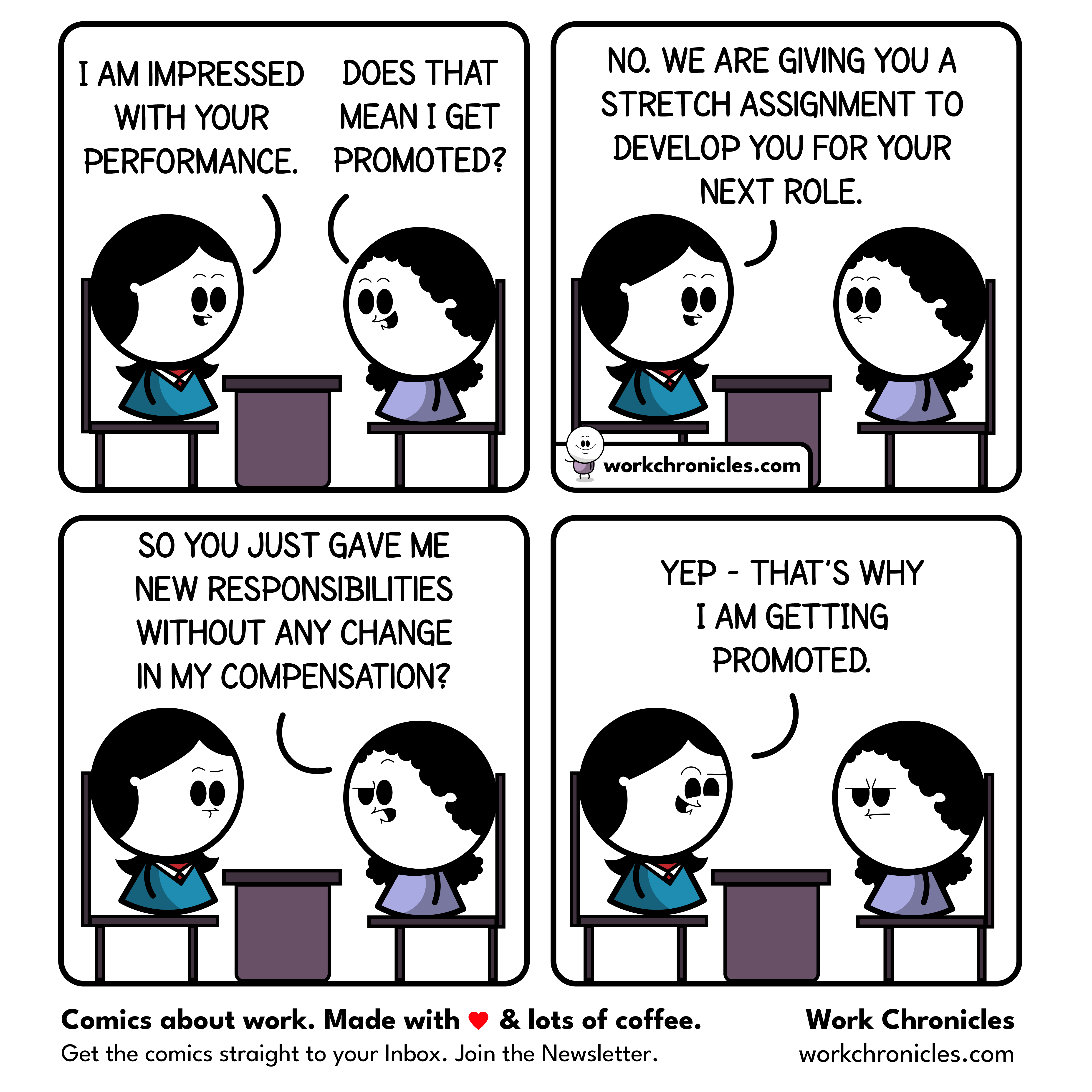
3. (comic) Promotions and Stretch Assignments
Not an actual article, just amusing.
By: Work Chronicles

4. Early Wins
Early Wins
What it’s about: The article makes a practical case for why early wins matter when starting a new role, not as a performance flex, but as a foundation for building confidence in yourself, earning trust from others, and developing the relationships you’ll need to succeed longer term.
The three criteria for what makes a good early win are worth remembering: small enough to be low-risk, collaborative enough to surface who you should be relying on, and relevant enough to demonstrate you actually understand the business and its priorities.
The closing advice is simple and right: work with your manager to set 90-day goals that meet those criteria, and if you’re the manager, set those expectations deliberately rather than leaving new arrivals to figure it out alone.
A Ready Set Note: This is exactly why developing leadership behaviors before you need them matters. The leaders who navigate new roles most effectively aren’t the ones figuring out Inclusive Authority and Clarity Establishment for the first time under pressure, they’re the ones who’ve already been building those muscles. The Ready Set exists precisely for that: so that when you cross the starting line, you’re not starting from zero.

5. Why High Performers Burn Out Faster as Managers - And How to Break the Cycle
By: Lauren Davidson
What it’s about: The article identifies a predictable pattern: high-performing individual contributors who transition into management burn out faster because the very habits that made them successful (personal execution, perfectionism, constant availability) become liabilities when success depends on creating conditions for others to excel.
The three compounding problems (quality control spiral, availability trap, and impact illusion) all stem from the same root: an identity still anchored in personal output rather than team capability. The four shifts offered: redefining excellence as team output, practicing “good enough” leadership, modeling sustainable performance, and delegating for development not just efficiency, are practical and sequenced in a way that actually builds toward the identity change required.
The closing diagnostic is the right one: if someone can do a task 70% as well as you can, that’s enough to delegate it. Waiting for 100% readiness means they never develop and you never get out from under the load.
A Ready Set Note: This is exactly the identity shift The Ready Set is built around. The leaders who struggle most in this transition aren’t lacking capability, they’re lacking the behavioral awareness to recognize that the job changed when the title did. Inclusive Authority, Shared Success, and Adaptive Thinking aren’t just behaviors for leading teams well. They’re the behaviors that protect high performers from becoming the bottleneck they never intended to be. Developing them before the promotion is always better than unlearning the old ones after it.

6. You Promoted The Wrong Person And You Already Know It.
What it’s about: The article tackles one of the most uncomfortable leadership realities, the wrong promotion, and makes the case that every week of inaction compounds the cost, not just in performance but in trust, culture, and the quiet decisions your best people are making about their own futures while you delay yours.
The Play-Doh versus Lego analogy cuts through cleanly: the problem isn’t usually the person, it’s a leader who filled a seat without thinking about architecture, pressing people into shapes that were never theirs to fill instead of building intentionally around what each person actually is.
The most important reframe is separating the person from the position. The wrong promotion doesn’t make someone a bad person, it makes them a person in the wrong seat. And the most human thing a leader can do is find where someone actually thrives rather than protecting a fit that’s quietly shrinking them.
A Ready Set Note: This is exactly why succession readiness and talent development can’t wait until a seat needs filling. Critical Path Thinking applied to people means understanding what each person is capable of before the pressure of an open role forces a decision. The leaders who make the best promotion calls aren’t the ones who react fastest, they’re the ones who’ve been paying close enough attention to know the answer before the question gets urgent.

7. My Leader Only Gets Soundbites About My Performance
What it’s about: The article addresses a common but underappreciated problem: senior leaders form career-defining narratives about people based on secondhand soundbites, and those narratives stick unless someone actively works to replace them with better signal.
The strategic insight is that upgrading the signal works in two directions, directly with senior leaders through frequent, evidence-based updates, and indirectly through the peers and colleagues who are actually carrying the soundbites to the people who matter.
The closing line is the one worth remembering: when you’re not telling your story, someone else always is, and the most effective response isn’t to correct inaccurate narratives, it’s to give people better facts to carry in their place.
A Ready Set Note: This is exactly the visibility gap that Signal Forward is built to close. Core talent doing exceptional work quietly is one of the most expensive problems in organizations. Not because the work isn’t happening, but because the people evaluating it never get a clear enough picture to act on it. Developing the behavioral awareness to manage your own visibility isn’t self-promotion. It’s a leadership skill.

8. A Letter to Managers and Leaders from HR
What it’s about: The article is a sharp, satirical letter from HR to managers and leaders, essentially handing back every responsibility that leadership quietly outsourced to HR over the years (engagement, culture, discipline, development, hiring, layoffs, and team building) with a clear message: these are your people, and looking after them is your job.
The core argument underneath the humor is serious: HR confused itself and everyone else by absorbing leadership responsibilities that were never theirs to own, and the result is a function that does everything except what it’s actually designed for (policies, procedures, and practices that protect the business and make leaders better at leading).
The closing line says it all: HR doesn’t want to clean up the mess anymore. Put your big manager and leader pants on.
A Ready Set Note: This is exactly the argument The Ready Set is built on. When organizations don’t develop leaders before they need them, someone has to fill the gap, and it usually ends up being HR, doing work that was never theirs while the actual leadership development problem goes unaddressed. Engagement isn’t an HR metric. Culture isn’t an HR deliverable. They’re both the direct output of leadership behavior, compounded daily. The Ready Set exists to develop those behaviors before the mess starts, not after.

I really appreciate the mention and the way you reinforced and summarized the heart of what I was writing about. It is so sad to see people who just needed repositioning suffering at the hand of misplacement, when they could be thriving in another role. But I think as we continue to have more of these conversations, leaders will begin to cultivate the Lego-like-lens for their teams and start to become better builders rather than fillers. Keep being awesome and thanks again!
Thank you for the mention!