


Signal Forward is a series inside The Ready Set, same publication, different altitude. The Ready Set is for leaders. Signal Forward is for everyone else: the individual contributors, specialists, and practitioners whose behavioral patterns determine whether their contribution gets seen, valued, and rewarded — regardless of title or tenure.
New here? Start with the first article. In People or HR? Pass this along to your team.
The last article covered the two traits that sit at the top of the cascade. Organizational Awareness tells you where your contribution matters. Influence Without Authority is how you deliver it beyond your immediate scope.
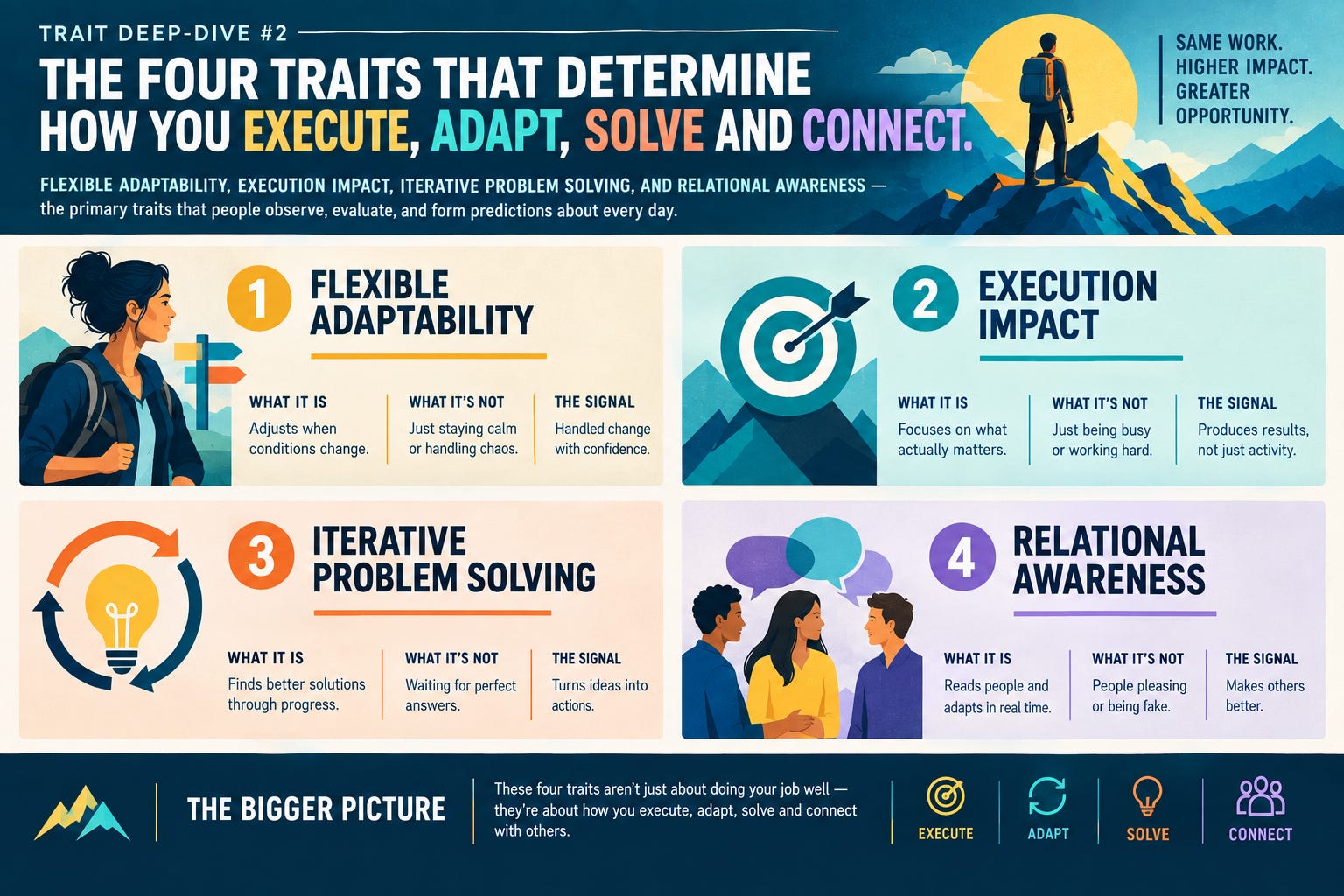
This article covers the four that sit beneath them. These are the traits people observe most directly in day-to-day work. They’re the behavioral evidence that accumulates into the prediction about whether you’re ready for more. And they’re the ones that most often contain the gap nobody has named clearly.
Flexible Adaptability. Execution Impact. Iterative Problem Solving. Relational Awareness.
One article for all four. Deep enough to be useful. Specific enough to act on.
Flexible Adaptability
What it actually is
Ty’s gap, as we’ve referenced throughout this series, wasn’t analytical skill. It was Flexible Adaptability. The trait that governs how you respond when things don’t go according to plan.
Flexible Adaptability is not the ability to stay calm. It’s not resilience in the general sense. It’s specifically about how quickly and gracefully you shift when conditions change, priorities move, or something you counted on stops being available.
The distinction worth making: adaptability without flexibility is rigidity that occasionally moves. Flexibility without adaptability is just chaos tolerance. The trait requires both. You need the flexibility to accept that what was true yesterday isn’t necessarily true today, and the adaptability to redirect your effort accordingly without making the change itself the story.
What it looks like when it’s strong
The meeting agenda changes at the last minute and the person with strong Flexible Adaptability adjusts without broadcasting how inconvenient the change was. The project scope shifts and they’re already thinking about what the revised scope requires before the meeting is over. The priority changes and they redirect without needing processing time or reassurance that the new direction is the right one.
More specifically: they separate their attachment to a method from their commitment to an outcome. Alicia did this when she learned that her communication style was creating friction in cross-functional settings. She didn’t defend the style. She asked what the alternative looked like and tried it. The goal was unchanged. The method changed. That’s Flexible Adaptability in its clearest form.
Strong in this trait also means you’re not the person who signals how hard the change is for you. Because that signal, however understandable, communicates something specific to the people around you: this person’s stability depends on conditions staying predictable. That’s not the prediction that leads to expanded responsibility.
What it looks like when it’s absent
Ty matched the energy of a stakeholder challenge in a cross-functional meeting. The situation had changed. New information was on the table. His response was to defend the original position rather than adapt to the new information. That’s the absence of Flexible Adaptability showing up under pressure.
Carmen’s sharpness with operators who gave her incomplete information is another version of it. The situation required her to adapt her communication to the reality that operators didn’t always have full information. Instead, she held to an expectation that the situation couldn’t meet and expressed frustration when it didn’t.
The consistent pattern when this trait is absent: visible brittleness when conditions change. Complaints about changes that could have been absorbed quietly. Defensiveness when the plan gets revised. A subtle but clear signal that this person’s performance is environment-dependent.
The signal it sends
Strong Flexible Adaptability sends a specific prediction: this person can handle more complexity without requiring stable conditions to function. That’s the prediction that leads to high-stakes assignments, cross-functional responsibility, and roles where the environment itself is part of the challenge.
Weak Flexible Adaptability sends the opposite: this person performs well in predictable conditions and will need significant support when conditions change. Not wrong exactly. Just constrained.
How to build it
The practice that builds this trait fastest: for the next thirty days, whenever something changes, your first internal question before any external response is, “What does the new situation require from me?” Not “Why did this change?” Not “Who decided this?” What does it require. That single question redirects your cognitive energy from processing the change to responding to it. The shift is small. The behavioral evidence it produces is significant.
Execution Impact
What it actually is
There’s a version of hard work that produces a lot of activity and not very much result. Most organizations are full of it. People who are visibly busy, clearly committed, and genuinely working hard at things that don’t move the needle.
Execution Impact is the trait that separates productive effort from activity. It’s the ability to identify what actually matters in any given task, project, or day, and direct disproportionate energy there while managing everything else at the level it requires.
This is not about working smarter instead of harder. That framing implies you get to work less. Execution Impact often means working just as hard, but at a completely different set of priorities.
What it looks like when it’s strong
Before starting a task, the person with strong Execution Impact spends a few minutes identifying the most important outcome and working backward from there. Not the most interesting part of the task. Not the part they’re most confident in. The part that most directly produces the result the work is supposed to create.
Dani showed this when she stopped treating all supply chain metrics as equally important and started filtering her attention toward the ones that directly impacted the VP’s cost report. Same role. Same workload. Different priority architecture. The impact of her work changed before any of her skills did.
Strong Execution Impact also means knowing what doesn’t need to be excellent. Some work needs to be thorough and precise. Some work needs to be adequate and fast. The person with this trait knows the difference and doesn’t spend excellence-level effort on adequate-level tasks. That discipline creates capacity that gets redirected toward the work that actually matters.
What it looks like when it’s absent
Two patterns show up most commonly. The first is uniform effort across non-uniform priorities. Everything gets the same level of attention regardless of what it produces. The result is consistent output quality across tasks that don’t deserve consistent investment.
The second is activity optimized for visibility rather than value. Work that looks substantial in a status update but doesn’t actually move anything forward. This pattern is particularly common in organizations that reward busyness, and it’s particularly dangerous for the individual contributor who relies on it because the 4.8 standard doesn’t grade on effort. It grades on impact.
In fifteen years of organizational work across a wide range of environments, both industrial and knowledge-based, this is probably the most common performance gap I observe. Not lack of effort. Effort directed at the wrong things. The person is genuinely working hard. The organization is genuinely underwhelmed. Both experiences are accurate. They’re just measuring different things.
The signal it sends
Strong Execution Impact sends a clear prediction: this person produces results, not just activity. They know what matters and they focus there. That’s the person you put on something important.
Weak Execution Impact sends a different read: this person works hard and produces inconsistent return on that effort. Good intentions. Unclear prioritization.
How to build it
One practice, applied daily: before starting your most significant task each morning, write down the single most important outcome that task needs to produce. Not the full scope of the task. The outcome. Then ask whether the way you’re planning to spend the next hour is directly producing that outcome or working around it.
It takes three minutes. Over thirty days it rewires how you orient to work entirely.
Iterative Problem Solving
What it actually is
Most individual contributors approach problems one of two ways. Either they wait until they have a complete answer before offering anything, or they offer the first answer they can think of without adequately testing whether it’s right.
Iterative Problem Solving is the space between those two. It’s the ability to move through problems progressively, offering partial insight, testing assumptions, incorporating new information, and refining the solution as the picture clarifies. Not waiting for certainty. Not pretending to certainty you don’t have. Solving in motion.
What it looks like when it’s strong
Elena’s second approach to the intake problem is a clean example. She didn’t wait until she had a perfect solution before engaging the coordinators. She also didn’t walk in with a final answer and present it as settled. She moved iteratively. She learned the situation more completely, refined her approach based on what she learned, and built a solution that incorporated real constraints she hadn’t known existed when she started.
The person with strong Iterative Problem Solving is comfortable saying “here’s what I know so far, here’s what I’m still figuring out, and here’s where I’d like your input.” That transparency about the problem-solving process is not weakness. It’s signal. It shows the organization how your thinking works, which is a more useful data point than any single answer you could produce.
Strong in this trait also means not abandoning a solution framework the moment it encounters friction. Iteration isn’t the same as starting over. It’s refining while maintaining direction.
What it looks like when it’s absent
Tomás’s first attempt with the dock layout is the example. He identified the problem accurately and brought a solution. The solution was right. The framing was wrong for the environment. He didn’t iterate based on the feedback he got. He restated the same concern the same way, twice, before a colleague translated it for him. He wasn’t doing anything wrong technically. He was solving to a finished answer rather than iterating based on what the environment was telling him.
The consistent pattern when this trait is absent: solutions that are technically correct but practically stuck because they didn’t incorporate enough reality-testing. Problems that get brought to leaders fully formed in ways that leave no room for collaborative refinement. A reputation for having answers but struggling to navigate the messy middle where answers become decisions.
The signal it sends
Strong Iterative Problem Solving sends a specific prediction: this person can work through problems in ambiguous conditions and produce decisions, not just analysis. That’s the person you pull into complex situations where the answer isn’t obvious and the process of finding it matters as much as the outcome.
Weak Iterative Problem Solving sends a narrower prediction: this person is strong on defined problems with clear parameters. Assign them something structured and they’ll deliver. Give them genuine ambiguity and the results are less predictable.
How to build it
The next time you bring a problem to a leader or a peer, bring it in stages rather than as a finished deliverable. “Here’s the problem as I understand it. Here are two approaches I’ve considered. Here’s where I need input before I can move forward confidently.” That structure surfaces your thinking process, which is more useful signal than a polished final answer, and it builds the iterative muscle through practice.
Relational Awareness
What it actually is
Carmen’s technical skill was the strongest on her crew. Her diagnostic speed was unmatched. She got passed over twice for the lead role. Her gap wasn’t expertise. It was Relational Awareness.
Relational Awareness is the ability to read how people are experiencing interactions in real time and adjust accordingly. Not reading minds. Not performing emotional intelligence for an audience. Just maintaining enough attention to the relational dimension of work that you can respond to what people actually need rather than what the task technically requires.
At the individual contributor level, this trait determines something specific: whether the experience of working with you is something people want to repeat. Not whether they respect your work. Whether they want more of your presence in their work.
What it looks like when it’s strong
Marcus D. texting the next shift about the access panel isn’t just proactive knowledge sharing. It’s Relational Awareness. He understood that the next crew’s experience of showing up to that job would be better with that information. He thought about their experience, not just his own deliverable.
Elena going to each clinic coordinator individually before the cross-functional meeting is Relational Awareness. She read that presenting a solution to a group before the individuals felt heard would produce resistance. She adjusted before the meeting happened, not after.
The person strong in this trait doesn’t require a difficult interaction to trigger awareness. They’re attending to the relational dimension as a standing practice. They notice when someone’s energy shifts in a meeting. They pick up on what isn’t being said alongside what is. They calibrate how much directness a situation can hold before they apply it.
Strong in this trait also means knowing your own relational patterns well enough to predict where they’ll create friction. Carmen’s sharpness wasn’t random. It was a consistent pattern under a specific trigger: incomplete information from operators. Strong Relational Awareness includes knowing your triggers and governing them before they govern you.
What it looks like when it’s absent
This is Carmen. Brilliant under pressure, technically. Sharp with people when stressed. Operators started working around her not because they didn’t respect her skill but because the experience of working with her when something went wrong was unpredictable. That unpredictability costs more than slower repair times.
The consistent pattern when this trait is absent: colleagues who respect the work but manage the relationship carefully. Cross-functional partners who route around rather than through. A reputation as someone who’s excellent to have in a normal situation and difficult to have in a tense one. That reputation doesn’t get named directly in most organizations. It just quietly shapes which opportunities move toward you and which ones get assigned to someone whose presence costs less.
I’ve watched this end otherwise strong careers more than I’d like. Not through a single dramatic event but through the slow accumulation of interactions that left people slightly worse off than before. The individual didn’t know. The organization did.
The signal it sends
Strong Relational Awareness sends one of the most valuable predictions an individual contributor can generate: working with this person makes things go better. Not just their own work. The experience for everyone around them. That’s the person teams want. That’s the person leaders protect.
Weak Relational Awareness sends a narrower prediction: this person is an asset in controlled conditions and a variable in relational ones. Talent worth having, with asterisks.
How to build it
One question, asked after every significant interaction for the next thirty days: how did the other person leave that conversation? Not what did we accomplish. How did they leave it. Energized, neutral, or diminished. That question builds the observation muscle. Over thirty days it shifts your awareness from being entirely focused on your own performance in an interaction to attending to what the interaction produced for the other person.
That shift, practiced consistently, changes how people experience you before you’ve changed anything else.
The Four Together
These four traits produce observable impact directly. They’re what people see when they watch you work. They’re the behavioral data that accumulates into the prediction about your readiness for more.
Two things worth noting about how they interact.
Flexible Adaptability and Execution Impact are about your relationship with work. How you respond when conditions change. How you prioritize effort within the work you’ve been given. They’re largely internal disciplines that produce external evidence.
Iterative Problem Solving and Relational Awareness are about your relationship with people. How you navigate problems in collaboration with others. How you attend to the experience of the people around you while getting things done. They’re relational disciplines that also produce external evidence.
A signal that’s strong on the first pair and weak on the second produces someone who executes well independently but creates friction in collaboration. A signal strong on the second pair and weak on the first produces someone who’s excellent to work with but inconsistent under pressure. The full picture requires all four.
Pick the one where your gap is largest. Define a practice. Run it for thirty days. That’s where the next article’s trait framework picks up.
Question for this week: Of the four traits in this article, which one produced the clearest recognition when you read about what it looks like when it’s absent? That recognition is usually more useful than any self-assessment score. I’d love to hear what came up in the comments.

Subscribe to The Ready Set
By Ryan Carnes | A data-backed development experience
Providing executive caliber leadership and talent content and resources to everyone. Subscribe free and get new behavioral-based leader and talent insights every week.
Plus two Ready Set resources to put to work immediately.