


Signal Forward is a series inside The Ready Set, same publication, different altitude. The Ready Set is for leaders. Signal Forward is for everyone else: the individual contributors, specialists, and practitioners whose behavioral patterns determine whether their contribution gets seen, valued, and rewarded, regardless of title or tenure.
New here? Start with the first article. In People or HR? Pass this along to your team.
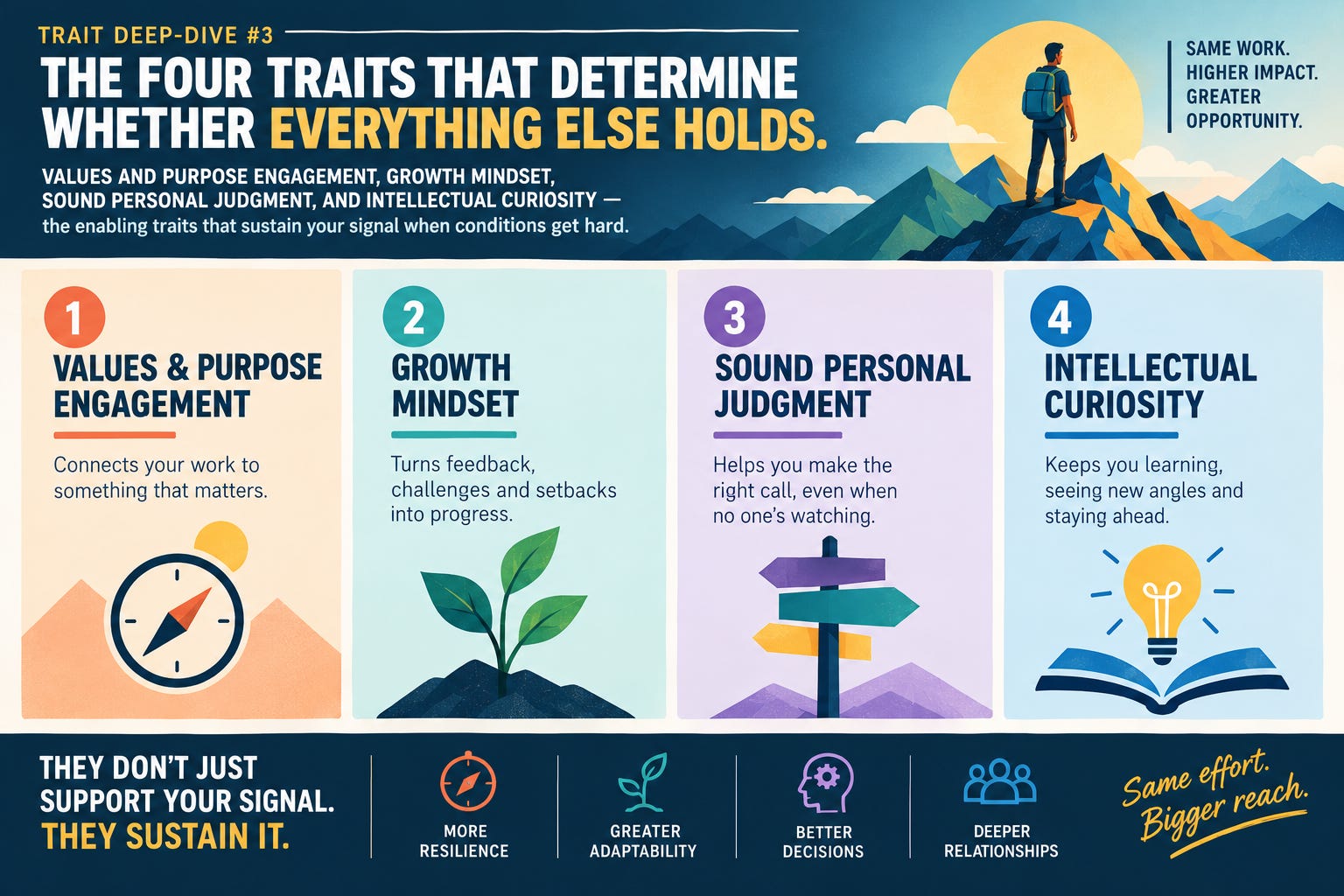
The six primary traits we covered in the last two articles produce observable impact. They’re the behaviors people watch, evaluate, and form predictions about. They’re what gets you noticed, included, and considered.
The four traits in this article don’t work that way. They don’t produce impact directly. They sustain it.
Here’s the distinction worth understanding clearly. The enabling traits are the foundation that determines whether your primary traits hold up under pressure, remain credible across relationships, and stay consistent long enough to compound into the signal that actually changes your trajectory. Without them, the primary traits are impressive in short bursts and unreliable over time. With them, they become the behavioral architecture that makes careers move.
The individual contributor who has strong primary traits but weak enabling traits will perform well in normal conditions and crack in difficult ones. That crack, observed once at the wrong moment by the wrong person, can reset months of strong signal in a single conversation. The enabling traits are what prevent that from happening.
Values and Purpose Engagement. Growth Mindset. Sound Personal Judgment. Intellectual Curiosity.
Values and Purpose Engagement
What it actually is
Every organization has a stated set of values. Most individual contributors could recite them if asked. Almost none of them have thought seriously about whether those values actually govern their daily decisions or whether they’re just a poster near the break room.
Values and Purpose Engagement is the trait that bridges that gap. It’s the degree to which your daily work is genuinely connected to something that matters to you beyond the paycheck. Not as a philosophical exercise. As a behavioral reality that’s observable to the people around you.
This matters more than most career advice acknowledges, for a specific reason. Purpose is what sustains signal consistency when conditions make consistency hard. The 4.8 standard is achievable when work is interesting, colleagues are reasonable, and circumstances are favorable. When a project is grinding, the team is dysfunctional, or the organization is going through something difficult, the only thing that sustains consistent behavioral investment is meaning. And meaning has to be genuine. Performed purpose fades under pressure faster than no purpose at all.
What it looks like when it’s strong
Dani connecting her supply chain metrics to customer impact changed how she oriented to the work. She wasn’t different because she learned a new skill. She was different because the work became meaningful in a way it hadn’t been before. Her engagement level changed. Her initiative changed. The signal she produced changed. All of it flowed from a shift in how connected she felt to the purpose behind what she was doing.
The person strong in this trait tends to do a few things consistently. They can articulate why the work matters beyond what they’re being paid to do. Not in a corporate-language way. In a genuine, specific way that reflects actual understanding of the downstream impact of their contribution. They also make decisions that reflect values alignment. When something feels wrong, they say so rather than going along. When something aligns with what they care about, the engagement is visible.
They also tend to have a longer horizon than people without this trait. Because they’re connected to something beyond the immediate task, they can absorb a bad week, a difficult project, or an organizational frustration without it derailing their overall trajectory. Purpose is a stabilizer. It keeps the signal consistent when conditions work against it.
What it looks like when it’s absent
The pattern is specific and recognizable. Work quality that varies with circumstances rather than staying consistent. High engagement when conditions are favorable, visible disengagement when they’re not. A signal that peaks in good moments and erodes in difficult ones.
This is probably the most common reason I watch high-potential professionals plateau in the middle of their careers. Not skill gaps. Not political failures. Just a gradual erosion of connection to why the work matters. They keep doing the work. They stop being animated by it. The signal becomes mechanical. And mechanical signal, however technically correct, doesn’t produce the prediction that opens doors. Because what organizations are really assessing when they consider someone for more responsibility is whether this person’s engagement is self-sustaining or environment-dependent.
The signal it sends
Strong Values and Purpose Engagement sends a prediction that’s genuinely hard to manufacture: this person’s investment in the work doesn’t depend on me managing their motivation. That’s the prediction that makes leaders comfortable giving someone more latitude, more responsibility, and more visibility.
Weak Values and Purpose Engagement sends the opposite. This person performs when conditions are good and requires active management when they’re not. That’s not unworkable. It’s just constraining.
How to build it
Two questions worth sitting with deliberately, not just once but on a recurring basis.
What would have to be true about my work for me to find it genuinely meaningful, not just tolerable?
And then: how much of that is actually present in what I’m doing right now?
The gap between those two answers is actionable. Sometimes it closes by reframing what you already have. Carmen reframed maintenance from fixing machines to protecting the plant’s output and her engagement shifted immediately. Sometimes it closes by having a conversation with a leader about how your role connects to something you actually care about. Sometimes it doesn’t close in the current environment and that’s useful information too. Purpose alignment isn’t always about finding it where you are. Sometimes it’s about being honest that it isn’t there and making a deliberate choice about what to do with that.
Growth Mindset
What it actually is
Growth Mindset has been written about enough that the phrase has started to lose meaning. So let’s be specific about what it means as a behavioral trait rather than a general philosophy.
At the trait level, Growth Mindset is observable in one specific place: how you respond when you’re wrong, when you fail, or when someone points out a gap in your performance or thinking.
That’s it. Not how you talk about learning. Not whether you have inspiring quotes about failure on your desk. How you actually behave in the moment when reality doesn’t match what you expected or wanted.
The reason this trait enables everything else is straightforward. Every other discipline in this series requires feedback to compound. The signal amplifier requires tracking what’s working. The CPP cadence requires honest input from your manager. The altitude ladder requires knowing where your current thinking is limited. All of it requires the ability to receive difficult information without making the reception of it more expensive than the information itself.
What it looks like when it’s strong
Alicia receiving the feedback about her communication style in cross-functional settings and not defending it is Growth Mindset. She could have explained why her style made sense. She could have contextualized the feedback in ways that reduced her responsibility to change. Instead she asked what the alternative looked like and tried it. That’s the behavior.
Ty’s parallel failure is instructive. When his timeline was challenged in the cross-functional meeting, the information on the table was legitimate. New data had surfaced that genuinely affected the situation. A Growth Mindset response would have been to engage with the new information, acknowledge the revision it required, and redirect toward solving the updated problem. Instead, Ty defended the original position. The behavior communicated that protecting the position mattered more than solving the problem. That’s not a character flaw. It’s a trait gap with predictable career consequences.
The person strong in this trait doesn’t perform humility. They’re genuinely curious when they’re wrong. They treat failure as data rather than as identity. They reference what they learned from something that didn’t work without minimizing that it didn’t work.
What it looks like when it’s absent
Defensiveness in response to feedback. Explaining why the feedback doesn’t fully apply rather than exploring what’s true in it. Patterns that don’t change despite clear signals that they should. A reputation for taking criticism personally even when it’s delivered professionally.
The absence of this trait creates a specific compounding problem. Without Growth Mindset, the feedback loop that every other discipline depends on stops functioning. You can run CPP conversations and receive specific, honest input about where your signal has gaps. But if you respond to that input in ways that make the conversation expensive for your manager, the quality of the input degrades over time. You’ll still get meetings. You’ll get less honesty. And less honesty means less accurate signal about where your actual gaps are.
I’ve watched this dynamic play out in enough coaching relationships to say it plainly: the most important factor in whether a development conversation produces growth is not the quality of the feedback. It’s the receiver’s capacity to absorb it without making the giver regret offering it. Growth Mindset is what creates that capacity.
The signal it sends
Strong Growth Mindset sends a prediction that dramatically expands the range of environments where someone can be trusted with responsibility: this person can be given honest feedback and will use it. That prediction changes the relationship with leadership from managed performance to genuine development. It opens conversations that don’t happen with people who receive feedback defensively.
Weak Growth Mindset sends a narrower prediction: this person performs well in known territory and requires careful handling when corrected. Some leaders will work around it. Most will quietly factor it into what they’re willing to trust this person with.
How to build it
The practice that moves this trait is uncomfortable and specific. For the next thirty days, whenever you receive any form of feedback or correction, your first response before anything else is one question asked internally: what’s the most accurate thing in this, even if it’s not the whole picture?
Not is this fair. Not is this how I would have said it. What is most accurate in it.
That question forces your attention toward the information rather than the delivery. Over thirty days it builds a reflex. Over ninety days that reflex is visible to the people around you as Growth Mindset.
Sound Personal Judgment
What it actually is
Sound Personal Judgment is the trait that governs what you do when nobody is watching and when no policy covers the specific situation in front of you.
It’s not ethics in a formal sense. It’s the day-to-day application of values and experience to situations that require a decision before any guidance is available. The call you make when a customer needs something outside your authority to give. The information you decide to share or not share about a peer. The moment in a meeting where you could stay quiet or speak up, and you have to decide which one serves the room rather than just your own comfort.
This trait operates quietly. It doesn’t show up in dramatic moments most of the time. It accumulates in the small decisions that nobody formally tracks but everyone observes.
What it looks like when it’s strong
Marcus D.’s decision to text the next shift crew about the access panel wasn’t in a procedure. It wasn’t required by his job description. It was a judgment call that the next crew’s efficiency mattered enough to warrant the thirty seconds it took. That’s Sound Personal Judgment applied to a small situation. Practiced consistently, it creates a pattern of decisions that the organization experiences as trustworthy.
The person strong in this trait tends to make decisions that hold up when examined later. Not because they’re perfect. Because the framework they’re applying is consistently aligned with what the organization values. Their judgment is predictable in the right way. You can anticipate how they’ll handle an ambiguous situation because you’ve seen the pattern of how they handle ambiguous situations.
They also know where their judgment ends. They’re not overconfident about the scope of their authority. They escalate when a decision is genuinely beyond their experience or authority, and they do it before rather than after. That knowing-when-to-escalate is as much a part of Sound Personal Judgment as knowing when to decide.
What it looks like when it’s absent
Two opposite failure modes. The first is poor judgment about when to act independently, producing decisions that cause problems the person didn’t anticipate and couldn’t walk back. The second is poor judgment about when to decide at all, producing chronic escalation of things that could and should have been handled without involving leadership.
Both are judgment gaps. Both create the same organizational read: this person’s decision-making requires active oversight. That read doesn’t preclude advancement in all cases. But it significantly narrows the range of roles someone will be seriously considered for, because most meaningful roles at the next level require the ability to make sound independent decisions under ambiguity.
Rashid’s poor judgment call during the depleted three-week stretch when he was covering double shifts is worth revisiting here. It wasn’t an ethics failure. It was a judgment call made without adequate capacity, that he would not have made rested. That’s the intersection of Sound Personal Judgment and Sustainable Signal. Judgment quality degrades when capacity is depleted. Which is why the Article 11 disciplines aren’t optional additions to this framework. They’re prerequisites for this trait to function at its full level.
The signal it sends
Strong Sound Personal Judgment sends a specific and highly valuable prediction: this person can be trusted to make good calls in situations I can’t anticipate. That prediction is the prerequisite for genuine autonomy. Without it, autonomy is a liability. With it, autonomy is an accelerant.
Weak Sound Personal Judgment sends a prediction that constrains the scope of what someone can be trusted with, regardless of technical skill. It’s often the invisible ceiling in careers that can’t explain why they’re stalled.
How to build it
This trait builds through reflection more than through practice in the traditional sense. After any decision you made independently in the last month, ask three questions. What information did I have when I made it? What values or priorities was I applying? Would I make the same call again with more time and information?
The answers to those three questions, examined honestly across a series of decisions, reveal the framework you’re actually applying versus the one you think you’re applying. That gap, where it exists, is where the development work lives.
Intellectual Curiosity
What it actually is
Intellectual Curiosity is the last enabling trait because it’s the one that keeps all the others from going stale.
It’s the drive to understand things more completely than your current role requires. To ask why beyond what the task demands. To follow a thread of interest into territory that isn’t directly useful yet but might be. To be genuinely interested in the world your organization operates in, in the people you work alongside, and in the problems that haven’t been solved yet.
At the individual contributor level, this trait produces something specific and valuable: the person who gets better faster than the environment requires. And in a world where AI is compressing the shelf life of technical skills, getting better faster than the environment requires is the only reliable hedge against obsolescence.
What it looks like when it’s strong
Dani asking her finance peer how supply chain metrics translated into the VP’s cost report wasn’t required by her job. It was curiosity. The question changed how she understood her role, which changed the value of her contribution, which changed her trajectory. A single curious question, asked because she genuinely wanted to understand the bigger picture.
Kenji, after not getting the senior analyst role, could have attributed the outcome to politics and moved on. Instead he asked specifically what the person who got the role had demonstrated that he hadn’t. That question required intellectual curiosity about a situation that was personally difficult. The answer he got changed what he focused on for the next twelve months.
The person strong in this trait asks questions in meetings that aren’t required to complete their tasks. They read industry material outside work hours without being told to. They’re interested in how things work beyond their immediate scope. And critically, their curiosity is visible to the people around them in a way that signals engagement that goes beyond the job description.
What it looks like when it’s absent
Narrowed focus that stops at the edge of defined responsibilities. No questions in meetings that aren’t directly relevant to the current task. Development that happens only when formally prompted. A professional identity that’s entirely defined by current skill set rather than expanding capacity.
The consistent pattern when this trait is absent is a career that plateaus at a specific level of complexity and doesn’t move beyond it. Not because the person can’t do more technically. Because the intellectual framework they’re bringing to work stopped expanding at some point, and the organization can feel it even when they can’t name it.
This is also the trait that makes AI a threat rather than an asset. The person with weak Intellectual Curiosity approaches AI as something to use for current tasks. The person with strong Intellectual Curiosity approaches it as something to understand, to experiment with, to figure out how to incorporate into a broader capability set. The second person gets elevated by AI. The first gets displaced by it.
The signal it sends
Strong Intellectual Curiosity sends a prediction that’s particularly valuable in uncertain environments: this person will figure out what they need to know when conditions change. That’s the prediction that leads to being trusted with novel problems, new domains, and ambiguous assignments where no established playbook exists.
Weak Intellectual Curiosity sends a narrower prediction: this person performs within established parameters and will need significant support when the domain changes. Valuable. Limited.
How to build it
One practice that consistently develops this trait: once per week, spend twenty minutes learning something about the broader industry or domain your organization operates in that has nothing to do with your current tasks. Not training that was assigned. Self-directed curiosity. An article. A conversation with someone in a different function. A question you’ve been carrying about how some part of the organization works that you’ve never asked.
Twenty minutes weekly. Fifty-two weeks. The compounding effect on how you understand the environment you operate in is significant. And the signal that curiosity sends, to the people who observe you asking questions and making connections they didn’t expect, is one of the clearest leading indicators of trajectory that exists.
The Full Map
Fifteen articles. Fifteen weeks of building one piece at a time.
Here’s what the full framework produces when it runs together. A signal that’s intentional rather than accidental. A trajectory that compounds rather than stalls. A professional identity that doesn’t depend on any single organization, any single leader, or any single technical skill remaining relevant.
The ten traits are the architecture. The disciplines throughout this series are how you build them. The 4.8 standard is how you measure whether the building is happening. The CPP cadence is how you stay calibrated. Sustainable signal is how you keep it running without burning down everything else that makes life worth having.
The question at the start of this series was simple. You’re already sending a signal. Is it designed?
Fifteen articles later, you have the answer to what a designed signal actually looks like. The only remaining question is whether you’ll build one.
Start with two traits. Define one practice for each. Run them for thirty days. Track the signal, not the effort. Revisit at sixty days. Rotate when the gap shifts.
That’s how traits become trajectory. Not through intention. Through behavioral evidence, accumulated over time, in the minds of every person who works alongside you.
The signal you build from here is yours. Design it well.
A final question for this series: Of the ten traits across all three deep-dives, which two would most change how people experience you if you closed the gap? Not the ones you’re weakest at in absolute terms. The ones where closing the gap would shift your signal the most noticeably.
Those are your starting point. I’d love to hear which two you landed on in the comments.
That’s a wrap on the Signal Forward launch series. Fifteen articles built for the individual contributor the industry forgot.
Everything in this series is being built into something larger. Later this year, we’re releasing a significant update to The Ready Set experience — an extension of the AI Ready Set Coach that will meet you exactly where you are, whether you’re two years into your first real role or two levels from the executive suite, and grow with you as you move. For individual contributors, that means the full Signal Forward framework: the behaviors, the disciplines, the trait development, and guided content built specifically for people doing excellent work who want to make sure it doesn’t stay invisible. More details coming soon. If you’re already a paid member, you’ll be among the first to know.
Thank you for being here for the start of something.

Subscribe to The Ready Set
By Ryan Carnes | A data-backed development experience
Providing executive caliber leadership and talent content and resources to everyone. Subscribe free and get new behavioral-based leader and talent insights every week.
Plus two Ready Set resources to put to work immediately.