


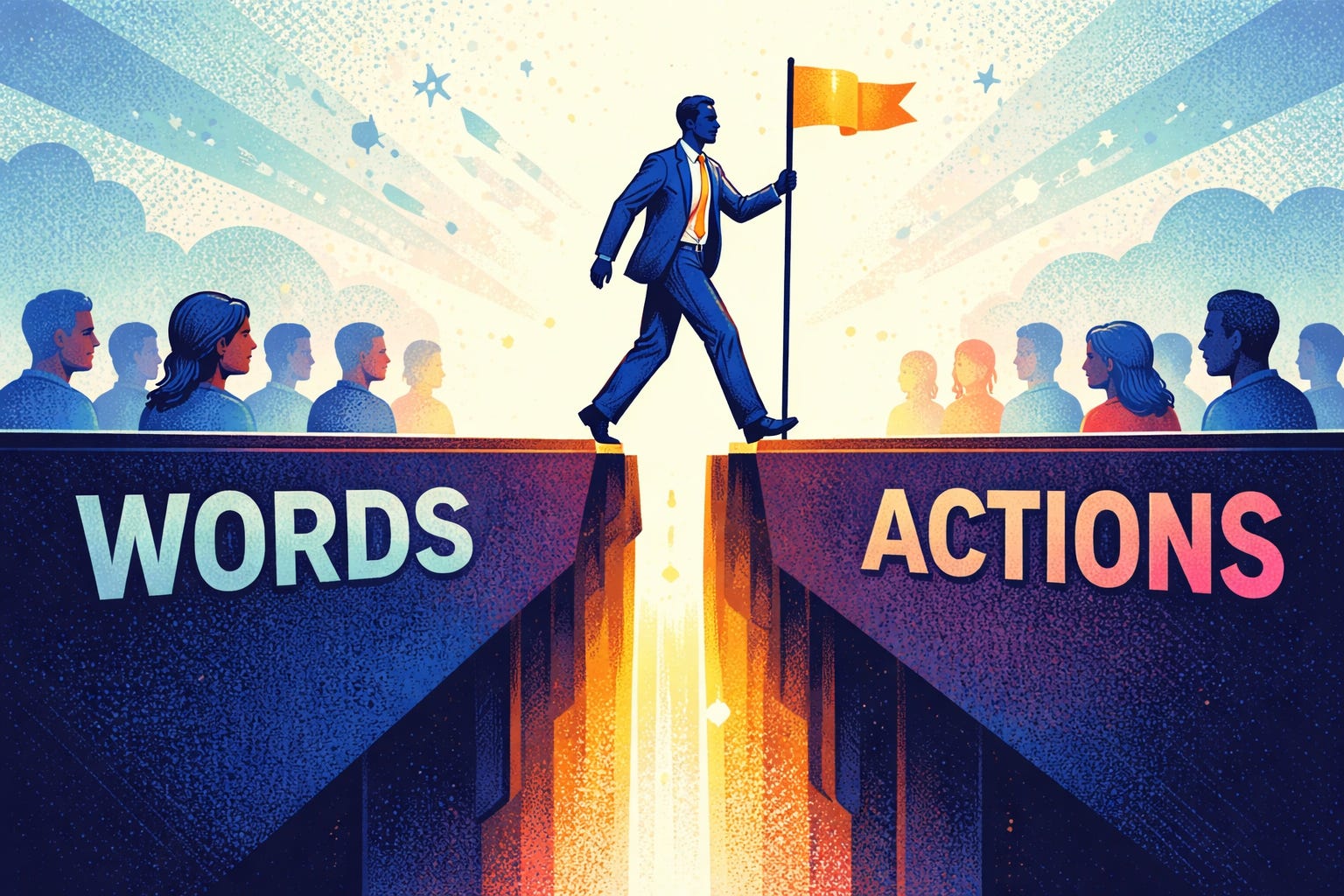
Quick note: this is behavior seven of ten in The Ready Set series. When the series wraps in three weeks, I’m opening paid membership alongside the final piece, including something I’ve been building for a while that I think you’ll find genuinely useful. More on this at the end of the article. For now, let’s talk about the behavior that makes everything else possible.
The Leader Everyone Watches When Things Get Hard
Most leadership behaviors are evaluated in ordinary moments, like how someone runs a meeting, gives feedback, or delegates a task. Those moments matter. But they’re not the moments that actually define a leader’s reputation.
Reputation gets built, or destroyed, in the moments when it costs something to do the right thing.
When the pressure is high and the easier path is right there.
When owning a mistake means looking fallible in front of people who are already uncertain.
When a decision that aligns with your values puts you at odds with someone above you in the org chart.
When the gap between what you said you’d do and what’s convenient to do becomes uncomfortably visible.
In those moments, people stop listening to what a leader says. They watch what a leader does. And what they see either builds trust that compounds over time, or confirms a suspicion they’ve been quietly carrying.
That’s the terrain of Values-Based Integrity and Authenticity. And it’s the behavior that everything else in this model depends on.
The Numbers Behind the Behavior
This isn’t a soft observation. The trust erosion that follows integrity failures is quantifiable and significant.
Gallup’s global research found that only 21% of employees strongly agree they trust the leadership of their organization.* Read that again. At any given moment, roughly four out of five employees are operating with some degree of doubt about whether their leaders mean what they say. That doubt doesn’t stay contained, it filters into how people engage, how much discretionary effort they give, and how long they stay.
Research consistently shows that trust and psychological safety are among the strongest predictors of employee engagement and innovation, and that leader behaviors are the decisive factor, with transparency, accountability, and consistent communication building trust while inconsistency, favoritism, and silence erode it.
The gap between stated values and lived behavior isn’t just a culture problem. It’s a performance problem. And it tends to be invisible to the leader causing it long after it’s visible to everyone else.
What This Behavior Actually Is
Values-Based Integrity and Authenticity is the leader’s commitment to act consistently with their core values and principles while remaining genuine and transparent in their interactions, especially when conditions make that difficult.
The two parts of that definition matter equally and they work together. Integrity without authenticity can look like rigid rule-following that feels disconnected from actual human judgment. Authenticity without integrity can look like emotional openness that never quite translates into reliable action. Together, they create something specific: a leader whose words and behavior are the same thing, not two different performances for two different audiences.
The philosopher Simone Weil, rarely quoted in leadership conversations but worth listening to here, put it plainly: “Attention is the rarest and purest form of generosity.”
Leaders who operate with genuine integrity aren’t just following a code of conduct. They’re paying attention, to their commitments, to the people affected by their decisions, and to the gap between what they intend and what they actually do.
That attention is what makes authenticity credible rather than performative.
What It Looks Like When It’s Missing
The most common integrity failure in leadership isn’t dramatic. It’s not fraud or misconduct. It’s the slow accumulation of small misalignments between what a leader says and what a leader does.
It’s the leader who talks openly about psychological safety and then visibly freezes out the person who raised a difficult question in a team meeting. The one who champions work-life balance in company all-hands and then sends non-urgent messages at 11pm with an implicit expectation of immediate response (further note on this below). The one who asks for honest feedback in surveys and then subtly distances themselves from the people whose feedback was critical.
None of these feel like integrity failures to the leader committing them. Each one has a reasonable explanation in the moment. But to the people watching, and people are always watching, they’re data points. And data points accumulate into a conclusion: what this leader says and what this leader does are two different things.
Once that conclusion forms, it’s remarkably difficult to reverse. Not impossible, but it takes sustained, visible, consistent behavior over time (far more effort than simply not creating the gap in the first place).
James Baldwin, writing about something much larger than organizational leadership but describing a dynamic that applies precisely here, observed: “Not everything that is faced can be changed, but nothing can be changed until it is faced.”
The integrity failures leaders most need to address are usually the ones they’ve been successfully not looking at.
The Behaviors That Signal It
Leaders strong in this behavior are recognizable by a few consistent patterns.
They follow through on commitments even when it’s inconvenient, and when they can’t, they say so proactively rather than quietly letting things lapse.
They speak plainly about what they know and don’t know, without the hedging and qualification that passes for communication in most organizations.
When they make mistakes, they own them specifically and visibly, not with performative self-flagellation, but with the kind of direct accountability that tells people this leader can be trusted to tell me the truth about themselves. Research in organizational psychology has found that when leaders conduct themselves with transparency, they reduce ambiguity and the risk associated with interactions, creating an environment where they are perceived as both integral and capable by their teams.** That perception, capable and trustworthy, is rarer than most leaders realize, and more valuable than either quality alone.
They also make decisions that reflect their stated values under pressure, not just when it’s easy. This is the highest-signal behavior in the entire cluster. Anyone can honor their values when the cost is low. The leaders whose teams will run through walls for them are the ones who’ve been seen doing it when the cost was real.
A Structural Variation Worth Noting
Most behaviors in The Ready Set are primarily developed through practice (doing the thing more deliberately, more consistently, with more reflection afterward). Values-Based Integrity and Authenticity has a different developmental sequence. It starts with clarity.
You can’t consistently act in alignment with your values if you haven’t clearly defined what they are. Not in abstract terms, not “honesty” and “respect” as words on a list, but specifically enough that they can actually function as decision filters when you’re under pressure and time is short.
So the first development step here isn’t behavioral. It’s reflective. What do you actually believe? What would you refuse to compromise regardless of the organizational pressure? Where have you previously felt genuinely proud of a decision, not because it was successful, but because it was right? Those answers are the raw material for a values set that’s real enough to act on.
From there, the practice is audit. Before significant decisions, the question isn’t just what should I do, it’s does this align with both my values and the organization’s? After significant interactions, the question isn’t just how did that go, it’s was I the same person in that room that I am everywhere else?
And then, hardest of all, seek feedback specifically on consistency. Not performance feedback. Consistency feedback. Ask someone who will tell you the truth: where do you see gaps between what I say and what I do? Most leaders never ask that question directly. The ones who do, and who sit with the answers without defending themselves, are the ones who build the kind of trust that sustains teams through genuinely difficult conditions.
The Standard Worth Holding
There’s a version of integrity that’s really just compliance (following the rules, staying out of trouble, not doing anything overtly wrong). That version isn’t what this behavior is about.
The standard here is higher and more human: being the same leader in public that you are in private, honoring what you’ve committed to even when no one would notice if you didn’t, and treating the alignment between your words and your actions as something worth protecting, not because it’s required, but because you’ve decided it matters.
That decision, made consistently over time, is what trust is actually built from.
Three behaviors left. Next week: Resilience.
One more thing before you go. This series has been about defining the behaviors, giving them shape, context, and enough specificity that they’re actually useful rather than just inspirational. Over the next few weeks I’m going to show you what I’ve been building alongside it, something that takes these ten behaviors and puts them to work for you personally, not as a reader but as a leader with a specific profile, specific strengths, and specific gaps worth closing. No pitch, no pressure. Just something I think you’ll find genuinely useful. More on that soon.
Note about “…sends non-urgent messages at 11pm with an implicit expectation of immediate response.”: Even if there is an “expectation” set by the leader that responses that late aren’t required, it still lingers on employees minds. “Do they actually mean that? Or are they just saying it because they “should” say it?” It’s time to start using the Schedule Email function. If it’s not urgent, just schedule it to go out in the morning. There’s nothing wrong with working late, believe me, I understand it. But we can give some grace to our employees by just scheduling emails to go out in the morning so they don’t have to lay awake wondering if they should be answering them.
*https://thehrc.com/trust-at-work-the-7-dimensions-of-credible-authenticity/
**https://www.frontiersin.org/journals/psychology/articles/10.3389/fpsyg.2024.1359581/full